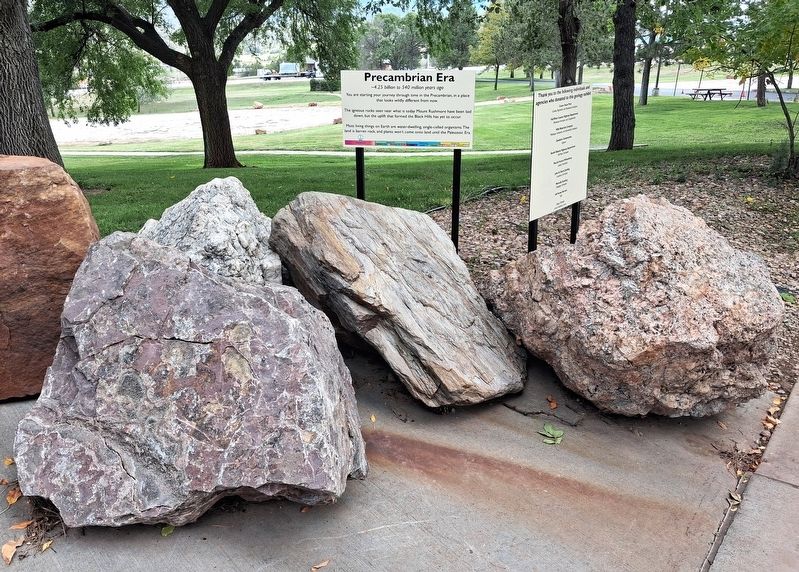
You are starting your journey through time in the Precambrian, in a place
that looks wildly different from now.
The igneous rocks seen near what is today Mount Rushmore have been laid
down, but the uplift that formed the Black Hills has yet . . . — — Map (db m314557) HM
Moving into the Paleozoic Era, it seems that little
has changed at first. Organisms living in the ocean
covering the Black Hills area at this time are
growing their shells with calcium carbonate. The
presence of calcium carbonate in the . . . — — Map (db m314556) HM
As you move through the Paleozoic Era, life has
emerged and spread onto land. The Black Hills are
still not yet present, and present-day South Dakota
resides near the outer edge of the supercontinent
Pangaea. We find few fossils in the area . . . — — Map (db m314554) HM
Also known as the age of dinosaurs, the latter
portions of the Mesozoic Era mark the presence
of shallow seas in the Black Hills area. What will
be South Dakota is home to marine reptiles like
plesiosaurs and mosasaurs, ammonites, . . . — — Map (db m314552) HM
As you arrive in the age of mammals, the world around you undergoes drastic changes. The late Cretaceous sea is gone and the Black Hills have risen, forming the basis for the modern landscape. The land is covered by rainforests, then savannahs, . . . — — Map (db m314551) HM
In this final leap through time, you find yourself in the Ice Age. Although colder and drier than today, the Black Hills region was not a frozen wasteland. The massive glaciers characteristic of this time do not reach western South Dakota. . . . — — Map (db m314541) HM