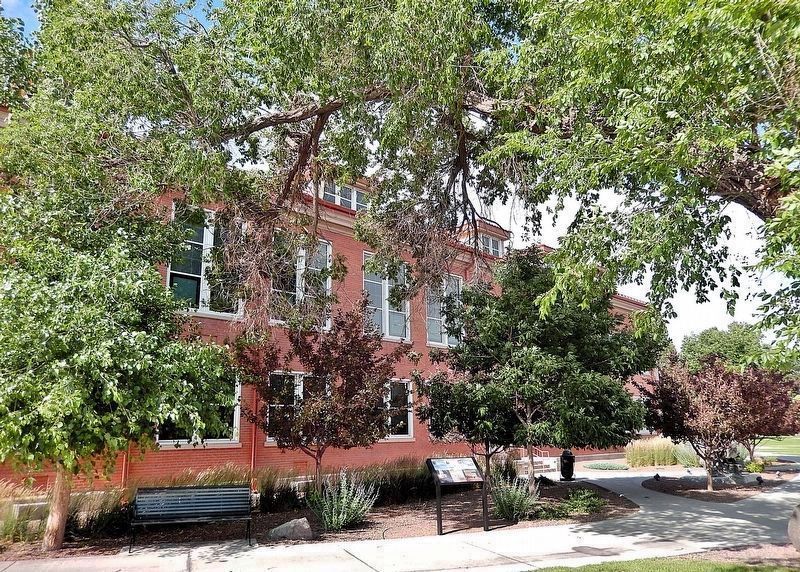
William H. “Billy” Adams Adams State University's founder and namesake, William H. “Billy” Adams (1861-1954), was a strong advocate for rural education. For a period of 50 years, Billy Adams held several offices in Colorado . . . — — Map (db m294413) HM
Deeply rooted in the Catholic religion, the Hispano settlers of the San Luis Valley shared unique spiritual beliefs. On the edge of the frontier, they were extremely isolated with only the occasional priest visiting to administer mass, rites, or . . . — — Map (db m282974) HM
Until the railroad arrived, there was no town where Antonito exists today. The Denver & Rio Grande Railroad (D&RG) had originally intended to establish its southern operations in the village of Conejos. Settlers there, some of the earliest to the . . . — — Map (db m282935) HM
Fred Warshauer was born in the Province of Posen in 1859 — a part of modern day Germany and Poland. He was Jewish and fled Europe to avoid being drafted into the Prussian army. He lived in poverty until coming to the United States and settling in . . . — — Map (db m282911) HM
George Bardsley resided on this site from 1869 to 1879. An early-day saloonkeeper, restauranteur and County Commissioner, Bardsley was elected Ellis County Sheriff in 1875 in a bitter contest with Jack Bridges. Bardsley captured Isaac “Big Ike” . . . — — Map (db m204749) HM
Frederick Fitzjarrald Haberlein (1944-2018), grew up at the Conejos Ranch on the Conejos River just west of Antonito. He graduated from Antonito High School and then attended Colorado State University on an art scholarship where he graduated with a . . . — — Map (db m282918) HM
This property was presented to the State Historical Society by the Fort Garland Historical Fair Association, which saved the fort for posterity. Established November 30, 1945, as a memorial to the first Colorado settlers, and the U.S. Army troops . . . — — Map (db m281275) HM
Language carries the culture. Read in English, the meanings here may differ from those of the traditional Spanish language of this area. The language, reminiscent of sixteenth century Spain, is a cornerstone of the culture. For half a century . . . — — Map (db m282900) HM
Thin black lines indicate changes in relevance. Between each pair of lines entries are ordered geographically but all have the same relevance.
* Inflectional forms of words are their plurals, singulars, and possessives as well as gramatical tenses and similar variations.