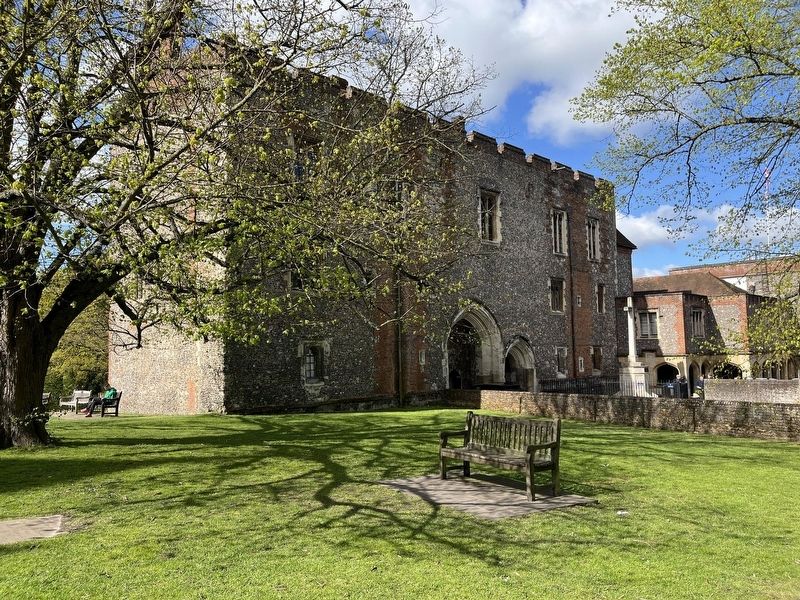
This gatehouse was built around 1362. It was once the main entrance to the Abbey of St Alban. This and the Abbey church now the Cathedral - are all that remain of Britain's leading medieval monastery.
The gatehouse was attacked in 1381 during . . . — — Map (db m250047) HM
This magnificent cathedral stands on the hillside where Alban, Britain's first saint, was buried. He gave his life for his Christian faith around the year 300. Step through the doors to discover his story and one of the most significant buildings in . . . — — Map (db m249793) HM
As the ancient town church of St Albans, St Peter's church and churchyard have many fascinating stories to tell. Some of these are of individuals who have left their imprint on our city's history, as well as on our minds and imaginations.
For . . . — — Map (db m246775) HM
All roads lead to...
Verulamium had four impressive gates at the points where major roads reached the town. The imposing London Gate sat astride Wating Street on its route from Dover to Chester via London. Other gates spanned roads which . . . — — Map (db m248155) HM
England's leading medieval abbey once stood here. Look for the outline of the white stone cloister arches on the wall of the church. The cloister was a square courtyard with a covered walkway. Here the monks talked, walked and sometimes wrote their . . . — — Map (db m249792) HM
Verulamium transformed
In the early 5th century AD the Roman legions were withdrawn from Britain as barbarian settlement within the borders of the Roman Empire increased. The largest markets for the economy of Roman Britain were lost and . . . — — Map (db m248154) HM
History
Welcome to St Peter's, St Albans. St Peter's is an ancient gateway church to St Albans which has been serving the city and welcoming visitors and pilgrims for over 1000 years.
This large open churchyard provides a window into the . . . — — Map (db m246776) HM
Solid and secure
Verulamium's town walls were built in the late 3rd century AD and were almost two miles long and seven feet thick. They were built of flint and lime mortar with courses of brick tiles running through them to provide . . . — — Map (db m248157) HM
Verlamion - the Iron Age Town
At the time of the Roman conquest of Britain AD 43 there was a thriving Iron Age town here called Verlamion, established by a major British tribe, the Catuvellani.
The settlement covered a much larger area . . . — — Map (db m248159) HM
This tree has grown from a conker which itself came from one of the last trees left standing after the Battle of Verdun during the First World War.
On 21st February 1916, the Germans attacked the mighty fortress of Verdun in eastern France in . . . — — Map (db m248158) HM