
St Albans in Hertfordshire, England, United Kingdom — Northwestern Europe (the British Isles)
Historical Memorials
Photographed by Ray Gurganus, April 18, 2024
1. Historical Memorials Marker
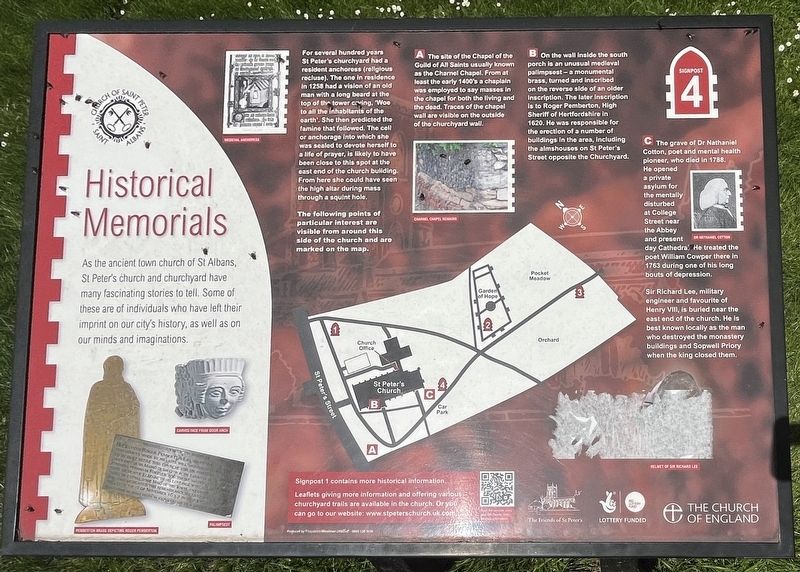
For several hundred years St Peter's churchyard had a resident anchoress (religious recluse). The one in residence in 1258 had a vision of an old man with a long beard at the top of the tower crying. 'Woe to all the inhabitants of the earth'. She then predicted the famine that followed. The cell or anchorage into which she was sealed to devote herself to a life of prayer, is likely to have been close to this spot at the east end of the church building. From here she could have seen the high altar during mass through a squint hole.
The following points of particular interest are visible from around this side of the church and are marked on the map.
The site of the Chapel of the Guild of All Saints usually known as the Charmel Chapel. From at least the early 1400's a chaplain was employed to say masses in the chapel for both the living and the dead. Traces of the chapel wall are
this page online
On the wall inside the south porch is an unusual medieval palimpsest -- a monumental brass, turned and inscribed on the reverse side of an older inscription. The later inscription is to Roger Pemberton, High Sheriff of Hertfordshire in 1620. He was responsible for the erection of a number of buildings in the area, Including the almshouses on St Peter's Street opposite the Churchyard.
The grave of Dr Nathaniel Cotton, poet and mental health pioneer, who died in 1788. He opened a private asylum for the mentally disturbed at College Street near the Abbey and present day Cathedral. He treated the poet William Cowper there in 1763 during one of his long bouts of depression.
Sir Richard Lee, military engineer and favourite of Henry VIII, is buried near the east end of the church. He is best known locally as the man who destroyed the monastery buildings and Sopwell Priory when the king closed them. (Marker Number 4.)
Topics. This historical marker is listed in these topic lists: Cemeteries & Burial Sites • Religion & Religious Structures • Science & Medicine • Women.
Location. 51° 45.316′ N,
Photographed by Ray Gurganus, April 18, 2024
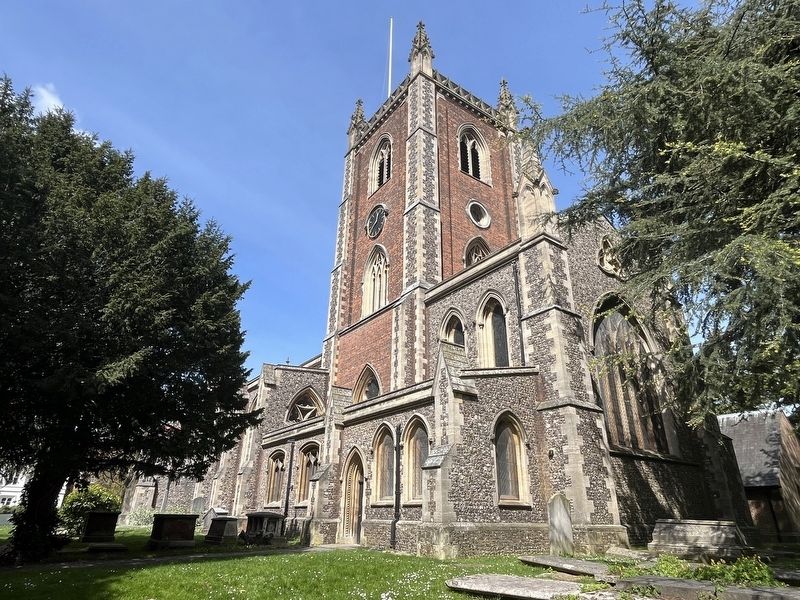
2. St Peter's Church

Regionally, this marker is in the Greater South East. Globally, it is on the Atlantic Ocean, in the North Atlantic Region, in Europe, in Atlantic Europe, on one of the British Isles, in the Western World, and in the Anglosphere. Historically, it finds itself in what was once the Roman Empire.
Other nearby markers. At least 8 other markers are within walking distance of this marker: St Peter's Church (about 90 meters away, measured in a direct line); Betty Entwistle (approx. 0.3 kilometers away); Farriers Arms (approx. 0.6 kilometers away); The Verdun Tree (approx. 0.7 kilometers away); The Lost Abbey (approx. 0.8 kilometers away); An Ancient Story, An Ancient Building (approx. 0.8 kilometers away); The Abbey Gatehouse and Romeland (approx. 0.8 kilometers away); Holywell House (approx. 0.9 kilometers away). Touch for a list and map of all markers in St Albans.
Credits. This page was last revised on May 16, 2024. It was originally submitted on May 16, 2024, by Ray Gurganus of Washington, District of Columbia. This page has been viewed 102 times since then and 7 times this year. Photos: 1, 2. submitted on May 16, 2024, by Ray Gurganus of Washington, District of Columbia. • Andrew Ruppenstein was the editor who published this page.
Editor’s want-list for this marker. photo of the marker within its surroundings • Can you help?
