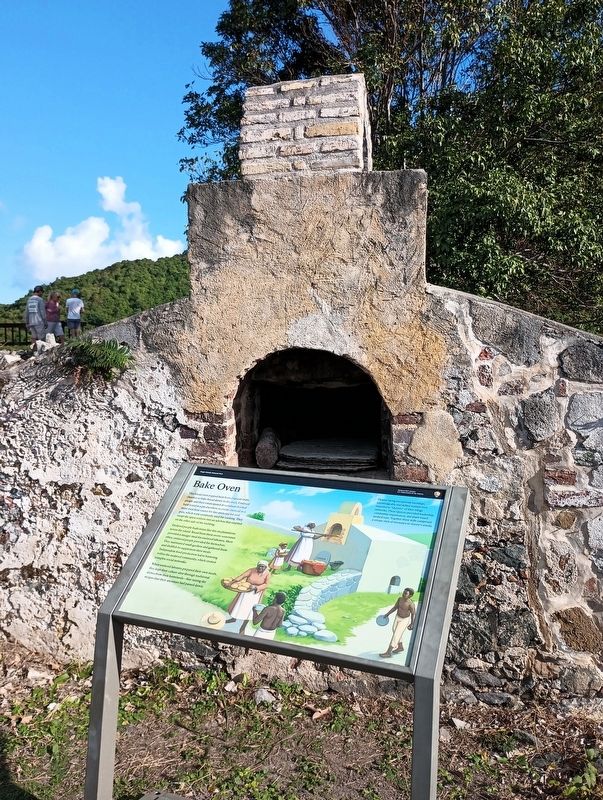
This bread oven trapped heat from charcoal in the chamber to bake bread slowly in the oven. Enslaved
people and their emancipated descendants burned hard wood in a pit elsewhere to create charcoal as a
more even heat source for this oven and . . . — — Map (db m291780) HM
In 1935, Herman Creque bought the Annaberg Plantation from Carl Francis, the son of
George Francis. Creque's heirs sold the property to Laurance Rockefeller's Jackson Hole
Preserve in 1954. Two years later, the preserve transferred the iconic . . . — — Map (db m291804) HM
Peter Oxholm designed the plans for the Annaberg sugar factory and windmill in 1797. Enslaved African craftsmen constructed the buildings while the plantation was under the ownership of "slave trader, merchant, and shipbuilder" James Murphy. The . . . — — Map (db m291782) HM
You are looking north towards the British Virgin Islands (BVI), a beacon of freedom for enslaved people on St. John during the mid-1800s.
On August 1, 1834, a massive uprising of enslaved people forced King William IV of Great Britain to . . . — — Map (db m291789) HM
Throughout its history, Annaberg's enslaved residents engaged in a struggle for power and
dignity. The planter class fought to dehumanize and control them in pursuit of profit.
Annaberg's legacies call us to reflect on the conditions that . . . — — Map (db m291781) HM
George Francis was born into slavery on Annaberg Plantation during the first decade of the 1800s. When he was enslaved, Francis gained influence that gave him opportunities beyond the reach of the other enslaved people. After inheriting two acres . . . — — Map (db m291778) HM
The sugar boom created an economy built on the brutal enslavement of human beings. The strength, experience, and intelligence of enslaved people guided every aspect of sugar production from cultivation to refinement. Beginning with piles of sugar . . . — — Map (db m291786) HM
The building you are standing in once housed a complete sugar factory. The extracted cane juice flowed from the windmill or animal mill, through gutters, and into this boiling room.
Each sugar factory operation required an artisan "sugar . . . — — Map (db m291784) HM