Annaberg Sugar Plantation near Leinster Bay in St. John, Virgin Islands — The Caribbean (The West Indies)
Freedom Across the Narrows
Photographed by Michael Fischer, January 9, 2026
1. Freedom Across the Narrows Marker
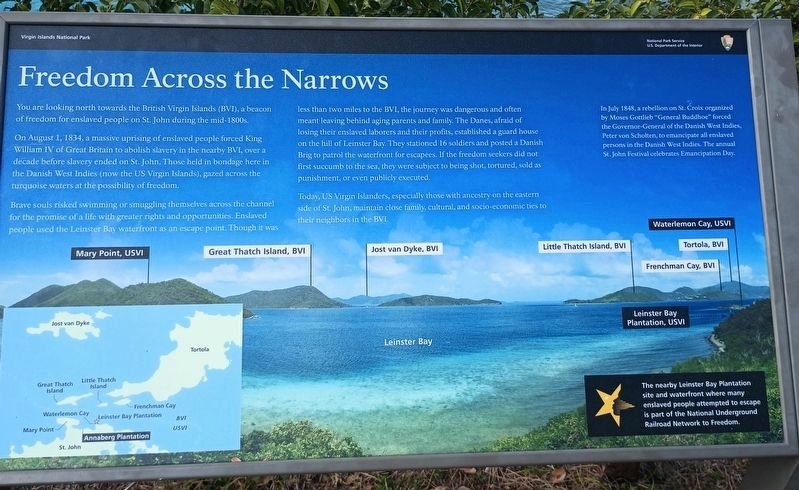
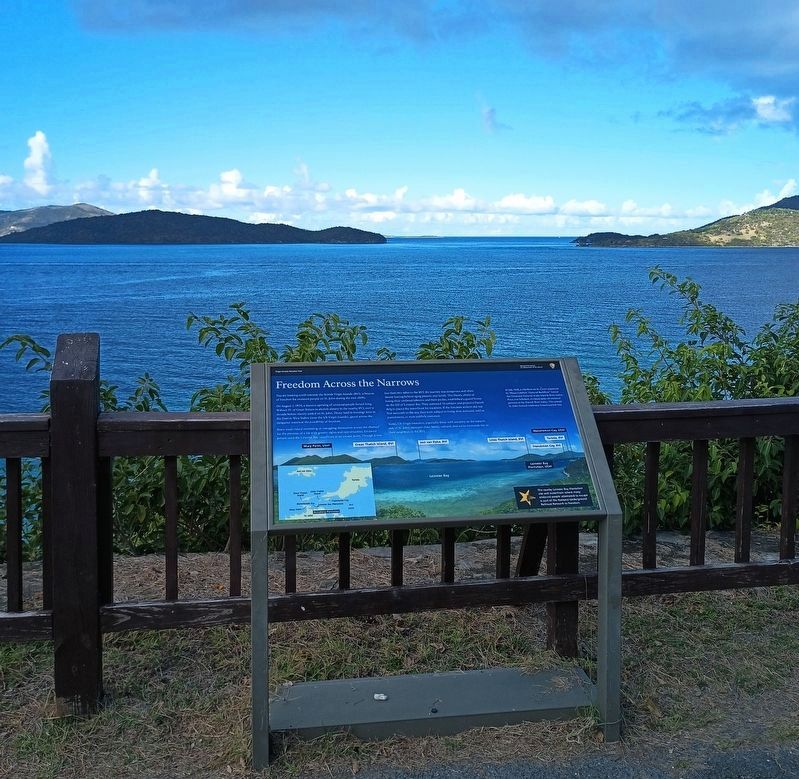
You are looking north towards the British Virgin Islands (BVI), a beacon of freedom for enslaved people on St. John during the mid-1800s.
On August 1, 1834, a massive uprising of enslaved people forced King William IV of Great Britain to abolish slavery in the nearby BVI, over a decade before slavery ended on St. John. Those held in bondage here in the Danish West Indies (now the US Virgin Islands), gazed across the turquoise waters at the possibility of freedom.
Brave souls risked swimming or smuggling themselves across the channel for the promise of a life with greater rights and opportunities. Enslaved people used the Leinster Bay waterfront as an escape point. Though it was less than two miles to the BVI, the journey was dangerous and often meant leaving behind aging parents and family. The Danes, afraid of losing their enslaved laborers and their profits, established a guard house on the hill of Leinster Bay. They stationed 16 soldiers and posted a Danish Brig to patrol the waterfront for escapees. If the freedom seekers did not first succumb to the sea, they were subject to being shot, tortured, sold as punishment,
this page online
Today, US Virgin Islanders, especially those with ancestry on the eastern side of St. John, maintain close family, cultural, and socio-economic ties to their neighbors in the BVI.
In July 1848, a rebellion on St. Croix organized by Moses Gottlieb "General Buddhoe" forced the Governor-General of the Danish West Indies, Peter von Scholten, to emancipate all enslaved persons in the Danish West Indies. The annual St. John Festival celebrates Emancipation Day.
[Background photo, looking north across Leinster Bay, with islands named left to right]
Mary Point, USVI · Great Thatch Island, BVI · Jost van Dyke, BVI · Little Thatch Island, BVI · Waterlemon Cay, USVI · Frenchman Cay, BVI · Tortola, BVI · Waterlemon Cay · Leinster Bay Plantation, USVI
[Bottom right black box text reads]
The nearby Leinster Bay Plantation site and waterfront where many enslaved people attempted to escape is part of the National Underground Railroad Network to Freedom.
Erected by National Park Service.
Topics and series. This historical marker is listed in these topic lists: Abolition & Underground RR • African Americans
Photographed by Michael Fischer, January 9, 2026
2. Freedom Across the Narrows Marker
Location. 18° 21.788′ N, 64° 43.768′ W. Marker is near Leinster Bay in St. John, Virgin Islands. It is in Annaberg Sugar Plantation. It can be reached from Leinster Bay Trail. Touch for map. Marker is in this post office area: St John VI 00830, United States of America. Touch for directions.

Regionally, it is one of the Lesser Antilles on the Caribbean Sea, on in the Atlantic Ocean, in North America, in the Western Hemisphere, in the Western World, and in the Anglosphere.
Other nearby markers. At least 8 other markers are within walking distance of this marker: Windmill (a few steps from this marker); Crushing Cane with Wind (a few steps from this marker); History of Annaberg (a few steps from this marker); Bake Oven (within shouting distance of this marker); Producing Sugar (within shouting distance of this marker); Life After Emancipation (within shouting distance of this marker); The Sugar Factory (within shouting distance of this marker); Confronting a Turbulent Past (within shouting distance of this marker). Touch for a list and map of all markers in Leinster Bay.
More about this marker. Annaberg Sugar Plantation is a unit of Virgin Islands National Park.
Also see . . . Annaberg Sugar Plantation. (Submitted on January 17, 2026, by William Fischer, Jr. of Reynoldsburg, Ohio.)
Credits. This page was last revised on January 17, 2026. It was originally submitted on January 17, 2026, by William Fischer, Jr. of Reynoldsburg, Ohio. This page has been viewed 77 times since then. Photos: 1, 2. submitted on January 17, 2026, by William Fischer, Jr. of Reynoldsburg, Ohio.
