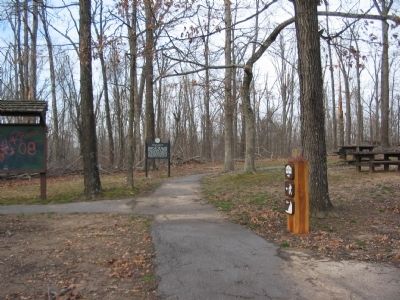
Named for the white clay which resembles chalk, this magnificent bluff is one of the most important historical landmarks in Arkansas. At this point the St. Francis River cuts through Crowley's Ridge from west to east and forms the boundary between . . . — — Map (db m18136) HM
Since Crowley's Ridge provided the only natural route for north-south travel across the lowlands of northeastern Arkansas, an Indian trail and later a military road crossed the river here. About 1840 Abraham Seitz established a ferry which was later . . . — — Map (db m4912) HM
Chalk Bluff occupied a strategic position during the Civil War. Its cliffs commanded a vital river crossing on the only major road from Missouri into the Crowley's Ridge country. Provisions were collected here and shipped downstream to Confederate . . . — — Map (db m18186) HM
On March 10, 1863 Union cavalry captured the ferry after a three-hour fight. They burned buildings and stores of corn in Chalk Bluff and destroyed a large uncompleted ferry boat. Two weeks later on March 24 Union cavalry returned to Chalk Bluff . . . — — Map (db m4906) HM
In April 1863 a Confederate army of 5000 men commanded by General John S. Marmaduke advanced into Missouri. Forced to retreat before superior Union forces, the Confederates on May 1-2 fought a successful delaying action here while their army crossed . . . — — Map (db m4911) HM
This early settlement, located on
the military road which connected
Chalk Bluff and Gainesville, is said
to have acquired its name because
stores and houses, were “scattered
about” over the area. Civil War skirmishes were fought here August . . . — — Map (db m255364) HM
In the 1850s Helena businessmen dreamed of a railroad connecting the city with Little Rock. They drew up plans, but powerbrokers diverted money from the Helena project to a line connecting Memphis and Little Rock. Arkansas's First Railroad . . . — — Map (db m262841) HM
Captain George W. Stevens was born in Lowndes County, Alabama, on July 12, 1830. He lived in Arkansas briefly where he married Martha McDonald in 1852. The couple moved to the Wise County area in 1855 and Stevens became a leader in the efforts to . . . — — Map (db m108526) HM
Front
In 1940 singer-guitarist Booker “Bukka” White, who lived in Aberdeen during the 1920s and ‘30s, recorded the blues classic “Aberdeen Mississippi Blues.” Twenty-three years later the song’s title enabled blues researchers to . . . — — Map (db m102609) HM
(This marker has two panels. From the left panel:)
Key Map
Traveling across this bridge, the fourth Red Bridge near this location since 1859, you may notice art panels attached to each of the large pillars that rise at both . . . — — Map (db m210568) HM
Thin black lines indicate changes in relevance. Between each pair of lines entries are ordered geographically but all have the same relevance.
* Inflectional forms of words are their plurals, singulars, and possessives as well as gramatical tenses and similar variations.