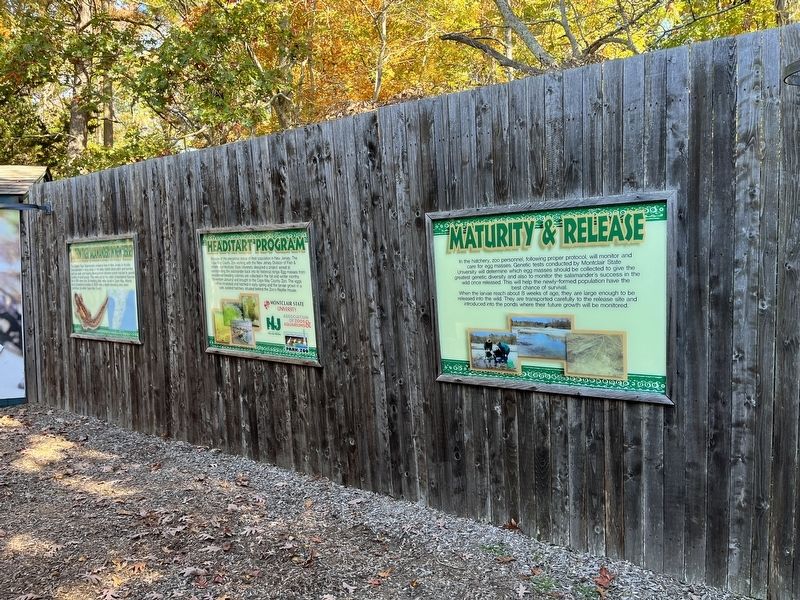
Near County Park Road west of North Main Street (U.S. 9), on the left when traveling west.
The Eastern Tiger Salamanders presence here in New Jersey is trouble. Once prevalent in many areas of the state, habitat destruction and barriers such as roads and housing developments between ponds had led to genetic isolation of small groups. They . . . — — Map (db m209372) HM
The sketch below, done by a Union soldier, shows the landscape in front of you as it looked in 1863. During the Civil War, this was the rear of Chatham—a functional space unadorned with gardens or architectural finery. Union soldiers had . . . — — Map (db m35387) HM
The Central Railroad of New Jersey built this long complex of 30 sheds in 1904 to process oysters that were harvested from the Delaware Bay. Originally, oysters were shipped in their shells via the railroad. Shucking, or removing oysters from their . . . — — Map (db m64333) HM
On Ye Greate Street at Market Street on Ye Greate Street.
In the winter of 1774, the American colonies were struggling to define their future relationship with Great Britain. The British tax on tea had sparked the 1773 Boston Tea Party. The harsh response, to close the port of Boston, lead to the First . . . — — Map (db m17730) HM
On South 7th Street just south of East Elmer Street, on the right when traveling south.
Born in 1853 in Philadelphia, Mary J. Dunlap was awarded her medical degree in 1886 from the Woman's Medical College of Pennsylvania. Dr. Dunlap was the first female Superintendent and Medical Director for the newly established Home for . . . — — Map (db m153760) HM
In the 17th and early 18th centuries, while struggling to maintain their lifestyle of hunting, fishing and gathering, the Lenape released their lands to incoming Europeans through sales and treaties. The Europeans unwittingly brought with them . . . — — Map (db m233032) HM
On Ye Greate Street at Bridgeton Road on Ye Greate Street.
Greenwich was the principal colonial settlement of Cumberland County, serving as one of New Jersey’s first official ports-of-entry under British rule. While other early settlers, primarily Dutch and Swedish, were the first Europeans to explore this . . . — — Map (db m92316) HM
On Ye Greate Street at Market Street on Ye Greate Street.
Monument front:
In honor of the Patriots of Cumberland Co., NJ who—on the evening of December 22, 1774—burned British tea near this site.
List of Patriots on Marker:
Tea Burners
Ebenezer Elmer
Timothy Elmer . . . — — Map (db m17692) HM
Thin black lines indicate changes in relevance. Between each pair of lines entries are ordered geographically but all have the same relevance.
* Inflectional forms of words are their plurals, singulars, and possessives as well as gramatical tenses and similar variations.