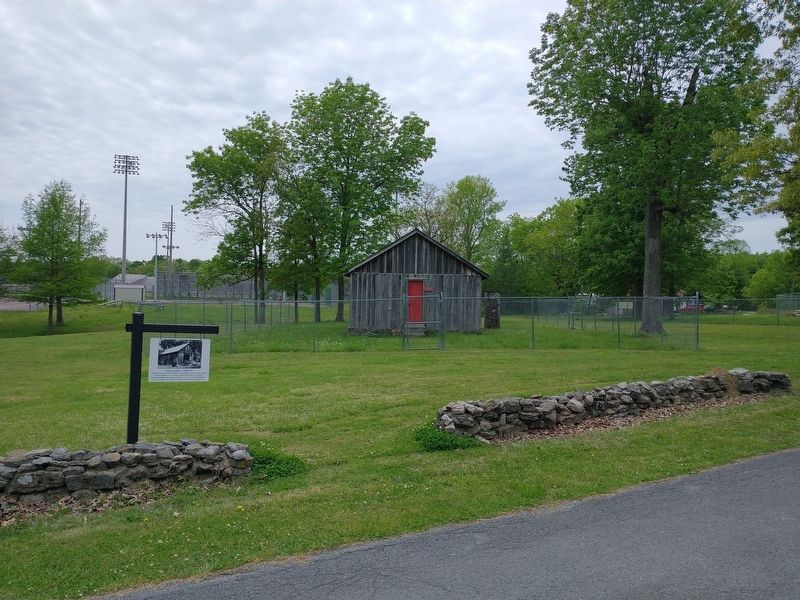
The original school was located about one mile south of the current Trenton city limit on State Highway 11. It was used as a school, church, barn, and residence. The original building was completely destroyed in a tornado. 98% of the building was . . . — — Map (db m221121) HM
The Redding House is a large double-pen log structure with an open breezeway between the pens. There are stone chimneys on either end of the house. The structure is in excellent condition and has been fully restored by the owner. This was a working . . . — — Map (db m167717) HM
James William Cureton was born on December 25, 1829 in North Carolina. As a young man he went to Tennessee where he married Nancy Boyd. In 1849, he moved to Dade County in Georgia with the intention of finding a good site for a water powered mill. . . . — — Map (db m167659) HM
The Zachariah O'Neal House is a rectangular single-pen log structure having corner timbering, and constructed with hewn logs. At one end there is a brick chimney. There is some weathering on the north end of the structure, but there is a new roof . . . — — Map (db m167698) HM
The Lynching of Henry White. On September 20, 1916, Henry White, a 24-year-old African American was lynched by a large white mob in the city of Durham in Walker County. Georgia. Mr. White had come to Durham from Chattanooga, Tennessee and . . . — — Map (db m168093) HM
William Isham Cole was born May 7, 1805. He married Lovina Clark about the same time as the Treaty of New Echota between the U.S. Government and the Cherokee Nation that ended all Native land claims in the State of Georgia. Cole took advantage of . . . — — Map (db m134461) HM
Founded by settlers who came by wagon train from Dade County, Ga., 1871. Early services were in home of S. B. Austin, the leader. Austin gave land for a cemetery and church. A log meetinghouse was built and in use in Feb. 1872. This was the first . . . — — Map (db m188366) HM
During the war, the Macon Iron Works were built near the Trenton spring. The company was chartered in Macon, Georgia in 1862. "Mr. J. Cowles and his associates, of Macon," James A. Nisbet wrote on October 3, 1862, "have secured a large iron estate, . . . — — Map (db m167689) HM
(side 1)
Originally African American residents of Coconut Grove attended integrated religious services at Union Chapel, now known as Plymouth Congregational Church. The African Americans, who were used to a more spirited religious . . . — — Map (db m120630) HM
Located one mile east of this point on the south bank of the Withlacoochee River at the crossing of the Fort King Road. The Fort, built in 1837, named for Major Francis Langhorne Dade, served for many years as a depot and observation post in the . . . — — Map (db m41170) HM
Major Francis L. Dade and his command consisting of detachments of the Fourth Infantry, Second and Third Artillery United States Army, while marching from Tampa Bay to Fort King was attacked by a superior force of Seminole Indians commanded by Mico . . . — — Map (db m20024) HM
When the Europeans arrived in America, two tribes of Indians were found in Florida, the Calusa and the Tequesta. These tribes emerged from the Archaic Period (the time when Florida became subtropical, around 5000 B.C.). The Calusa was the largest . . . — — Map (db m222295) HM
This 1850s structure is the oldest standing house in Miami-Dade County. It was built by William Wagner, a German immigrant and U.S. Army veteran. After being wounded in the Mexican-American War in 1847, Wagner returned to Fort Moultrie, Georgia to . . . — — Map (db m78192) HM
The Lyric Theater was built in 1913 by Geder Walker, an enterprising African American businessman from Georgia who also owned and operated the theater. It quickly became the center of a thriving entertainment district of hotels, restaurants, and . . . — — Map (db m278168) HM
Often called the “State of Dade,” because, as legend has it, the county seceded from the Union ahead of Georgia, and only returned to the Union July 4, 1945.
Created December 25, 1837, and named for Major Francis Langhorne Dade, . . . — — Map (db m57731) HM
In early September 1863, a major Federal army entered Georgia for the first time since the outbreak of war. A division of Union Major General William S. Rosecrans' Army of the Cumberland arrived here on September 4th, the first of at least 25,000 . . . — — Map (db m82779) HM
Thin black lines indicate changes in relevance. Between each pair of lines entries are ordered geographically but all have the same relevance.
* Inflectional forms of words are their plurals, singulars, and possessives as well as gramatical tenses and similar variations.