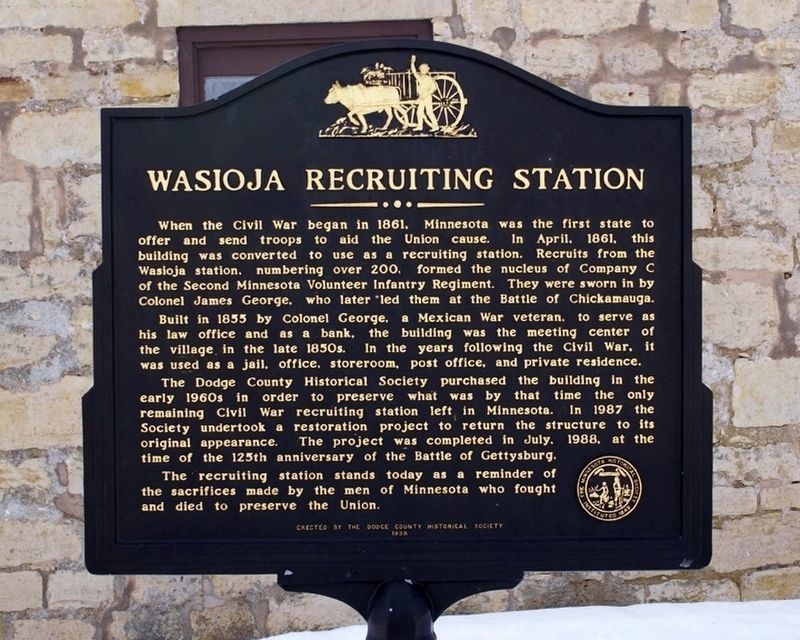
When the Civil War began in 1861, Minnesota was the first state to offer and send troops to aid the Union cause. In April 1861, this building was converted to use as a recruiting station. Recruits from the Wasioja station, numbering over 200, . . . — — Map (db m114961) HM
The role of buildings in the development of a community and their significance in history is amply pointed out by the history of this structure. Anxious to promote the growth of the newly formed town, the citizens agreed to provide the Free Will . . . — — Map (db m115028) HM
John Hischi founded the Dodge County Brewery in May of 1857. This establishment was located on Fifth Street West near the 1918 Opera House, making this business the oldest microbrewery in Minnesota. One year later, Hirschi sold the business to . . . — — Map (db m297579) HM
This small limestone building was built in 1855. It is most well known as the last remaining Civil War recruiting station in Minnesota. The Wasioja Grange and Old Settlers Society were instrumental in its preservation in the 1960s. A . . . — — Map (db m287744) HM
The Wasioja Baptist Church, erected in 1858, was built by pledges and barters during a nationwide economic recession.
In Wasioja's earliest days, its first ten families organized a congregation for themselves. In the summer . . . — — Map (db m286434) HM
Mantorville schools began teacher training or normal training in 1913. Young women, having completed at least three years of high school, could prepare for teaching in rural schools through this type of program. Often Normal Schools evolved into . . . — — Map (db m288211) HM
Christian Adam(s) was born circa 1812 in Prussia. He sailed from LeHavre, France aboard the ship Pactolus which arrived in New York City October 12, 1846. The passenger manifest listed his occupation as farmer.
Petronella Keller Adam(s) was . . . — — Map (db m73759) HM
Thin black lines indicate changes in relevance. Between each pair of lines entries are ordered geographically but all have the same relevance.
* Inflectional forms of words are their plurals, singulars, and possessives as well as gramatical tenses and similar variations.