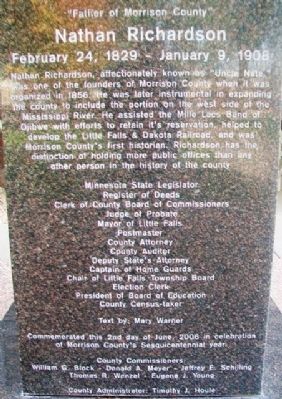
Nathan Richardson, affectionately known as "Uncle Nate," was one of the founders of Morrison County when it was organized in 1856. He was later instrumental in expanding the county to include the portion on the west side of the Mississippi River. . . . — — Map (db m78471) HM
Belle Prairie, meaning, "beautiful prairie," was named by French fur traders and voyageurs. It was organized as a township on March 25, 1859. Belle Prairie was the home of the first school in Morrison County started in 1849 by Frederick Ayer. Belle . . . — — Map (db m78448) HM
The Morrison family made significant contributions to Crow Wing, and to Minnesota history. Brothers William and Allen Morrison were born in Canada and both became well-known Minnesota fur traders. Allen established one of the earliest trading . . . — — Map (db m302983) HM
In 1880, two of Beaulieu's nephews dismantled the house and its 1850s addition, and moved the two sections from Crow Wing to their farms, in Morrison County. Both parts were subsequently sold. One section burned in 1923. The other, the original . . . — — Map (db m279371) HM
Lt. Zebulon Pike was charged with exploring the Mississippi River from St. Louis, Missouri, to its source in Minnesota after this area was bought as part fo [sic] the Louisiana Purchase. When Pike and his men reached what is now Morrison County . . . — — Map (db m278813) HM
This riverfront park is named after James Green, a Pennsylvanian, who, with his wife, Isabella, and three children, came here in 1848 from the Selkirk colonies (Winnipeg). Their arrival marked the beginning of permanent settlement at Little . . . — — Map (db m78713) HM
Erected in 1952 to the Memory of Reverend Francis Xavier Pierz "Father of the Diocese of St. Cloud" 1785-1880 By assignment of Bishop Joseph Crétin of St. Paul he came to the Upper Mississippi and its tributaries in 1852 to convert the Indians and . . . — — Map (db m213533) HM
Thin black lines indicate changes in relevance. Between each pair of lines entries are ordered geographically but all have the same relevance.
* Inflectional forms of words are their plurals, singulars, and possessives as well as gramatical tenses and similar variations.