3 entries match your criteria.
Entries Containing All of the Phrases «rock island county» AND «illinois»
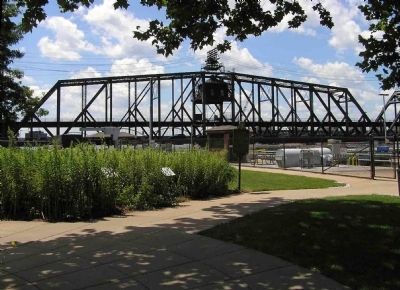
By Paul Crumlish, July 9, 2010
Wide view of the Sherman's March Marker
RANKED BY RELEVANCE
1 ► Illinois, Rock Island County, Rock Island — Fort Armstrong —  |
| Fort Armstrong was built in 1816-1817. Its riverside was protected by limestone bluffs and its other sides were formed in part by the rear walls of barracks and storehouses. Blockhouses, like the replica, stood at three corners. The pyramid of . . . — — Map (db m33225) HM | |||
| 2 ► Illinois, LaSalle County, Troy Grove — Prudence Crandall: Abolitionist, Educator, and Woman’s Rights Advocate — |
| Prudence Crandall (1803-1890) was a white teacher who gained fame for conducting an advanced academy for Black women in Canterbury, Connecticut. Sparked by discussions with Maria Davis, a Black woman who shared abolitionist literature with her, . . . — — Map (db m250332) HM | |||
| 3 ► Illinois, Rock Island County, Rock Island — To the Memory of La Main Cassee "The Broken Hand," a Fearless Sauk Chief — |
| A true friend of the American cause during the Revolutionary War. His village occupied these and adjacent grounds and withstood a British war party on its way to attack General George Rogers Clark in 1779. This also commemorates the burning of . . . — — Map (db m201880) HM | |||
Thin black lines indicate changes in relevance. Between each pair of lines entries are ordered geographically but all have the same relevance.
* Inflectional forms of words are their plurals, singulars, and possessives as well as gramatical tenses and similar variations.
Nov. 12, 2026