Troy Grove in LaSalle County, Illinois — The American Midwest (Great Lakes)
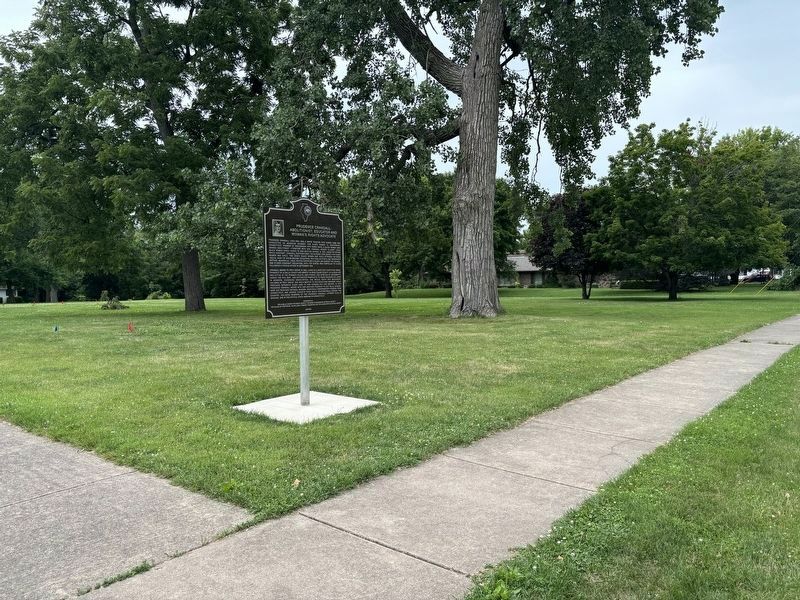
Prudence Crandall: Abolitionist, Educator, and Woman’s Rights Advocate

Photographed by Connor Olson, July 4, 2024
1. Prudence Crandall: Abolitionist, Educator, and Woman’s Rights Advocate Marker
Prudence Crandall (1803-1890) was a white teacher who gained fame for conducting an advanced academy for Black women in Canterbury, Connecticut. Sparked by discussions with Maria Davis, a Black woman who shared abolitionist literature with her, Crandall agreed to admit local Black woman Sarah Harris to her existing school in 1832. Under withering white contempt, Crandall restructured the academy exclusively for Black women and girls. Two dozen Black women and girls attended between 1833-34, many of whom became educators, political activists, and newspaper editors. Meanwhile, local Whites contrived a Black law against the school, and stoked constant vigilantism, until the school was compelled to close following a vicious attack in September 1834.
Crandall moved to Troy Grove in 1842, living in Illinois for thirty-five years, primarily in La Salle County and briefly in Rock Island County. In Illinois she was active in the women’s rights, abolitionist, and spiritual movements. During the Civil War, she distributed pamphlets to Union soldiers on leave in Mendota, endorsing emancipation. She would teach her neighbors children
this page online
Erected 2022 by La Salle County Historical Society, The Mendota Museum and Historical Society, The Village of Troy Grove, The William G. Pomeroy Foundation, and the Illinois State Historical Society.
Topics and series. This historical marker is listed in these topic lists: Abolition & Underground RR • Civil Rights • Women. In addition, it is included in the Illinois State Historical Society series list. A significant historical year for this entry is 1832.
Location. 41° 27.978′ N, 89° 5′ W. Marker is in Troy Grove, Illinois, in LaSalle County. It is on Main Street south of High Street, on the right when traveling south. Touch for map. Marker is in this post
Photographed by Connor Olson, July 4, 2024
2. Prudence Crandall: Abolitionist, Educator, and Woman’s Rights Advocate Marker

Regionally, this marker is in Northern Illinois and specifically in the Illinois River Valley. It is also in the American Midwest and in the Corn Belt. Globally, it is in North America, the Western Hemisphere, the Western World, and the Anglosphere. Historically, it finds itself in what was once the territory of the Mississippian Culture and also the Northwest Territory.
Other nearby markers. At least 8 other markers are within 8 miles of this marker, measured as the crow flies: Wild Bill Hickok (here, next to this marker); James Butler "Wild Bill" Hickok (within shouting distance of this marker); Troy Grove Township Veterans Memorial (within shouting distance of this marker); Civil War Memorial (within shouting distance of this marker); Railroads and the Founding of Mendota (approx. 6.1 miles away); Cherry Mine Disaster (approx. 7.2 miles away); We of Cherry Honor Our Service Personnel (approx. 7.2 miles away); Cherry Miner's Memorial / Afterward-at-Cherry (approx. 7.3 miles away). Touch for a list and map of all markers in Troy Grove.
Credits. This page was last revised on July 7, 2024. It was originally submitted on July 4, 2024, by Connor Olson of Menomonee Falls, Wisconsin. This page has been viewed 421 times since then and 68 times this year. Photos: 1, 2. submitted on July 4, 2024, by Connor Olson of Menomonee Falls, Wisconsin. • J. Makali Bruton was the editor who published this page.
