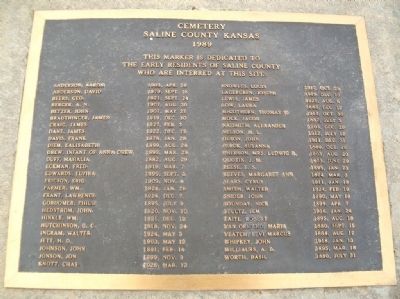
In June of 1872 Saline County obtained ownership of the North East Quarter of Section 25 for, and to be used as, "a country farm and asylum for the poor" except an one acre tract to be used as a cemetery. This site is the one acre tract known as . . . — — Map (db m80620) HM
Lynching in America
Between 1865 and 1950, at least 6,500 Black people were victims of lynchings in the United States, including at least 22 documented victims of racial terror lynching in Kansas. After the Civil War ended in 1865, . . . — — Map (db m250405) HM
1790
Indians Along the Missouri
The Missouri River served as a boundary between Indian tribes in historic times. The Osage dominated a vast area south of the river. To the north, the loway, and later Sauk and Fox, held power. . . . — — Map (db m247363) HM
In 1877, the Chicago & Alton Railroad decided to build a bridge across the Missouri River at Glasgow. It was to be the first large all-steel bridge in the world. Mr. A.F. Hay, of Burlington, Iowa, had developed a steel that met all specifications & . . . — — Map (db m216963) HM
The 1860 census shows 15,000 people living in Saline county, 5,000 of whom were enslaved African Americans. The collapse of the hemp market and emancipation in 1865 resulted in many African Americans leaving farms and plantations. Many "freedmen" . . . — — Map (db m247019) HM
Site of
first free ferry on Smoky Hill River 1858-1867
Commemorated by
Saline County Chapter
Native Daughters of Kansas
December 10, 1933 — — Map (db m122952) HM
Thin black lines indicate changes in relevance. Between each pair of lines entries are ordered geographically but all have the same relevance.
* Inflectional forms of words are their plurals, singulars, and possessives as well as gramatical tenses and similar variations.