near Jackson in Aiken County, South Carolina — The American South (South Atlantic)
Savannah River Site
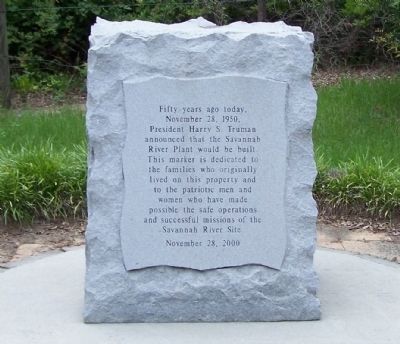
Photographed by Mike Stroud, July 2008
1. Savannah River Site Marker
Erected 2000.
Topics. This historical marker is listed in these topic lists: Charity & Public Work • Science & Medicine • War, Cold • Waterways & Vessels. A significant historical date for this entry is November 28, 1950.
Location. 33° 13.507′ N, 81° 43.834′ W. Marker is in near Jackson, South Carolina, in Aiken County. It is on Atomic Road (State Highway 125) near Government 3, on the right when traveling south. Touch for map. Marker is in this post office area: Aiken SC 29808, United States of America. Touch for directions.

Regionally, this marker is in Greater Augusta and in the Midlands. It is also in the American South and specifically in the Deep South. Globally, it is in North America, the Western Hemisphere, the Western World, and the Anglosphere. Historically, it finds itself
this page online
Other nearby markers. At least 10 other markers are within 16 miles of this marker, measured as the crow flies: Site of Ellenton (here, next to this marker); William Bartram Trail (approx. 9.6 miles away); Savannah River Plant (approx. 11.8 miles away); Botsford Church - 1773 (approx. 12 miles away in Georgia); Speedwell Methodist Church (approx. 14.7 miles away); Redcliffe Plantation (approx. 15.3 miles away); Downer Institute & School / Downer School, 1924–1986 (approx. 15.6 miles away); Farm Equipment in the Twentieth Century (approx. 15.7 miles away); Historic Church (approx. 15.7 miles away); Silver Bluff Baptist Church (approx. 15.8 miles away).
Regarding Savannah River Site. When the Cold War began in the 1950s, the nation called on Aiken, Barnwell and Allendale counties to provide about 200,000 acres of farmland and forest. Nearly 1,500 families were displaced in the name of freedom and protection from Soviet Communism.
The federal government put more
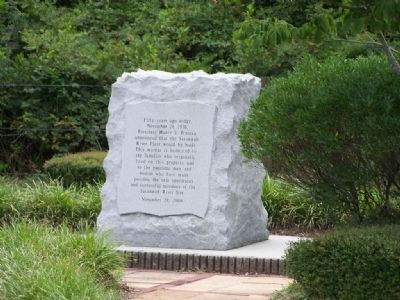
Photographed by Mike Stroud, 2008
2. Savannah River Site Marker
Related markers. Click here for a list of markers that are related to this marker. To better understand the relationship, see markers
Also see . . .
1. Savannah River Site. Official Site of the SRS. (Submitted on August 6, 2008, by Mike Stroud of Bluffton, South Carolina.)
2. Savannah River Site. The Savannah River Site (SRS) is a nuclear materials processing center in the United States state of South Carolina, located on land in Aiken, Allendale and Barnwell Counties adjacent to the Savannah River, 25 miles from Augusta, Georgia. (Submitted on March 16, 2009, by Brian Scott of Anderson, South Carolina.)
3. Savannah River Site (SRS). The Savannah River Site (SRS), a 310 square mile (198,344-acre) site, is located in the south eastern coastal area of the United States in the state of South Carolina. (Submitted on March 16, 2009, by Brian Scott of Anderson, South Carolina.)
4. SRS - 50th Anniversary. Through text and images,
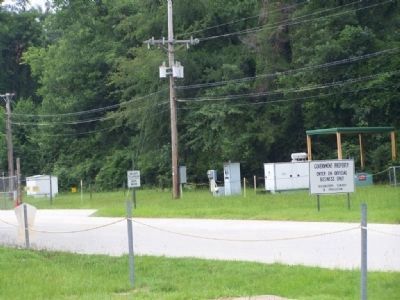
Photographed by Mike Stroud, 2008
3. Savannah River Site
Additional commentary.
1. Full text of the P and R Reactor's Historical Markers
The following inscriptions appear on two historical markers, erected in 2008 by the U.S. Department of Energy. Unfortunately, these markers are closed to the general public. The text comes from the South Carolina Department of Archives and History.
P Reactor (Marker 2-36)
[Front]: One of five production reactors at Savannah River Plant, now Savannah River Site, P Reactor was the site of cutting-edge neutrino research. In 1956, Drs. Clyde Cowan, Jr., and Frederick Reines used P Reactor to confirm for the first time the existence of the free neutrino, a sub-atomic particle of extremely small mass. As a result, Reines won the 1995 Nobel Prize in Physics.
[Reverse] P Reactor not only generated prize-winning research but also produced plutonium and tritium
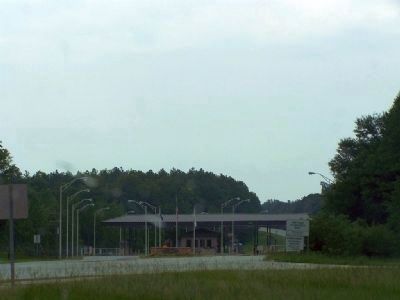
Photographed by Mike Stroud, 2008
4. Savannah River Site Controlled Entry
R Reactor (Marker 2-37)
[Front] One of five production reactors at the Savannah River Plant, now Savannah River Site, R Reactor produced plutonium and tritium for national defense. Built 1951-53, it was the first of the five reactors to go on-line, with initial start-up on Dec. 28, 1953. The first irradiated fuel left the reactor in June 1954. The reactor continued operation until final shut-down in 1964.
[Reverse] This was the first production reactor to use heavy water as the neutron moderator and coolant. It was also the first to have vertical fuel and control rod assemblies, with more than 600 positions in the reactor tank. Originally rated at 378 MW, R Reactor achieved power levels many times that. It was the largest of the SRP reactors and was a prototype for the other four.
— Submitted January 10, 2011, by Brian Scott of Anderson, South Carolina.
2.
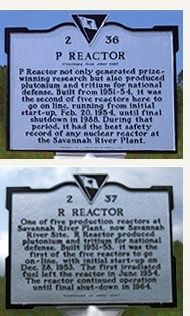
Photographed by SRS History Highlights
5. Savannah River Site Marker
SRS History 2008:
• Historical markers were placed in P and R Areas commemorating the role played by P- and R-Reactor towards winning the Cold War. The site’s first two nuclear production reactors, R-Reactor began operations in 1953, P-Reactor in 1954.
2-36 Reads:
P Reactor
P Reactor not only generated prize- winning reach but also produced plutonium and tritium for national defense. Built from 1951 - 1954, it was the of five reactors here to go on line, running from initial start - up, Feb. 20, 1954, until final shutdown in 1988. During that period, it had the best safety record of any nuclear reactor at Savannah River Plant.
2-37 Reads:
R Reactor
One of five production reactors at Savannah River Plant, now Savannah River Site, R Reactor produced plutonium and tritium for national defense. Built in 1951 - 1953, it was the first of five reactors to go on-line with initial start-up on Dec. 28, 1953. The first irradiated fuel left the reactor in June 1954. The reactor continued operation until final shut-down in 1964.
• Historical markers were placed in P and R Areas commemorating the role played by P- and R-Reactor towards winning the Cold War. The site’s first two nuclear production reactors, R-Reactor began operations in 1953, P-Reactor in 1954.
2-36 Reads:
P Reactor
P Reactor not only generated prize- winning reach but also produced plutonium and tritium for national defense. Built from 1951 - 1954, it was the of five reactors here to go on line, running from initial start - up, Feb. 20, 1954, until final shutdown in 1988. During that period, it had the best safety record of any nuclear reactor at Savannah River Plant.
2-37 Reads:
R Reactor
One of five production reactors at Savannah River Plant, now Savannah River Site, R Reactor produced plutonium and tritium for national defense. Built in 1951 - 1953, it was the first of five reactors to go on-line with initial start-up on Dec. 28, 1953. The first irradiated fuel left the reactor in June 1954. The reactor continued operation until final shut-down in 1964.
Aiken Standard
8/27/10
A crowd of more than 50 people gathered in front of the Greater Aiken Chamber of Commerce Friday morning to commemorate scientific history made in Aiken 54 years ago.
Members of local government, county residents and Savannah River Site employees and their families kicked off the all-day celebration of the discovery of the neutrino, an elementary particle with no charge and nearly no mass first detected at SRS.
The discovery, made by a team led by Clyde Cowan and Frederick Reines, earned the only Nobel Prize for physics ever awarded in the state of South Carolina to date.
"Neutrinos are the closest thing to nothing that's still something," SRS Heritage Foundation Executive Director Walt Joseph said last week, a sentiment that was also printed on T-shirts worn by several members of the audience."If the neutrino had never been detected, the conservation of energy would have always been in doubt," Joseph said Friday.
The discovery of the neutrino came about when scientists were unable to account for a small amount of energy in their calculational models that they could not detect. Through the use of P Reactor at SRS, Cowan and Reines were able to detect the particle, which can pass through matter almost undisturbed.
The importance of the discovery did not stop at its detection, Joseph said, but allowed scientists to apply the new knowledge to calculations related to the Big Bang, also known as the "Birth of the Universe."
The ceremony's speakers, including County Council chairman Ronnie Young, praised the members of the audience - many of whom wore shirts with SRS emblems embroidered on them - for their contributions to an important piece of local history.
"Those who come after us will understand the heritage of the site," Young said.
Among the crowd on Friday morning
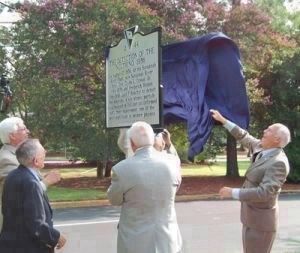
By Anna Doliaitis, Staff writer, Aiken Standard, August 27, 2010
6. Savannah River Site Marker New Marker 2-44
*** Marker Reads... ***
The Detection of the Neutrino, 1956
On August 27, 1956, at the Savannah River Plant (now Savannah River Site), Drs. Clyde L. Cowan, Jr. (1919-1974) and Frederick Reines (1918-1999) used P Reactor to detect the neutrino, a sub-atomic particle hypothesized in 1930 but unconfirmed until their experiment, one of the most significant in modern physics.
The Nobel Prize, 1995
In 1995 Dr. Frederick Reines was awarded the Nobel Prize in Physics for his and Dr. Clyde L. Cowan’s detection of the neutrino at the Savannah River Plant. The Nobel citation called their experiment “a pioneering contribution that opened the doors to the region of ‘impossible’ neutrino experiments.”
2-44 Erected by the Savannah River Site Heritage Foundation, 2010
The Detection of the Neutrino, 1956
On August 27, 1956, at the Savannah River Plant (now Savannah River Site), Drs. Clyde L. Cowan, Jr. (1919-1974) and Frederick Reines (1918-1999) used P Reactor to detect the neutrino, a sub-atomic particle hypothesized in 1930 but unconfirmed until their experiment, one of the most significant in modern physics.
The Nobel Prize, 1995
In 1995 Dr. Frederick Reines was awarded the Nobel Prize in Physics for his and Dr. Clyde L. Cowan’s detection of the neutrino at the Savannah River Plant. The Nobel citation called their experiment “a pioneering contribution that opened the doors to the region of ‘impossible’ neutrino experiments.”
2-44 Erected by the Savannah River Site Heritage Foundation, 2010
"The family is so excited, and we have such memories of Aiken. It is so wonderful that they've kept the history," said Marian, who was just over 1 year old at the time of the discovery. "It is so exciting what they're doing because the newcomers don't know the history."
Elizabeth, who was 11 years old when her father detected the neutrino at SRS, recalls the partnership between her father and Reines.
"Fred kept the math going, and Daddy - he liked the math, but he kept the equipment going," she said.
The historical marker, which now stands directly in front of the chamber building at 121 Richland Ave., was also unveiled during the ceremony. The plaque, a replica of the original plaque awarded by the U.S. Atomic Energy Commission which is now at the University of California-Irvine, was also officially unveiled at the ceremony.The celebration continued Friday afternoon with informative presentations at USCA's Etherredge Center. The crowd watched a video of the late Cowan discussing the experiments and research that led to the neutrino's detection, as well as presentations about neutrinos in particle astrophysics and neutrino research in using accelerators.
The evening concluded with a sit-down dinner at Newberry Hall and a speech by Dr. John Palms, distinguished president emeritus of the University of South Carolina.
The event was part of Aiken's 175th anniversary celebration.
— Submitted January 10, 2011, by Mike Stroud of Bluffton, South Carolina.
Credits. This page was last revised on July 17, 2026. It was originally submitted on August 6, 2008, by Mike Stroud of Bluffton, South Carolina. This page has been viewed 3,602 times since then and 108 times this year. Photos: 1, 2, 3, 4. submitted on August 6, 2008, by Mike Stroud of Bluffton, South Carolina. 5. submitted on January 19, 2009, by Mike Stroud of Bluffton, South Carolina. 6. submitted on January 10, 2011, by Mike Stroud of Bluffton, South Carolina. • Craig Swain was the editor who published this page.
