Pisté in Tinum, Yucatán, Mexico — The Southeast (Yucatan Peninsula)
The Colonnade of the Northeastern Corner
Photographed by J. Makali Bruton, January 17, 2017
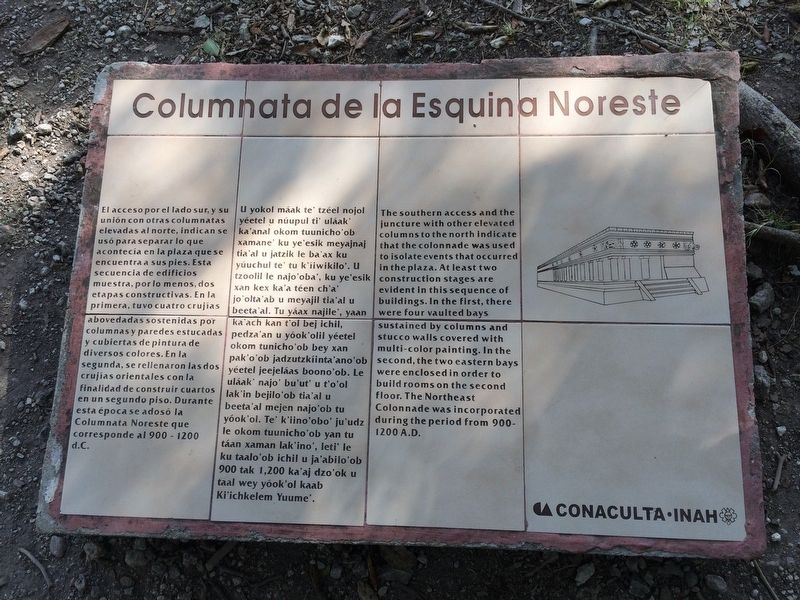
1. The Colonnade of the Northeastern Corner Marker
Maya-Yucateco:
U yokol máak te’ tzéel nojol yéetel u núupul ti’ uláak’ ka’anal okom tuunicho’ob xamane’ ku ye’esik meyajnaj tia’al u jatzil le ba’ak ku yúuchul te’ tu k’íiwikilo’. U tzoolil le najo’oba’, ku ye’esik xan kex ka’a téen ch’a’ jo’olta’ab u meyajil tia’al u beeta’al. Tu yáax najile’, yaan ka’ach kan t’ol bej ichil, pedza’an u yóok’olil yéetel okom tunicho’ob bey xan pak’o’ob jadzutzkíinta’ano’ob yéetel jeejeláas boono’ob. Le uláak najo’ bu’ut’ u t’o’ol lak’in bejilo’ob tia’al u beeta’al mejen najo’ob tu yóok’ol. Te’ k’iino’obo’ ju’udz le
this page online
English:
The southern access and the juncture with other elevated columns to the north indicate that the colonnade was used to isolate events that occurred in the plaza. At least two construction stages are evident in this sequence of buildings. In the first, there were four vaulted bays sustained by columns and stucco walls covered with multi-color painting. In the second, the two eastern bays were enclosed in order to build rooms on the second floor. The Northeast Colonnade was incorporated during the period from 900 1200 A.D.
Erected by Consejo Nacional para la Cultura y las Artes de México (CONACULTA)-INAH.
Topics. This historical marker is listed in these topic lists: Anthropology & Archaeology • Architecture • Indigenous Peoples and Communities • Man-Made Features. A significant historical year for this entry is 1200.
Location. 20° 40.931′ N, 88° 33.986′ W. Marker is in Pisté, Yucatán, in Tinum. It can be reached from Carretera Costera de Golfo (Route 180).
Photographed by J. Makali Bruton, January 17, 2017
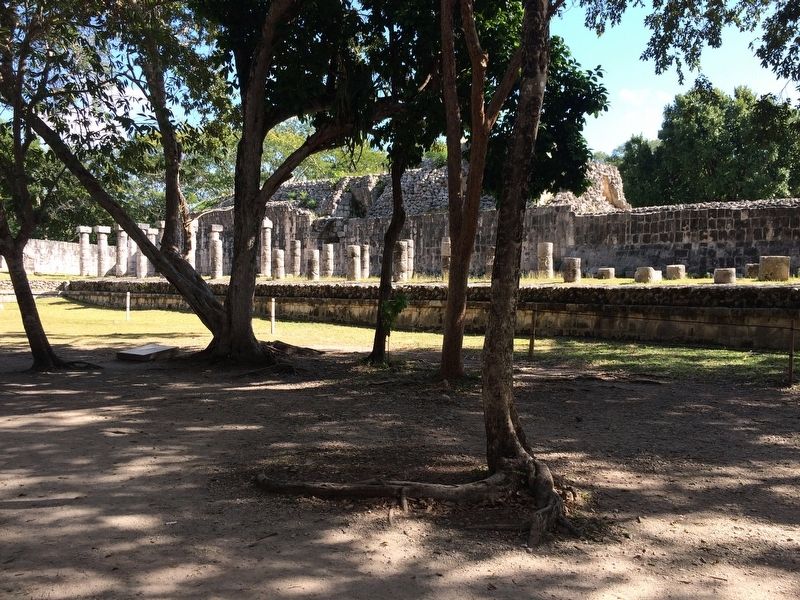
2. The Colonnade of the Northeastern Corner Marker
The colonnade is in the background of this view towards the northeast.

Regionally, this marker is in the Mexican Gulf Coast, in the Maya Heartland, and on the Yucatán Peninsula. Globally, it is in North America, Mesoamerica, a Gulf of Mexico state, and the Western Hemisphere. Historically, it finds itself in what was once New Spain and also a Spanish colony.
Other nearby markers. At least 8 other markers are within walking distance of this marker: The Palace of the Sculpted Columns (a few steps from this marker); The Northern Colonnade (within shouting distance of this marker); Temple of the Small Tables (within shouting distance of this marker); The Plaza of the Thousand Columns (about 90 meters away, measured in a direct line); The Southeastern Colonnade (about 120 meters away); The Market (about 120 meters away); The Temple of the Warriors (about 150 meters away); Temple of the Large Tables (about 180 meters away). Touch for a list and map of all markers in Pisté.
Credits. This page was last revised on March 11, 2017. It was originally submitted on March 11, 2017, by J. Makali Bruton of Washington, District of Columbia. This page has been viewed 234 times since then and 12 times this year. Photos: 1, 2. submitted on March 11, 2017, by J. Makali Bruton of Washington, District of Columbia.
