Santa Elena, Yucatán, Mexico — The Southeast (Yucatan Peninsula)
The Pillory Shrine
Photographed by J. Makali Bruton, January 20, 2017
1. The Pillory Shrine Marker
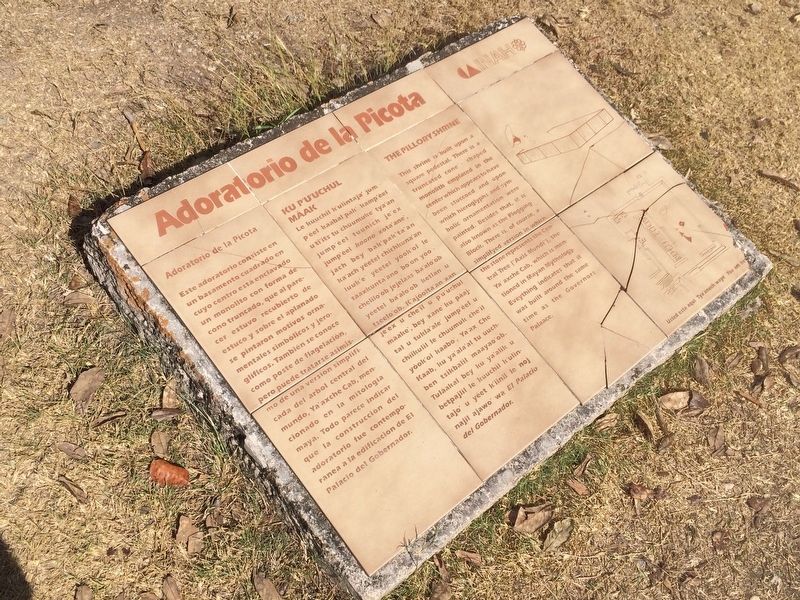
Adoratorio de la Picota
Este adoratorio consiste en un basamento cuadrada en cuyo centro está enclavado un monolito con forma de cono truncado, que al parecer estuvo recubierto de estuco y sobre el aplanado se pintaron motivos ornamentales simbólicos y jeroglíficos. También se conoce como poste de flagelación, pero puede tratarse asimismo de una versión simplificada del árbol central del mundo, Ya’axche Cab, mencionado en la mitología maya. Todo parece indicar que la construcción del adoratorio fue contemporánea a la edificación de El Palacio del Gobernador.
Maya-Yucateco:
Ku P’u’uchul Máak
Le kúuchil k’ulintaja’ jump’éel kaakbal pak’ kamp’éel u’ti’its tu chúumuke’ tya’an jump’éel tuunich je’ex jump’éel koono xota’ane’, jach bey bak’pak’ta’an ka’ach yéetel yook’ol le táaxkunta’ano bo’on yoo chelilo’ob jejelaas ba’alo’ob yéetel ba’alo’ob ketlan u tseelo’ob. K’ajoolta’an xan je’ex u che’il u p’u’uchul maake’, bey xane’ ku paajtal u tukla’ale’ jump’éel u chiikulil le chuumuk che’il yóok’ol kaabo’, Ya’ax Che’ Kaab, ku ya’ala’al tu úuchben tsikbalil maayao’ob. Tuláakal bey ku ya’alik u betpajlil le kúuchil k’ulintajo’ u yéet k’iinil
this page online
English:
The Pillory Shrine
This shrine is built upon a square pedestal. There is a truncated cone-shaped monolith emplaced in the center which appears to have been stuccoed and upon which hieroglyphics and symbolic ornamentation were painted. Besides that, it is also known as the Flogging Block. There is, of course, a simplified version in which the stone represents the Central Tree (“Axis Mundi”), the Ya’axche Cab, which mentioned in Mayan Mythology. Eveything indicates that it was built around the same time as the Governor’s Palaace.
Erected by Consejo Nacional para la Cultura y las Artes de México (CONACULTA)-INAH.
Topics. This historical marker is listed in these topic lists: Anthropology & Archaeology • Indigenous Peoples and Communities • Man-Made Features.
Location. 20° 21.51′ N, 89° 46.25′ W. Marker is in Santa Elena, Yucatán. It can be reached from Route 261. The marker is east of the Governor's Palace at Uxmal Archaeological Site, near the Pillory Shrine, some ten kilometers from Muna, south of Mérida.

Photographed by J. Makali Bruton, January 20, 2017
2. An additional Pillory Shrine Marker
This additional marker is some meters from the featured marker. It reads:
Adoratorio de la Picota
Consiste en un basamento cuadrada en cuyo centro está enclavado un monolito de forma cilíndrica, que parece haber estado recubierto de estuco y pintado con motivos ornamentales y jeroglíficos. También se conoce como poste de flagelación, pero es más probable que sea un altar en forma de columna que representa a la yaxche, o ceiba, común en la región Puuc, aunque ésta es de mayores dimensiones. En algunas ocasiones se ha sugerido que se trata de un monumento fálico en posición de fertilizara la madre tierra, aunque no hay evidencia contundente para esta identificación.
Es muy probable que la elaboración de este adoratorio corresponda con la construcción del Palacio del Gobernador.
English:
The Pillory Shrine
It consists of a square base with a cylindrical monolith located in the center which appears to have been covered with stucco and painted with decorative motifs and hieroglyphics. Also known as a whipping post but more likely to be an altar in the form of a column that represents a yaxche, or ceiba, common in the Puuc region, although its dimensions are larger. It has been suggested that this is a phallic monument in position to fertilize mother earth although there is no compelling evidence for it to be identified as such.
It is likely that the development of this place of worship corresponds to the construction of the Governor’s Palace.

Regionally, this marker is in the Mexican Gulf Coast, in the Maya Heartland, and on the Yucatán Peninsula. Globally, it is in North America, Mesoamerica, a Gulf of Mexico state, and the Western Hemisphere. Historically, it finds itself in what was once New Spain and also a Spanish colony.
Other nearby markers. At least 8 other markers are within walking distance of this marker: The Governor's Palace (a few steps from this marker); The Throne of the Jaguar (a few steps from this marker); Architecture (within shouting distance of this marker); The Great Temple / Great Pyramid (about 120 meters away, measured in a direct line); The Ballgame (about 150 meters away); The Pigeon-House Cluster (about 180 meters away); The Columns Building or the East Portico (about 210 meters away); Quadrangle of the Birds (approx. 0.3 kilometers away). Touch for a list and map of all markers in Santa Elena.
Photographed by J. Makali Bruton, January 20, 2017
3. The Pillory Shrine Marker
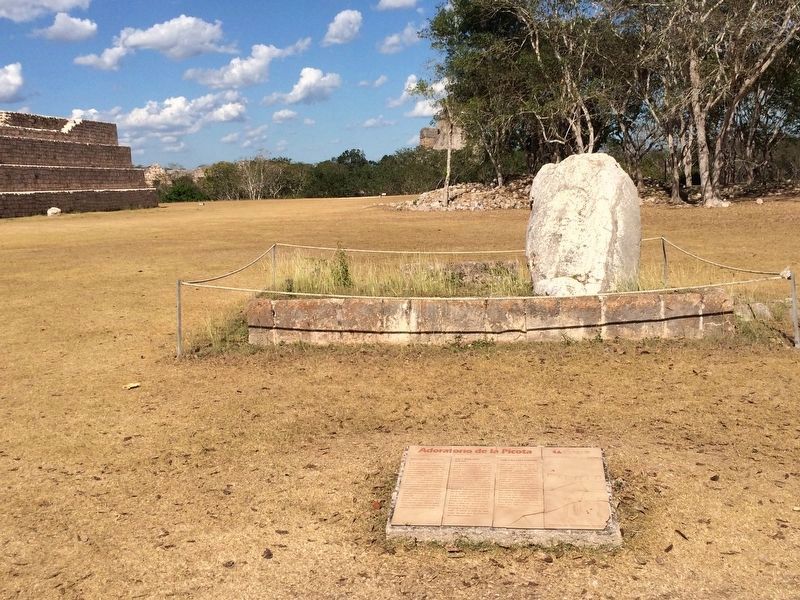
The so-called "Pillory" Shrine can be seen just past the marker.
Photographed by J. Makali Bruton, January 20, 2017
4. The Pillory Shrine Marker
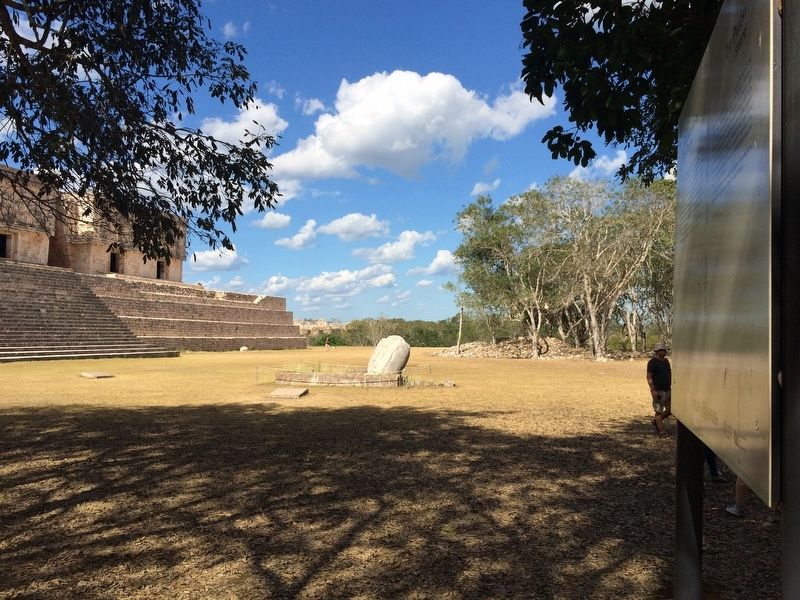
In this additional view it is possible to see the featured marker in the distance next to the Pillory Shrine, with the additional marker to the right in the foreground.
Credits. This page was last revised on April 19, 2017. It was originally submitted on April 19, 2017, by J. Makali Bruton of Washington, District of Columbia. This page has been viewed 404 times since then and 41 times this year. Photos: 1, 2, 3, 4. submitted on April 19, 2017, by J. Makali Bruton of Washington, District of Columbia.
