Chattanooga in Hamilton County, Tennessee — The American South (East South Central)
Chattanooga National Cemetery
Photographed by Brandon Stahl, April 24, 2017
1. Chattanooga National Cemetery Marker
National Cemetery
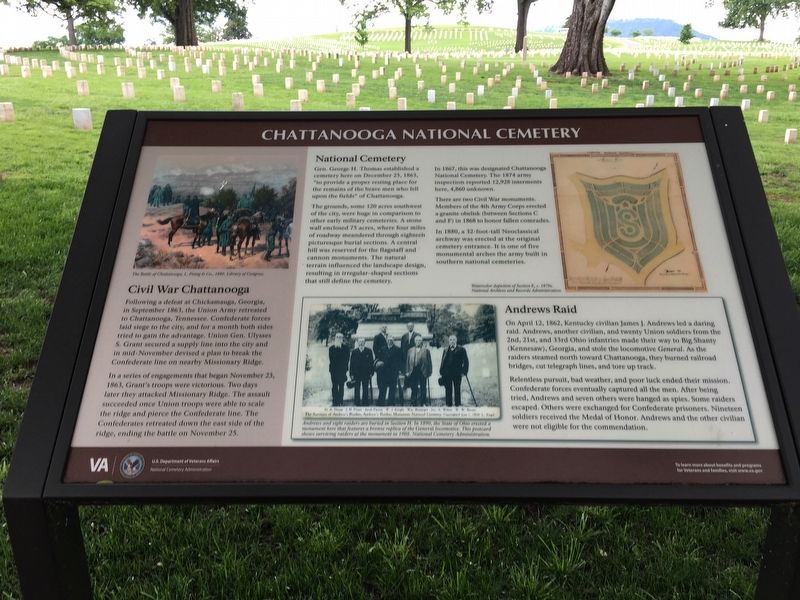
Gen. George H. Thomas established a cemetery here on December 25, 1863, "to provide a proper resting place for the remains of the brave men who fell upon the fields" of Chattanooga.
The grounds, some 120 acres southwest of the city, were huge in comparison to other early military cemeteries. A stone wall enclosed 75 acres, where four miles of roadway meandered through eighteen picturesque burial sections. A central hill was reserved for the flagstaff and cannon monuments. The natural terrain influenced the landscape design, resulting in irregular-shaped sections that still define the cemetery.
In 1867, this was designated Chattanooga National Cemetery. The 1874 army inspection reported 12,928 interments here, 4,860 unknown.
There are two Civil War monuments. Members of the 4th Army Corps erected a granite obelisk (between sections C and F) in 1868 to honor fallen comrades.
In 1880, a 32-foot-tall Neoclassical archway was erected at the original cemetery entrance. It is one of five monumental arches the army built in southern national cemeteries.
(caption) Watercolor depiction of Section
this page online
(sidebar)
Civil War Chattanooga
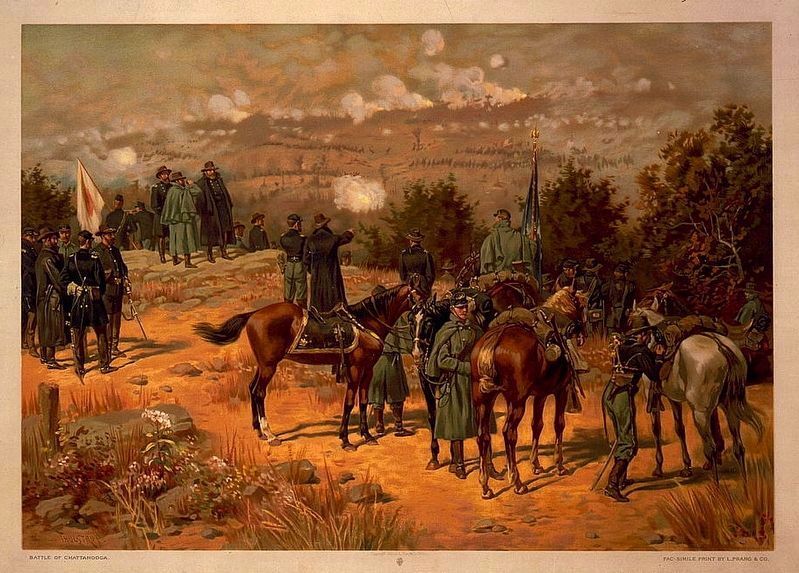
Following a defeat at Chickamauga, Georgia, in September 1863, the Union Army retreated to Chattanooga, Tennessee. Confederate forces laid siege to the city, and for a month both sides tried to gain the advantage. Union Gen. Ulysses S. Grant secured a supply line on nearby Missionary Ridge.
In a series of engagements that began November 23, 1863, Grant's troops were victorious. Two days later they attacked Missionary Ridge. The assault succeeded once Union troops were able to scale the ridge and pierce the Confederate line. The Confederates retreated down the east side of the ridge, ending the battle on November 25.
(caption) The Battle of Chattanooga, L. Prang & Co., 1880, Library of Congress.
(sidebar)
Andrews Raid
On April 12, 1862, Kentucky civilian James J. Andrews led a daring raid. Andrews, another civilian, and twenty Union Soldiers from the 2nd, 21st, and 33rd Ohio infantries made their way to Big Shanty (Kennesaw), Georgia, and stole the locomotive General. As the raiders steamed north towards Chattanooga, they burned
Photographed by L. Prang & Co., circa 1880
2. Battle of Chattanooga
Library of Congress [LC-DIG-pga-04032]
Relentless pursuit, bad weather, and poor luck ended their mission. Confederate forces eventually captured all the men. After being tried, Andrews and seven others were hanged as spies. Some raiders escaped. Others were exchanged for Confederate prisoners. Nineteen soldiers received the Medal of Honor. Andrews and the other civilian were not eligible for the commendation.
(caption) Andrews and eight raiders are buried in Section H. In 1890, the State of Ohio erected a monument here that features a bronze replica of the General locomotive. This postcard shows surviving raiders at the monument in 1908. National Cemetery Administration.
Erected by U.S. Department of Veterans Affairs.
Topics and series. This historical marker is listed in these topic lists: Cemeteries & Burial Sites • Railroads & Streetcars • War, US Civil. In addition, it is included in the National Cemeteries series list. A significant historical date for this entry is December 25, 1863.
Location. 35° 2.231′ N, 85° 17.194′ W. Marker is in Chattanooga, Tennessee, in Hamilton County. It can be reached from
Photographed by Brandon Stahl, April 24, 2017
3. Chattanooga National Cemetery Marker

Regionally, this marker is in the American South, specifically in the Upper South, in Appalachia, and specifically in Southern Appalachia. Globally, it is in North America, the Western Hemisphere, the Western World, and the Anglosphere. Historically, it finds itself in what was once the original Cherokee Nation, the territory of the Mississippian Culture, one of the Confederate States of America, and the Antebellum South.
Other nearby markers. At least 8 other markers are within walking distance of this marker: A National Cemetery System (a few steps from this marker); Veterans of Foreign Wars Memorial (approx. 0.2 miles away); All Former POWs and MIAs Memorial (approx. 0.2 miles away); Women of World War II (approx. 0.2 miles away); 84th Infantry Division (approx. 0.2 miles away); Sixth U.S. Cavalry
Photographed by Tom Bosse, November 13, 2021
4. Chattanooga National Cemetery Marker
Also see . . .
1. Chattanooga National Cemetery. (Submitted on May 9, 2017, by Brandon Stahl of Fairfax, Virginia.)
2. Desmond Doss Biography. (Submitted on May 9, 2017, by Brandon Stahl of Fairfax, Virginia.)
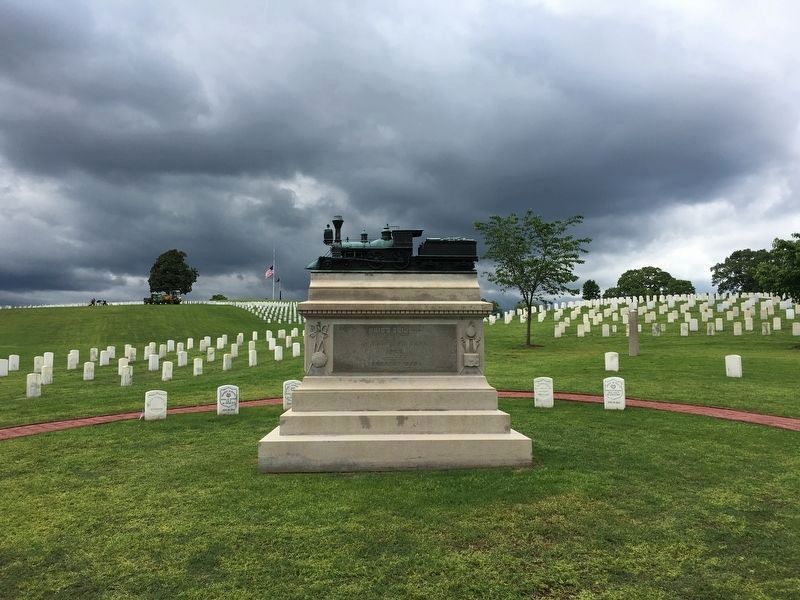
Photographed by Brandon Stahl, April 24, 2017
5. The Andrews' Raiders Monument
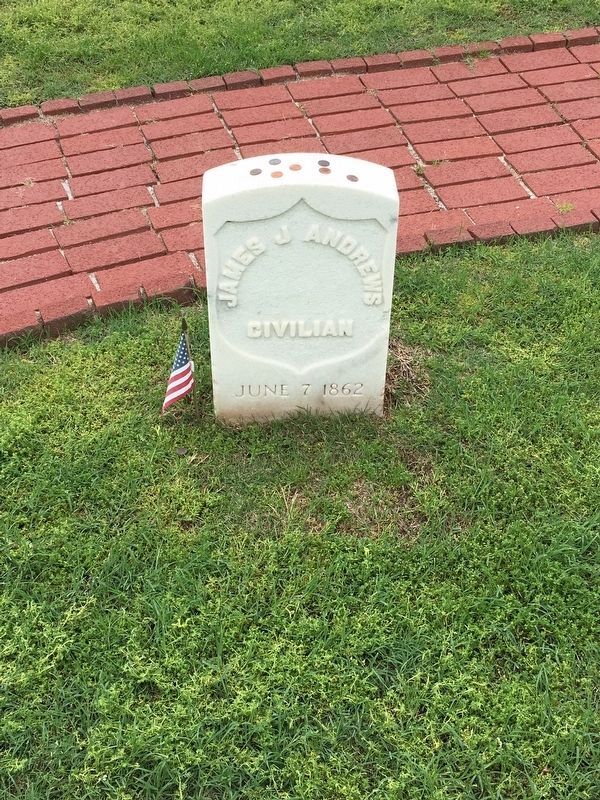
Photographed by Brandon Stahl, April 24, 2017
6. James Andrews' Grave
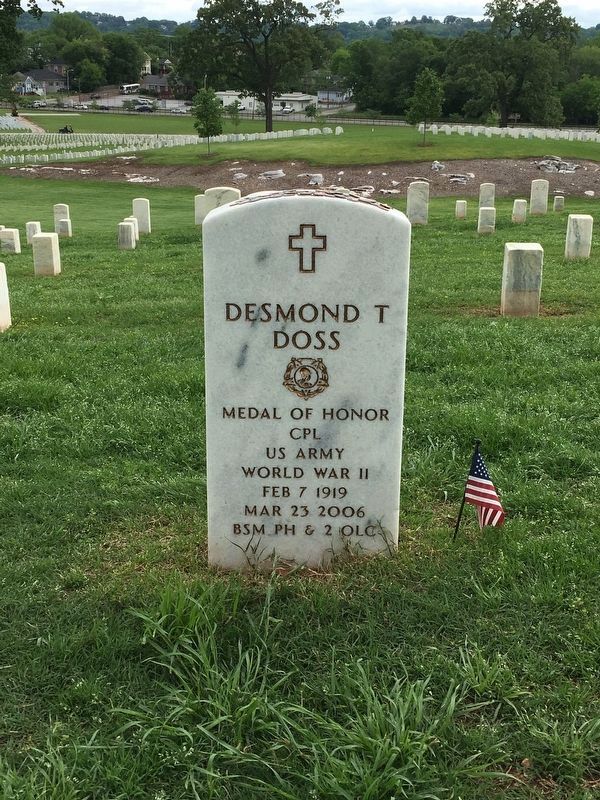
Photographed by Brandon Stahl, April 24, 2017
7. The Grave of Desmond Doss
Desmond Doss is the Medal of Honor awardee that the movie Hacksaw Ridge is based on. His grave is in Section P of the cemetery.
Credits. This page was last revised on December 26, 2021. It was originally submitted on May 9, 2017, by Brandon Stahl of Fairfax, Virginia. This page has been viewed 1,084 times since then and 59 times this year. Photos: 1. submitted on May 9, 2017, by Brandon Stahl of Fairfax, Virginia. 2. submitted on May 10, 2017. 3. submitted on May 9, 2017, by Brandon Stahl of Fairfax, Virginia. 4. submitted on December 26, 2021, by Tom Bosse of Jefferson City, Tennessee. 5, 6, 7. submitted on May 9, 2017, by Brandon Stahl of Fairfax, Virginia. • Bernard Fisher was the editor who published this page.
