Wythe in Hampton, Virginia — The American South (Mid-Atlantic)
Stalemate in Hampton Roads
In a “big glass case”
| — | 1862 Peninsula Campaign | — |
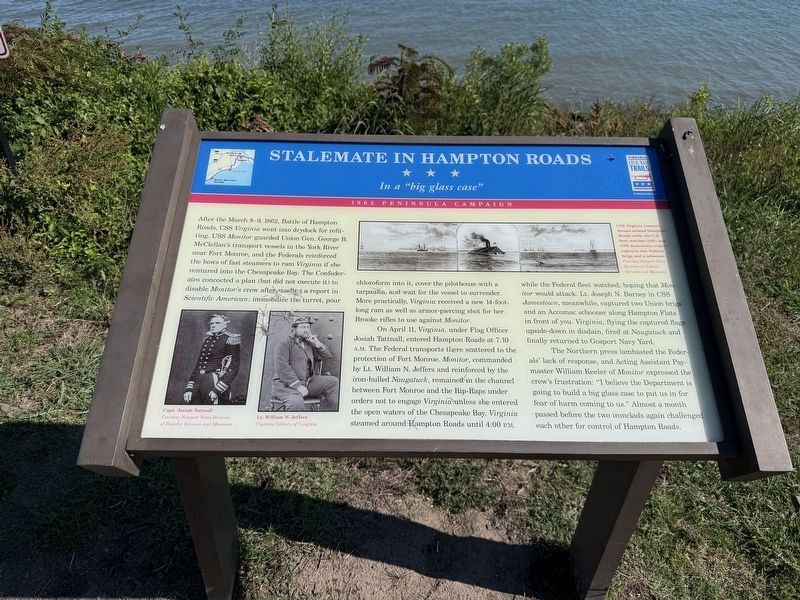
After the March 8-9, 1862, Battle of Hampton Roads, CSS Virginia went into drydock for refitting. USS Monitor guarded Union Gen. George B. McClellan’s transport vessels in the York River near Fort Monroe, and the Federals reinforced the bows of fast steamers to ram Virginia if she ventured into the Chesapeake Bay. The Confederates concocted a plan (but did not execute it) to disable Monitor’s crew after reading a report in Scientific American: immobilize the turret, pour chloroform into it, cover the pilothouse with a tarpaulin, and wait for the vessel to surrender. More practically, Virginia received a new 14-foot-long ram as well as armor-piercing shot for her Brooke rifles to use against Monitor.
On April 11, Virginia, under Flag Officer Josiah Tattnall, entered Hampton Roads at 7:10 A.M. The Federal transports there scattered to the protection of Fort Monroe. Monitor, commanded by Lt. William N. Jeffers and reinforced by the iron-hulled Naugatuck, remained in the channel between Fort Monroe and the Rip-Raps under orders not to engage Virginia unless she entered the open waters of Chesapeake Bay. Virginia steamed around
this page online
The Northern press lambasted the Federals’ lack of response, and Acting Assistant Paymaster William Keeler of Monitor expressed the crew’s frustration: “I believe the Department is going to build a big glass case to put us in for fear of harm coming to us.” Almost a month passed before the two ironclads again challenged each other for control of Hampton Roads.
Erected by Virginia Civil War Trails.
Topics and series. This historical marker is listed in these topic lists: Military • Notable Events • War, US Civil • Waterways & Vessels. In addition, it is included in the Virginia Civil War Trails series list. A significant historical date for this entry is March 8, 1862.
Location. 37° 0.149′ N, 76° 21.665′ W. Marker is in Hampton, Virginia. It is in Wythe. It is at the intersection
Photographed by Bill Coughlin, August 11, 2008
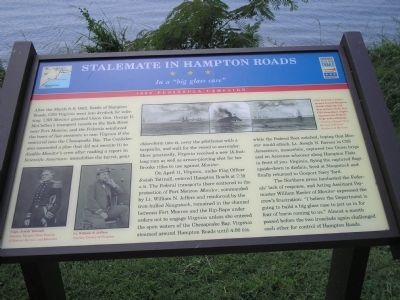
2. Stalemate in Hampton Roads Marker

Regionally, this marker is on Virginia’s Peninsula and in Coastal Virginia. It is also in the American South, specifically in the Upper South, in the Tidewater, and on the Eastern Seaboard. Globally, it is in the North Atlantic Region, North America, the Western Hemisphere, the Western World, and the Anglosphere. Historically, it finds itself in what was once the territory of the Mississippian Culture, one of the original Thirteen Colonies, one of the Confederate States of America, and the Antebellum South.
Other nearby markers. At least 8 other markers are within walking distance of this marker: Battle of Hampton Roads (a few steps from this marker); Fertile Hunting Grounds For The Indians (about 500 feet away, measured in a direct line); The Development Of Olde Wythe (approx. 0.2 miles away); First Church at Kecoughtan (approx. 0.2 miles away); Olde Wythe During Colonial Times (approx. ¼
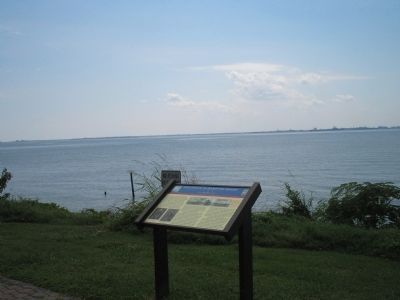
Photographed by Bill Coughlin, August 11, 2008
3. Stalemate in Hampton Roads Marker
Other markers no longer nearby. First Battle of Ironclads (was here, next to this marker but has been replaced with another marker now near it); Wythe's Birthplace (was approx. 0.4 miles away but has been replaced with another marker now near it).
More about this marker. The top of the marker contains a picture with the caption “CSS Virginia (center), steams around Hampton Roads while the U.S. fleet watches (left) and CSS Jamestown (right) captures two Federal brigs and a schooner. - Courtesy Newport News Division of Historic Services and Museums.” The lower left of the marker features photographs of CSS Virginia Commander “Capt. Josiah Tattnall, courtesy Newport News Division of Historic Services and Museums” and USS Monitor Commander “Lt. William N. Jeffers, Courtesy Library of Congress.”
Also see . . . Tidewater Virginia, The 1862 Peninsula Campaign.
Photographed by Bill Coughlin, August 11, 2008
5. Stalemate in Hampton Roads Marker
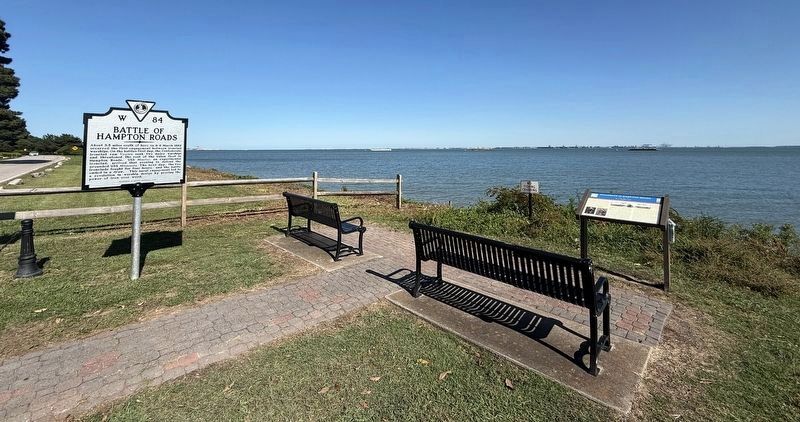
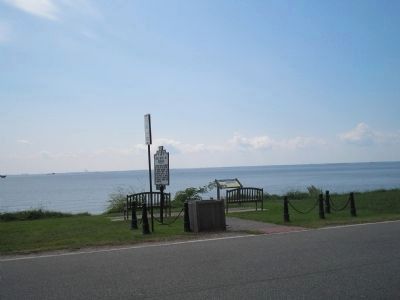
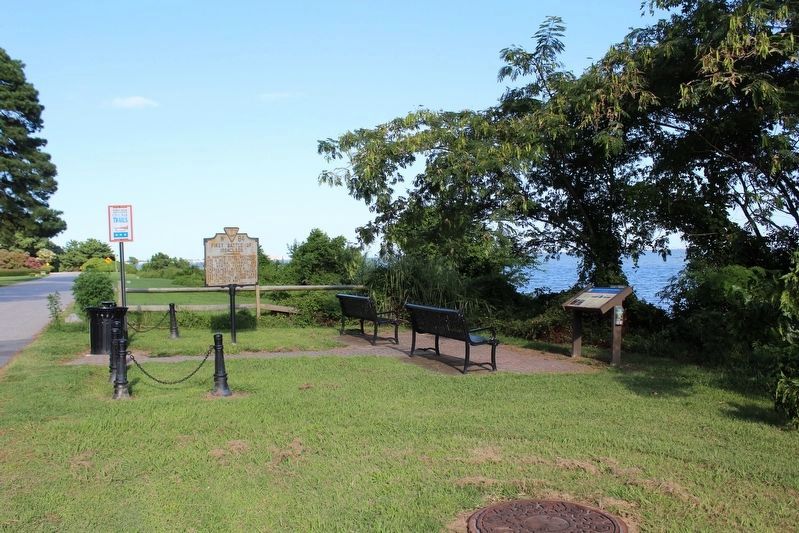
Two markers are found at this location on the Hampton Roads waterfront.
Photographed by Evan Dwyer, August 9, 2025
6. Stalemate in Hampton Roads Marker
Ironically, over time this "overlook" has become the only overgrown area along the Old Wythe neighborhood's waterfront on the Hampton Flats. A reader cannot actually view the geographic area discussed on the marker while standing at it.
Credits. This page was last revised on June 4, 2026. It was originally submitted on August 16, 2008, by Bill Coughlin of Woodland Park, New Jersey. This page has been viewed 2,110 times since then and 59 times this year. Photos: 1. submitted on June 4, 2026, by Devry Becker Jones of Washington, District of Columbia. 2, 3. submitted on August 16, 2008, by Bill Coughlin of Woodland Park, New Jersey. 4. submitted on June 4, 2026, by Devry Becker Jones of Washington, District of Columbia. 5. submitted on August 16, 2008, by Bill Coughlin of Woodland Park, New Jersey. 6. submitted on September 3, 2025, by Evan Dwyer of Richmond, Virginia.
