Colonia Tlatelolco in Ciudad de México, Mexico — The Valley of Mexico (The Central Highlands)
Tlatelolco
Photographed by J. Makali Bruton, August 7, 2017
1. Tlatelolco Marker

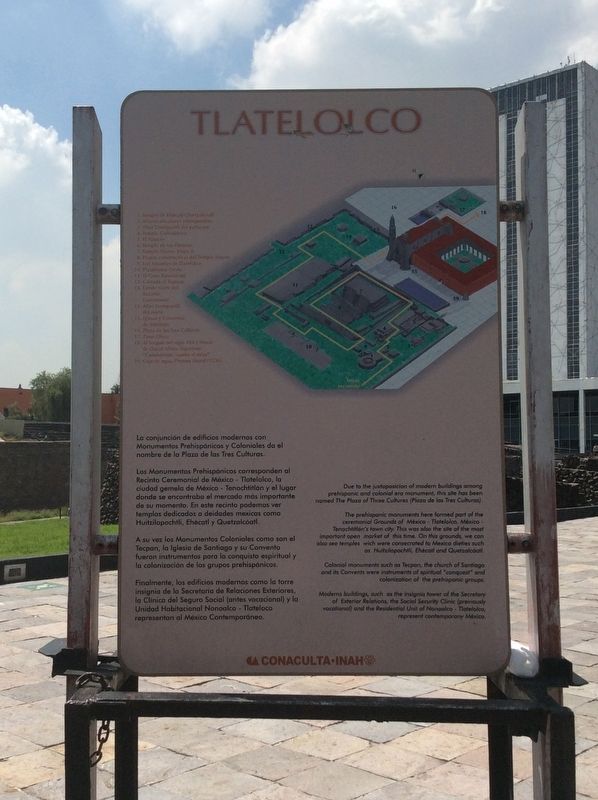
Los Monumentos Prehispánicos corresponden al Recinto Ceremonial de México - Tlatelolco, la ciudad gemela de México - Tenochtitlán y el lugar donde se encontraba el mercado más importante de su momento. En este recinto podemos ver templos dedicados a deidades mexicas como Huitzilopochtli, Ehécatl y Quetzalcóatl.
A su vez los Monumentos Coloniales como son el Tecpan, la Iglesia de Santiago y su Convento fueron instrumentos para la conquista espiritual y la colonización de los grupos prehispánicos.
Finalmente, los edificios modernos como la torre insignia de la Secretaria de Relaciones Exteriores, la Clínica del Seguro Social (antes vocacional) y la Unidad Habitacional Nonoalco – Tlateloco representan al México Contemporáneo.
Leyenda del mapa del sitio:
1. Templo de Ehécatl-Quetzalcóatl
2. Altares circulares sobrepuestos
3. Altar Tzompantli del patio sur
4. Templo Calendárico
5. El Palacio
6. Templo de las Pinturas
7. Templo Mayor. Etapa II
8. Etapas constructivas del Templo Mayor
9.
this page online
10. Plataforma Oeste
11. El Gran Basamento
12. Calzada de Tepeyac
13. Límite norte del Recinto Ceremonial
14. Altar Tzompantli del norte
15. Iglesia y Convento de Santiago
16. Plaza de las Tres Culturas
17. Zona Chica
18. Al Tecpan del siglo XVI y Mural de David Alfaro Siqueiros: “Cuauhtémoc contra el mito”
19. Caja de agua, Pintura Mural (1536)
The prehispanic monuments here formed part of the ceremonial Grounds of Mexico - Tlatelolco, México – Tenochtitlán's town city. This was also the site of the most important open market of this time. On this grounds, we can also see temples wich were consecrated to Mexico dieties such as Huitzilopochtli, Ehécatl and Quetzalcóatl.
Colonial monuments such as Tecpan, the church of Santiago and its Convents were instruments of spiritual “conquest” and colonization of the prehispanic groups.
Moderns buildings, such as the insignia tower of the Secretary of Exterior
Photographed by J. Makali Bruton, August 7, 2017
2. Tlatelolco Marker
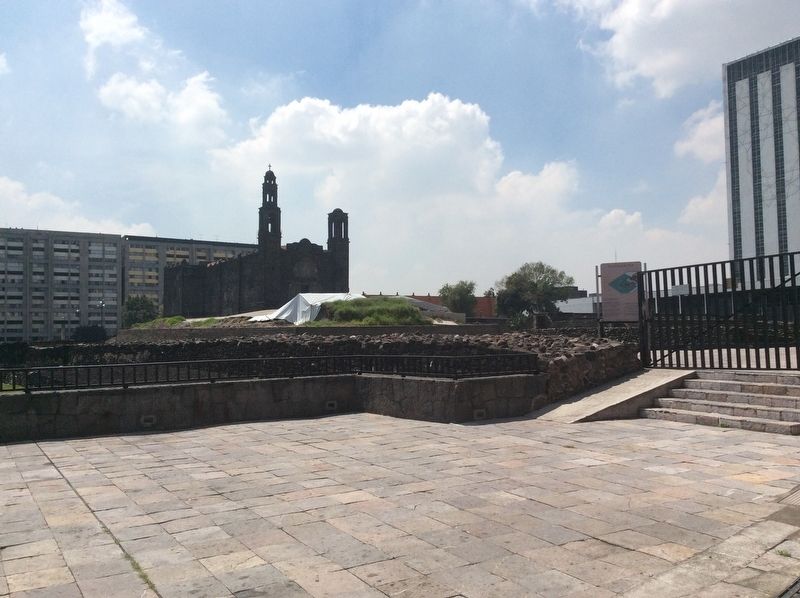
The marker can be seen here towards the right in this view to the west. The church of Santiago Apóstol can be seen in the distance. This marker is currently only visible by traveling along a residential walkway from the Plaza of the Three Cultures towards the west. In the past this may have been a secondary entry to the archaeological site, but it is now closed.
Site map legend not translated
Erected by Conaculta - INAH.
Topics. This historical marker is listed in these topic lists: Colonial Era • Indigenous Peoples and Communities • Man-Made Features.
Location. 19° 27.117′ N, 99° 8.288′ W. Marker is in Ciudad de México. It is in Colonia Tlatelolco. It is on Eje Central Lázaro Cárdenas, on the right when traveling north. The marker is near the now closed northwest entry onto the Tlatelolco archaeological site. It can be seen by accessing a residential walkway from the Plaza de las Tres Culturas towards the west. Instead of going underneath the pedestrian tunnel under Eje Central, turn to the south in order to view the marker from a distance. Touch for map. Marker is at or near this postal address: Eje Central Lázaro Cárdenas 362, Ciudad de México 06900, Mexico. Touch for directions.

Regionally, this marker is in Central Mexico and specifically in Mexico City Metropolitan Area. Globally, it is in North America, specifically in Mesoamerica, on the Ring of Fire, and in the Western Hemisphere. Historically, it finds itself in what was once New Spain, a Spanish colony, and the Aztec Empire.
Other nearby markers. At least 8 other markers are within walking distance of this marker: The Great Base: findings upon findings (within shouting distance of this marker); Templo Mayor: a temple built eight times (within shouting distance of this marker); Between the past and the modern times (within shouting distance of this marker); El Temazcal (about 90 meters away, measured in a direct line); Walls and roads: limits and communication (about 90 meters away); Stage 1 of the Templo Mayor de Mexico Tlatelolco (about 90 meters away); Favor request…and talent for the gods (about 120 meters away); Coyolxauhqui: The dismembered goddess (about 120 meters away). Touch for a list and map of all markers in Ciudad de México.
Credits. This page was last revised on April 17, 2020. It was originally submitted on August 12, 2017, by J. Makali Bruton of Washington, District of Columbia. This page has been viewed 253 times since then and 11 times this year. Photos: 1, 2. submitted on August 12, 2017, by J. Makali Bruton of Washington, District of Columbia.
