
Savannah in Hardin County, Tennessee — The American South (East South Central)
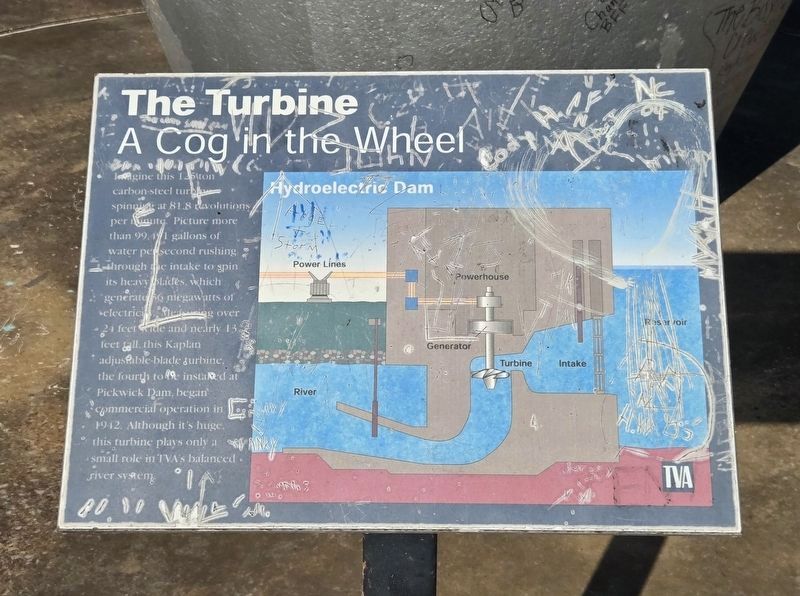
The Turbine
A Cog in the Wheel
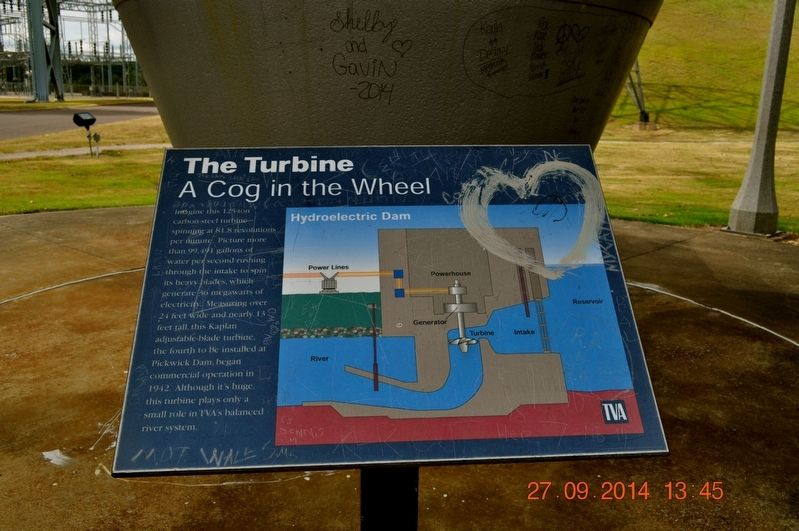
Photographed by Sandra Hughes, September 27, 2014
1. The Turbine Marker
Power Lines
River
Powerhouse
Generator
Turbine
Intake
Reservoir
Topics. This historical marker is listed in these topic lists: Environment • Man-Made Features • Waterways & Vessels. A significant historical year for this entry is 1942.
Location. 35° 4.389′ N, 88° 15.039′ W. Marker has been damaged. Marker is in Savannah, Tennessee, in Hardin County. It is on Power Lane. Marker is located at Pickwick Dam Next to the Power House. Touch for map. Marker is at or near this postal address: 350 Power Ln, Savannah TN 38372, United States of America. Touch for directions.

Regionally, this marker is in West
this page online
Other nearby markers. At least 8 other markers are within 6 miles of this location, measured as the crow flies: Pickwick Landing Dam (here, next to this marker); Welcome (about 500 feet away, measured in a direct line); The Civilian Conservation Corps and Pickwick Landing State Park (approx. 1.6 miles away); Pickwick Landing (approx. 1.7 miles away); Battle of Shiloh (approx. 5.2 miles away); 54th Ohio Infantry (approx. 5.2 miles away); Chalmers' Brigade (approx. 5.3 miles away); 55th Illinois Infantry (approx. 5.6 miles away).
Also see . . . Kaplan turbine. The Kaplan turbine was an evolution of the Francis turbine. Its invention allowed efficient power production in low-head applications that was not possible with Francis turbines. The head ranges from 10–70 metres and
Photographed by Bradley Owen, October 29, 2026
2. The Turbine Marker
Marker has been vandalized.
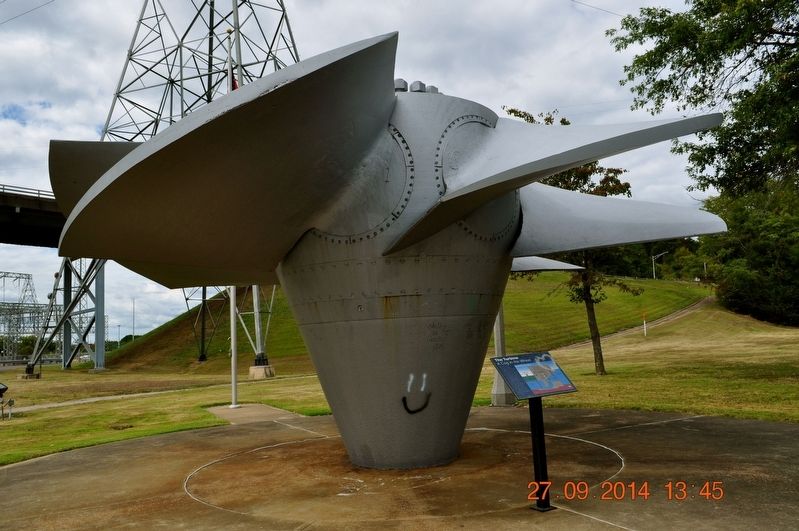
Photographed by Sandra Hughes, September 27, 2014
3. The Turbine Marker
Credits. This page was last revised on October 29, 2026. It was originally submitted on September 15, 2017, by Sandra Hughes Tidwell of Killen, Alabama, USA. This page has been viewed 414 times since then and 38 times this year. Photos: 1. submitted on September 15, 2017, by Sandra Hughes Tidwell of Killen, Alabama, USA. 2. submitted on October 29, 2026, by Bradley Owen of Morgantown, West Virginia. 3. submitted on September 15, 2017, by Sandra Hughes Tidwell of Killen, Alabama, USA. • Bill Pfingsten was the editor who published this page.
