Thunderbolt in Chatham County, Georgia — The American South (South Atlantic)
Colonials at Bonaventure
Photographed by Mike Stroud, August 2008
1. Colonials at Bonaventure Marker
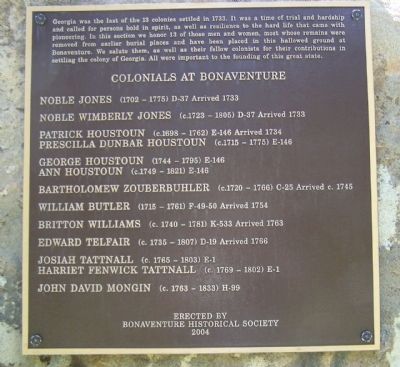
Georgia was the last of the 13 colonies settled in 1733. It was a time of trial and hardship and called for persons bold in spirit, as well as resilience to the hard life that came with pioneering. In this section we honor 13 of those men and woman, most whose remains were removed from earlier burial places and have been placed in this hallowed ground at Bonaventure. We salute them, as well as their fellow colonists for their contributions in settling the colony of Georgia. All were important to the founding of this great state.
Colonials at Bonaventure Noble Jones ( 1702 - 1775) D-37 arrived 1733
Noble Wimberly Jones (c. 1723 - 1805 ) D-37 arrived 1733
Patrick Houstoun (c. 1698 - 1762 ) E-146 arrived 1734
Prescilla Dunbar Houstoun (c.1715 - 1775) E-146
George Houstoun (1744 - 1795) E-146
Ann Houston (c.1749 - 1821) E-146
Bartholomew Zouberbuhler (c,1720 - 1766) C-25 arrived c. 1745
William Butler (1715 - 1761) F-49-50 arrived 1754
Britton Williams (c.1740 - 1781) K-533 arrived 1763
Edward Telfair (c. 1735 - 1807) D-19 arrived 1766
Josiah Tattnall (c. 1765 - 1803) E-1
Harriet Fenwick Tattnall (c.1769 - 1802) E-1
Click or scan to see
this page online
John David Mongin (c. 1763 - 1833) H-99
Erected 2004 by Bonaventure Historical Society.
Topics. This historical marker is listed in these topic lists: Cemeteries & Burial Sites • Colonial Era. A significant historical year for this entry is 1733.
Location. 32° 2.758′ N, 81° 2.699′ W. Marker is in Thunderbolt, Georgia, in Chatham County. It is on Near Noble Jones Drive. Bonaventure Cemetery, Bonaventure Lane. Touch for map. Marker is in this post office area: Savannah GA 31404, United States of America. Touch for directions.

Regionally, this marker is on Georgia’s Coastal Plain, on the Georgia Coast and the Golden Isles, and in Greater Savannah. It is also in the American South, specifically in the Deep South, and on the Eastern Seaboard. Globally, it is in the North Atlantic Region, North America, the Western Hemisphere, the Western World, and the Anglosphere. Historically, it finds itself in what was once New Spain, the territory of the Mississippian Culture, one of the original Thirteen Colonies, one of the Confederate States of America, and the Antebellum South.
Other nearby markers. At
Photographed by Mike Stroud, 2008
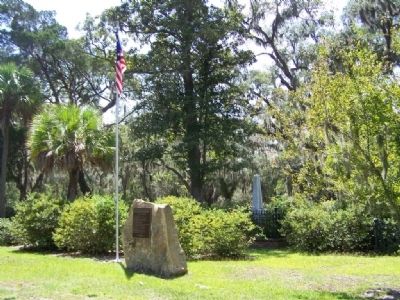
2. Colonials at Bonaventure Marker
More about this marker. Bonaventure Cemetery, in Savannah, Georgia, is located on the site of a plantation originally owned by John Mullryne, whose daughter Mary married Josias Tatnall, Sr. The wife of Tatnall's son, Harriet Fenwick Tattnall, was buried on the plantation in 1802. The plantation was converted to a cemetery in 1868, and was originally called Evergreen Cemetery; its name was changed to Bonaventure Cemetery in 1907.
The cemetery became famous when it was featured in the book Midnight in the Garden of Good and Evil by John Berendt,
Photographed by Mike Stroud, 2008
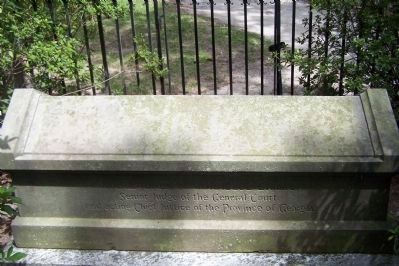
3. Colonials at Bonaventure - Cenotaph for Noble Jones (1702-1775)
He was an English-born carpenter, and was one of the first settlers of the Province of Georgia, one of its leading officials, Speaker of the Georgia House of Representatives, and prominent leader of the Georgia patriots during the American Revolution.
He, and his son Noble Wimberly, are buried nearby in a family vault behind George Jones (1766-1838).
Photographed by Mike Stroud, August 1, 2008
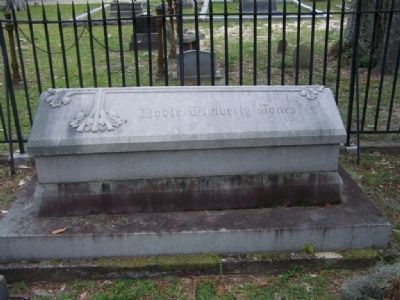
4. Colonials at Bonaventure - Noble Wimberly Jones (1852-1882)
Photographed by Mike Stroud, August 1, 2008
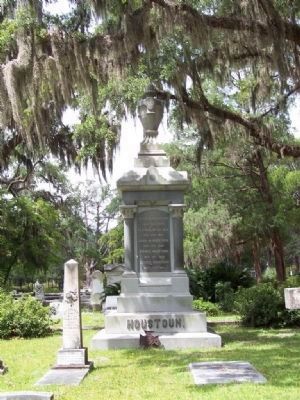
5. Colonials at Bonaventure - Houstouns
Born as the grandson of Scottish knight and baronet Sir Patrick Houstoun, Patrick Houstoun left Scotland in 1734 and settled near what is now Richmond Hill, Georgia, land that would later belong to Henry Ford. When Patrick’s cousin Sir John Houstoun died without male heirs, the title of baronet passed to Patrick. Houstoun then entered the political area, serving all three royal governors. He was soon appointed as a member of the Royal Council of Georgia, and Houstoun found himself the ranking member within mere months. Houstoun spent his time advising the governor on matters ranging from Indian affairs to matters of public safety.
Ann Priscilla Houstoun, married George McIntosh, fourth son of John Mohr McIntosh, the Highland Chieftain who went to Georgia from Inverness with 130 Highlanders. From this marriage descended branches of the families of Clinch, Sadler, Loud, Shanklin, Elliotts of South Carolina, Heyward and others.
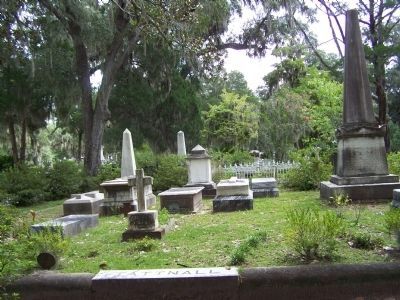
Photographed by Mike Stroud, 2008
6. Colonials at Bonaventure - Tattnall
Josiah Tattnall, Sr. (1762–June 6, 1803) was an American planter, soldier and politician from Savannah, Georgia. He represented Georgia in the U.S. Senate from 1796 to 1799 and was governor in 1801 and 1802.
Photographed by Mike Stroud, August 31, 2008
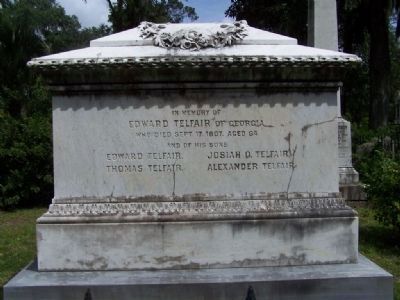
7. Colonials at Bonaventure - Telfairs
Telfair was a member of the Continental Congress for 1778, 1780, 1781, and 1782. He was one of the signers of the Articles of Confederation and a delegate to the State ratification convention. In 1783, he was commissioner to treat with the Cherokee Indians. Telfair was also designated agent on the part of Georgia to settle the northern boundary of the Commonwealth in February 1783, and eventually Governor of Georgia.
Photographed by Mike Stroud, August 31, 2008
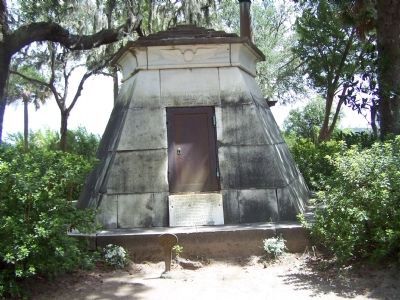
8. Colonials at Bonaventure - Mongins
Mr. Mongin was a planter of Sea Island cotton whose father-in-law lived at Bloody Point on Daufuskie Island. The Mongins inherited the Daufuskie property
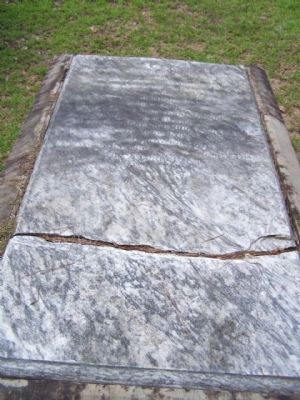
Photographed by Mike Stroud, 2008
9. Colonials at Bonaventure - William Butler
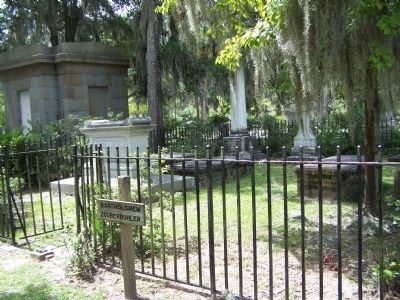
Photographed by Mike Stroud, 2008
10. Colonials at Bonaventure - Bartholomew Zouberbuhler
He was an ordained minister of Christ Church in 1745 and remained at that post for twenty-one years. He secured a teacher for Black slaves in 1751. (Far left side, lower grave).
Credits. This page was last revised on May 31, 2026. It was originally submitted on September 1, 2008, by Mike Stroud of Bluffton, South Carolina. This page has been viewed 2,685 times since then and 100 times this year. Photos: 1, 2. submitted on September 1, 2008, by Mike Stroud of Bluffton, South Carolina. 3. submitted on September 1, 2008. 4, 5, 6, 7, 8, 9, 10. submitted on September 1, 2008, by Mike Stroud of Bluffton, South Carolina. • Craig Swain was the editor who published this page.
