Southwest Waterfront in Southwest Washington in Washington, District of Columbia — The American Northeast (Mid-Atlantic)
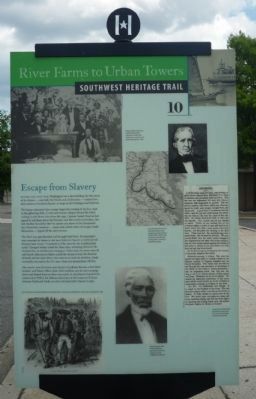
Escape from Slavery
River Farms to Urban Towers
| — | Southwest Heritage Trail | — |
Photographed by Richard E. Miller, June 27, 2009
1. Escape from Slavery Marker
Before the Civil War, Washington was a slave-holding city. But many of its citizens–especially free blacks and abolitionists–assisted freedom seekers at locations known as stops on the Underground Railroad.
The largest attempted slave escape began the evening of April 15, 1848. In the gathering dark, 77 men and women slipped aboard the Pearl, waiting ½ mile down river from this sign. Captain Daniel Drayton had agreed to sail them down the Potomac and then north to freedom. But bad weather forced the Pearl to anchor just short of the Chesapeake Bay. Meanwhile someone – many said the jilted suitor of Escapee Emily Edmonston – tipped off the slave owners.
The Pearl was apprehended and brought back here. Its passengers were marched in chains to jail near Judiciary Square as mobs jeered. Drayton later wrote, “it seems as if the time for the lynching had come.” Enraged whites rioted for three days, attacking offices of the National Era , an abolitionist newspaper. Unharmed, the slaves were all sold South. Edmonson’s father raised the money to buy the freedom of Emily and her sister Mary, who went on to work for abolition. Emily eventually returned to the DC area, where her descendants still live.
Also nearby were the home and church of Anthony Bowen, a free black minister and Patent Office clerk. Oral tradition says he met escaping slaves and helped them on their way north. In 1853 Bowen founded the nation’s first YMCA for African Americans in his home on E Street between Ninth and Tenth, as well as St. Paul AME Church in 1856.
Erected by Cultural Tourism DC. (Marker Number 10.)
Topics and series. This historical marker is listed in these topic lists: Abolition & Underground RR • African Americans • Notable Events • Waterways & Vessels.
this page online
Location. Marker has been reported missing. It was located near 38° 52.7′ N, 77° 1.399′ W. Marker was in Southwest Washington in Washington, District of Columbia. It was in Southwest Waterfront. It was at the intersection of 7th Street Southwest and Maine Avenue Southwest, in the median on 7th Street Southwest. Marker is south of Maine Avenue Southwest, at the west end of the median in the 7th Street Southwest crosswalk. Touch for map. Marker was at or near this postal address: 965 7th Street Southwest, Washington DC 20024, United States of America. Touch for directions.

Regionally, this marker was in the Washington Metropolitan Area. It was also in the American Northeast, in the Upper South, in the Mid-Atlantic, in the Tidewater, and in the Chesapeake Bay Region. Globally, it was in North America, the Western Hemisphere, the Western World, and the Anglosphere.
Other nearby markers. At least 8 other markers are within walking distance of this location:
Photographed by J. Makali Bruton, February 18, 2020
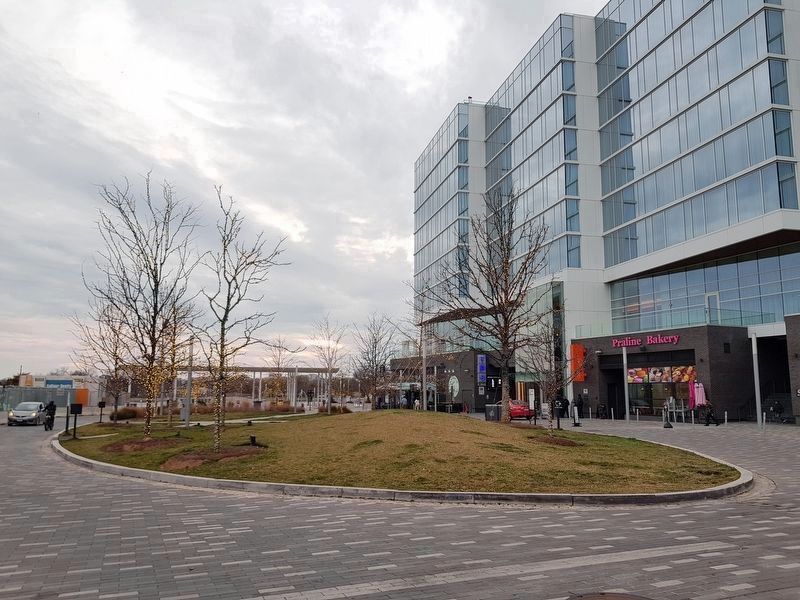
2. Previous location of the Escape from Slavery Marker
This view is looking towards the southwest from the corner of Maine Avenue SW and 7th Street SW. The marker would have previously been in the area in front of the glass building seen to the right. There has been extensive reconstruction in the area since the original photos of the marker were taken.
More about this marker.
Captions:
Photo, upper left: Emily and Mary Edmonson, wearing plaid shawls, appeared at a New York abolitionist convention with Frederick Douglass in 1850. (Madison County {New York} Historical Society)
Photo, lower left: Until 1850, slaves were openly traded here, and sights like this were common. Washington’s slaves were emancipated in 1862. “A Slave-Coffle passing the Capitol.” (Library of Congress.)
Map and portrait, near center of marker: This map shows how far the Pearl sailed before it was stopped near Point Lookout. Captain Daniel Drayton, top, served four years for slave stealing before
Photographed by Richard E. Miller, June 27, 2009
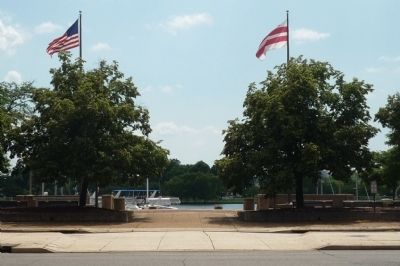
3. View from Escape from Slavery Marker toward Potomac River marina
Portrait, lower center: Anthony Bowen, AME minister, politician, government clerk, and conductor on the Underground Railroad. (Kautz Family Archives, YMCA of the USA.)
Newspaper clipping, center right: A writer for the National Era describes the angry mob that surrounded his office on Seventh Street, NW:
All we have to say is, we stand by the freedom of the press, whatever the result.
Wednesday morning, 8 o’clock. The mob dispersed last night about 12 o’clock–thanks to the efficient conduct of Captain Goddard and the rest of the police. The rumor that the office of the National Era was concerned in the escape of the slaves in the Pearl, is utterly groundless–this its originators know, but they are willing to use it to inflame popular feeling against our Press. Whatever we do, we do openly. We cherish an instinctive abhorrence of any movement which would involve us in the necessity of concealment, strategy, or trickery of any kind.
No! No! We understand this outrage. It is aimed at the Freedom of the Press. We own and edit a paper which is as free as the winds of heaven. It bows neither to slavery nor to the mob. We stand upon our rights as a man, and as an American citizen, and will use these rights, in speaking and writing freely upon any subject we please, despite all threats or violence.
Credits. This page was last revised on January 30, 2023. It was originally submitted on June 28, 2009, by Richard E. Miller of Oxon Hill, Maryland. This page has been viewed 2,358 times since then and 119 times this year. Last updated on January 9, 2018, by Devry Becker Jones of Washington, District of Columbia. Photos: 1. submitted on June 28, 2009, by Richard E. Miller of Oxon Hill, Maryland. 2. submitted on February 21, 2020, by J. Makali Bruton of Washington, District of Columbia. 3. submitted on June 28, 2009, by Richard E. Miller of Oxon Hill, Maryland. • Bill Pfingsten was the editor who published this page.
