Memphis in Shelby County, Tennessee — The American South (East South Central)
Plaquemine, Louisiana/Manchac Bend
Mississippi River Walk
Photographed by Jason Voigt, August 2, 2024
1. Plaquemine, Louisiana/Manchac Bend Marker
Marker was replaced with a newer one put up by Mud Island Park
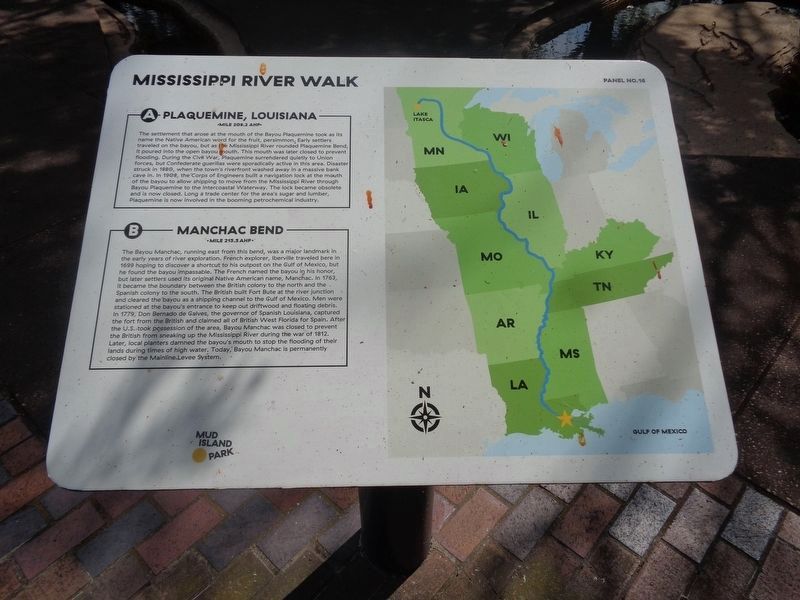
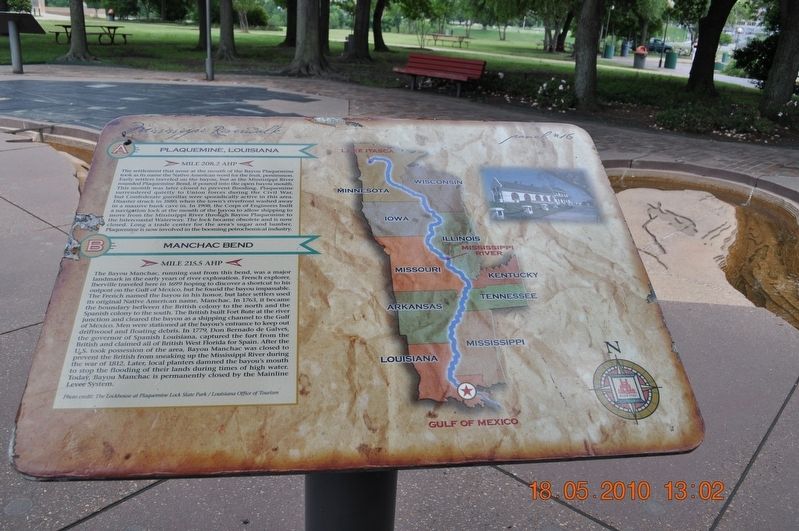
A) Plaquemine, Louisiana
Mile 208.2 AHP
The settlement that arose at the mouth of the Bayou Plaquemine took as its name the Native American word for the fruit, persimmon. Early settlers traveled on the bayou, but as the Mississippi River rounded Plaquemine Bend, it poured into the open bayou mouth. This mouth was later closed to prevent flooding. Plaquemine surrender quietly to Union forces during the Civil War, but Confederate gorillas were sporadically active in this area. Disaster struck in 1880 when the town’s riverfront washed away in a massive bank cave in. In 1908, the Corps of Engineers built a navigation lock at the mouth of the bayou to allow shipping to move from the Mississippi River through Bayou Plaquemine to the Intercoastal Waterway. The lock became obsolete and is now closed. Long a trade center for the area’s sugar and lumber, Plaquemine is now involved in the booming petrochemical industry.
B) Manchac Bend
Mile 215.5 AHP
The Bayou Manchac, running east from this bend was a major landmark in the early years of river exploration. French explorer, Iberville traveled here in 1699 hoping to discover
this page online
Photo Credit: The Lockhouse at Plaquemine Lock State Park/Louisiana Office of Tourism
Erected by Mississippi Riverwalk. (Marker Number 16.)
Topics.
Photographed by Sandra Hughes, May 18, 2010
2. White Hall Plantation/Union, Louisiana/Point Houmas Marker
Location. 35° 8.793′ N, 90° 3.571′ W. Marker is in Memphis, Tennessee, in Shelby County. It can be reached from Island Drive 0.8 miles south of West A.W. Willis Avenue. Located in Mud Island Park. Touch for map. Marker is at or near this postal address: 25 Island Dr, Memphis TN 38103, United States of America. Touch for directions.

Regionally, this marker is in West Tennessee. It is also in the American South, specifically in the Deep South, in the Upper South, in the Mississippi Delta, and in the Great River Road Region. Globally, it is in North America, the Western Hemisphere, the Western World, and the Anglosphere. Historically, it finds itself in what was once the territory of the Mississippian Culture, one of the Confederate States of America, and the Antebellum South.
Other nearby markers. At least 8 other markers are within walking distance of this marker: Claiborne Landing / Carville, Louisiana / Belle Grove

Photographed by Jason Voigt, August 2, 2024
3. Plaquemine, Louisiana/Manchac Bend Marker
Also see . . .
1. Plaquemines Parish, Louisiana. The name "Plaquemines," in French Creole, was derived from the Atakapa word, piakimin, meaning the local fruit persimmon. The French used it to name a military post they built on the banks of the Mississippi River, as the site was surrounded by numerous persimmon trees. Eventually the name was applied to the entire parish and to a nearby bayou. (Submitted on March 14, 2018, by Sandra Hughes Tidwell of Killen, Alabama, USA.)
2. Manchac, Louisiana. Fort Bute or Manchac Post, named after the then British Prime Minister John Stuart, 3rd Earl of Bute, was established in 1763 at the junction of Iberville River (Bayou Manchac) with the Mississippi River, and remained an important military and trading post in British West Florida until captured by Spanish forces under Bernardo Galvez of Louisiana (New Spain) on September 7, 1779, during what became known as Battle of Fort Bute of the American Revolutionary War. Manchac was raided in February 1778 by American forces under the command of James Willing[1]—see related articles, Continental Marines and USS Morris. Fort Bute/Manchac Post/Mississippi River at Bayou Manchac is 45 miles from Manchac. (Submitted on March 14, 2018, by Sandra Hughes Tidwell of Killen, Alabama, USA.)
3. Why Maps?. Fort Plaquemine, Plaquemine, La. is in slide 24 with many old Plaquemine pictures and levee failures. The is the only, known by me, drawing of Fort Plaquemine. (Submitted on April 4, 2018, by Kenneth Ramagost of Louisiana, USA.)
Credits. This page was last revised on August 15, 2024. It was originally submitted on March 14, 2018, by Sandra Hughes Tidwell of Killen, Alabama, USA. This page has been viewed 1,006 times since then and 112 times this year. Photos: 1. submitted on August 15, 2024, by Jason Voigt of Glen Carbon, Illinois. 2. submitted on March 14, 2018, by Sandra Hughes Tidwell of Killen, Alabama, USA. 3. submitted on August 15, 2024, by Jason Voigt of Glen Carbon, Illinois. • Bernard Fisher was the editor who published this page.
