Lottie in Baldwin County, Alabama — The American South (East South Central)
History of Lottie, Alabama
Photographed by Mark Hilton, August 22, 2018
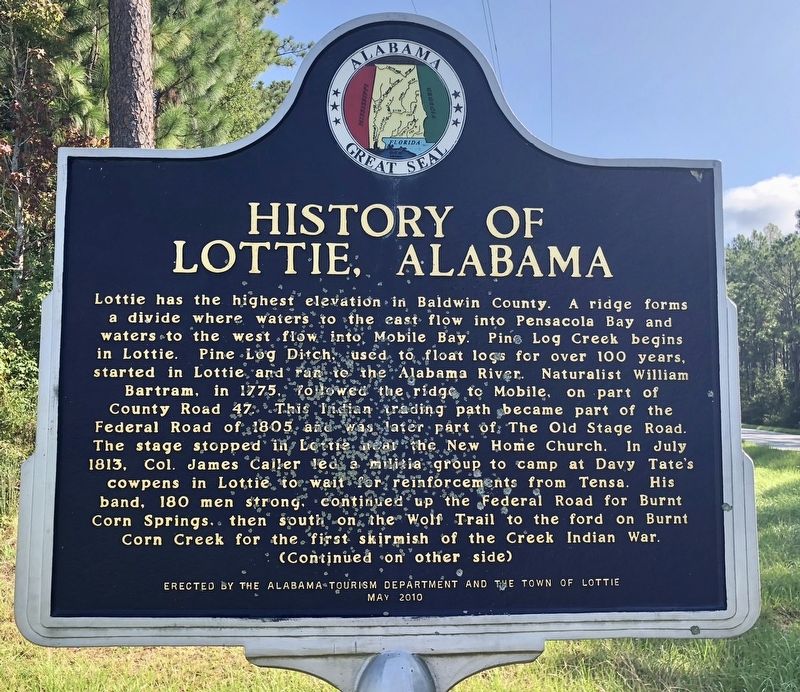
1. History of Lottie, Alabama Marker
Front
Lottie has the highest elevation in Baldwin County. A ridge forms a divide where waters to the east flow into Pensacola Bay and waters to the west flow into Mobile Bay. Pine Log Creek begins in Lottie. Pine Log Ditch, used to float logs for over 100 years, started in Lottie and ran to The Alabama River. Naturalist William Bartram, in 1775, followed the ridge path to Mobile, on part of County Road 47. This Indian trading path became part of the Federal Road of 1805 and was later part of the The Old Stage Road. The stage stopped in Lottie near The New Home Church. In July, 1813, Col. James Caller led a militia group to camp at Davy Tate's cowpens in Lottie to wait for reinforcements from Tensa. His band, 180 men strong, continued up the Federal Road for Burnt Corn Springs, then south on the Wolf Trail to the ford on Burnt Corn Creek for the first skirmish of the Creek Indian War.
Reverse
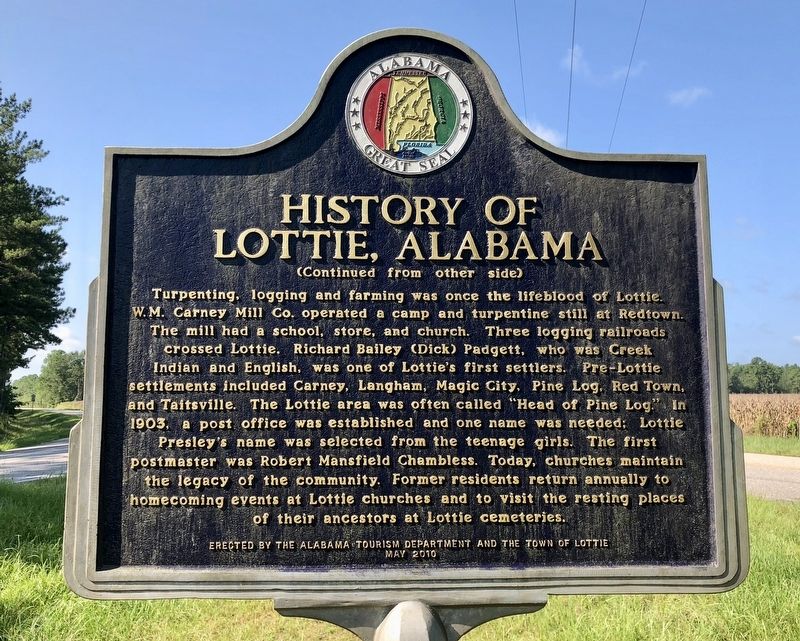
Turpenting, logging and farming was once the lifeblood of Lottie. W.M. Carney Mill Co. operated a camp and turpentine still at Redtown. The mill had a school, store,
this page online
Erected 2010 by Alabama Tourism Development and the Town of Lottie.
Topics. This historical marker is listed in these topic lists: Roads & Vehicles • Settlements & Settlers • Wars, US Indian • Waterways & Vessels. A significant historical month for this entry is July 1813.
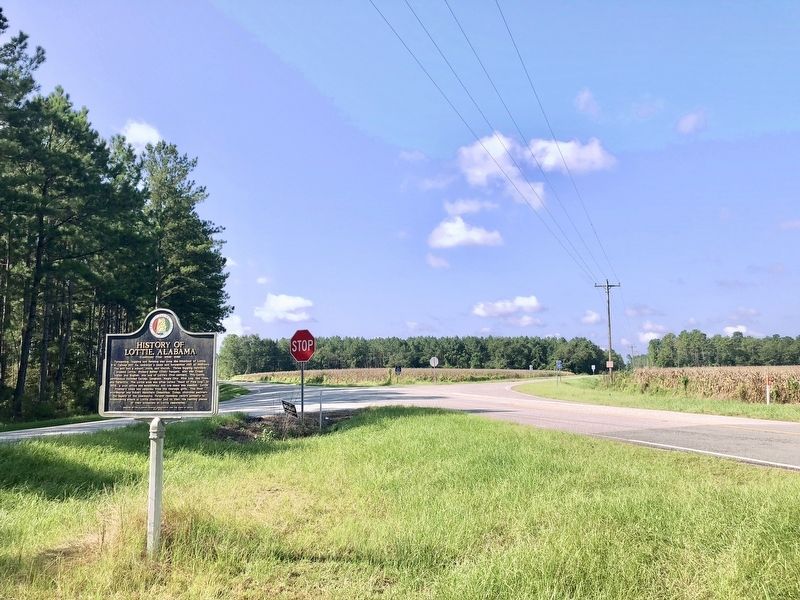
Location. 31° 7.102′ N, 87° 37.938′ W. Marker is in Lottie, Alabama, in Baldwin County. It is at the intersection of Jack Springs Road and Lottie Road (County Road 61), on the right
Photographed by Mark Hilton, August 22, 2018
2. History of Lottie, Alabama Marker (reverse)

Regionally, this marker is on the Gulf Coast and in the Mobile Bay area. It is also in the American South, specifically in the Deep South, and on the Gulf Coast. Globally, it is in North America, a Gulf of Mexico state, the Western Hemisphere, the Western World, and the Anglosphere. Historically, it finds itself in what was once New Spain, the Viceroyalty of New France, the territory of the Mississippian Culture, one of the Confederate States of America, and the Antebellum South.
Other nearby markers. At least 8 other markers are within 13 miles of this marker, measured as the crow flies: Perdido Vineyards (approx. 6.9 miles away); Tensaw / Early History of Tensaw (approx. 9.9 miles away); Railroad Bill (approx. 10½ miles away); Williams Station, Alabama 1866-1897 / Atmore, Alabama (approx. 10.6 miles away); Watson Cabin (approx. 10.7 miles away); The Old Federal Road / The Black Crossing (approx. 10.8 miles away); Escambia County Training School
Photographed by Mark Hilton, August 22, 2018
3. View of marker at intersection of Jack Springs and Lottie Roads.
Regarding History of Lottie, Alabama. Lottie is 310 feet [94 m] above sea level.
Photographed by Mark Hilton, August 22, 2018
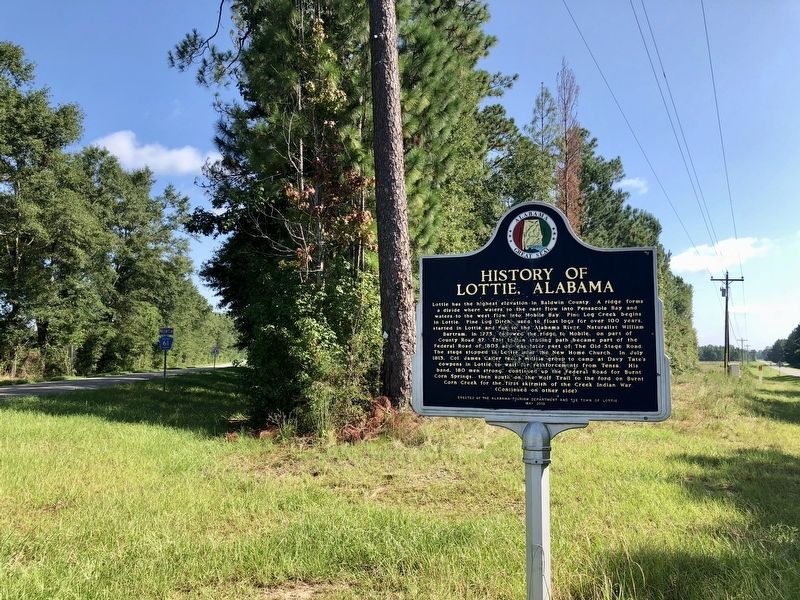
4. View looking north on Lottie Road.
Credits. This page was last revised on August 24, 2018. It was originally submitted on August 24, 2018, by Mark Hilton of Montgomery, Alabama. This page has been viewed 4,562 times since then and 342 times this year. Photos: 1, 2, 3, 4. submitted on August 24, 2018, by Mark Hilton of Montgomery, Alabama.
