
Dade City in Pasco County, Florida — The American South (South Atlantic)
As Good as Gold
Florida De Soto Trail
| — | July 19, 1539 | — |
Photographed by Cosmos Mariner, November 1, 2018
1. Good as Gold Marker
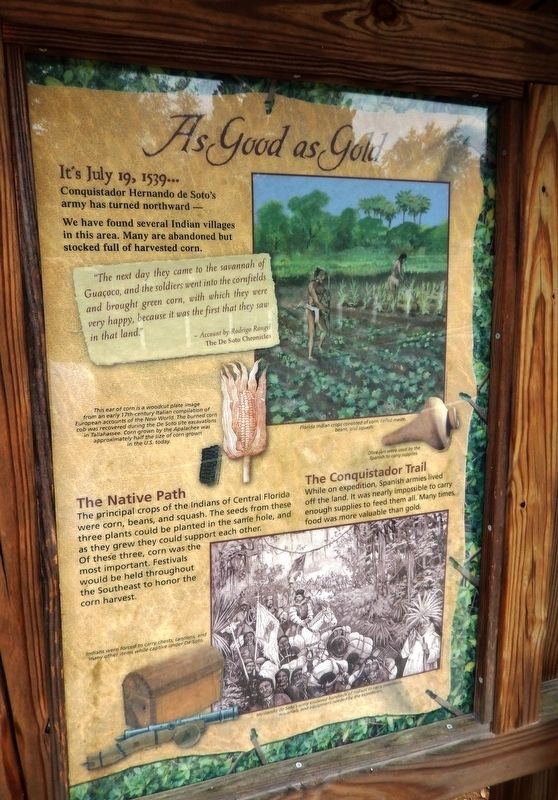
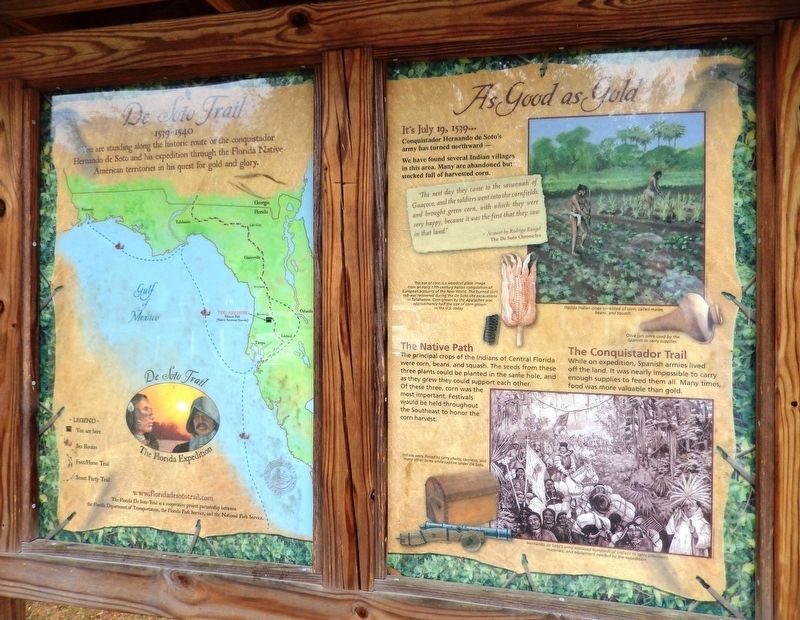
Conquistador Hernando de Soto’s army has turned northward –
We have found several Indian villages in this area. Many are abandoned but stocked full of harvested corn.
”The next day they came to the savannah of Guacoco, and the soldiers went into the cornfields and brought green corn, with which they were very happy, because it was the first that they saw in that land.”
- Account by Rodrigo Rangel
The De Soto Chronicles
The Native Path
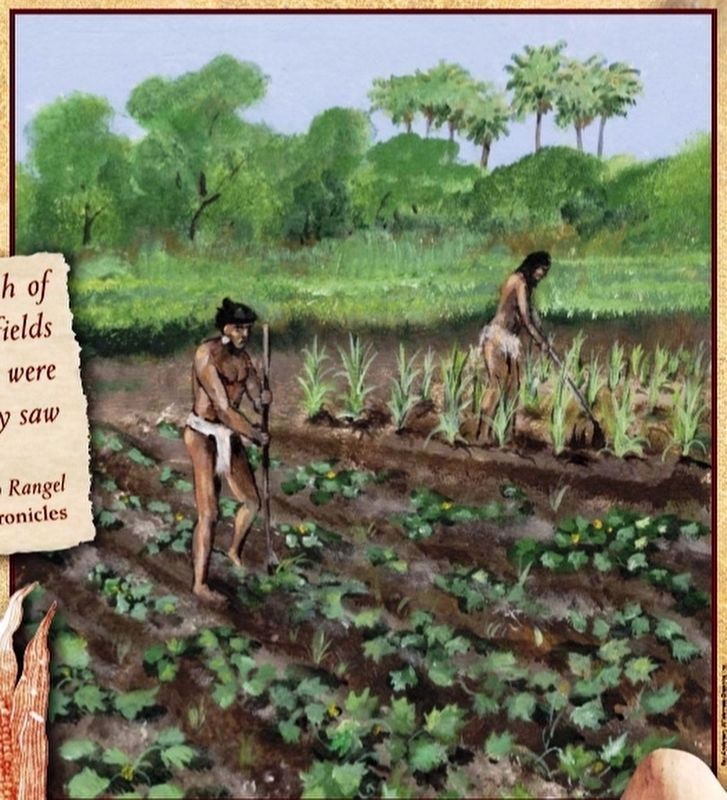
The principal crops of the Indians of Central Florida were corn, beans, and squash The seeds from these three plants could be planted in the same hole, and as they grew they would support each other. Of these three, corn was the most important. Festivals would be held throughout the Southeast to honor the corn harvest.
The Conquistador Trail
While on expedition, Spanish armies lived off the land. It was nearly impossible to carry enough supplies to feed them all. Many times, food was more valuable than gold.
Erected by Florida De Soto Trail, Florida Department of Transportation, the Florida Park Service, and the National Park Service.
this page online
Topics. This historical marker is listed in these topic lists: Agriculture • Colonial Era • Exploration • Indigenous Peoples and Communities. A significant historical date for this entry is July 19, 1539.
Location. 28° 21.359′ N, 82° 11.277′ W. Marker is in Dade City, Florida, in Pasco County. It is at the intersection of Bougainvillea Avenue and 7th Street (U.S. 98), on the left when traveling west on Bougainvillea Avenue. Marker is located beside the sidewalk at the northwest corner of Dade City's Hibiscus Park. Touch for map. Marker is in this post office area: Dade City FL 33525, United States of America. Touch for directions.

Regionally, this marker is on Florida’s Gulf Coast and on Tampa Bay. It is also in the American South and on the Gulf Coast. Globally, it is in the North Atlantic Region, North America, a Gulf of Mexico state, the Western Hemisphere, the Western World, and the Anglosphere. Historically, it finds itself in what was once New Spain, the territory of the Mississippian Culture, one of the Confederate States of America, and the Antebellum South.
Other nearby markers. At
Photographed by Ray Andersen, Wilderness Graphics, Inc.
2. Marker detail: Florida Indian crops consisted of corn, called maize, beans and squash
Corn grown by the Apalachee was approximately half the size of corn grown in the U.S. today.
More about this marker. Marker is a large, composite plaque mounted vertically within a heavy-duty wooden kiosk
Related markers. Click here for a list of markers that are related to this marker. Florida De Soto Trail
Also see . . . De Soto’s Expedition to North America. In 1536, de Soto obtained a royal commission to conquer and settle the region
Photographed by Florida Center for Instructional Technology, USF
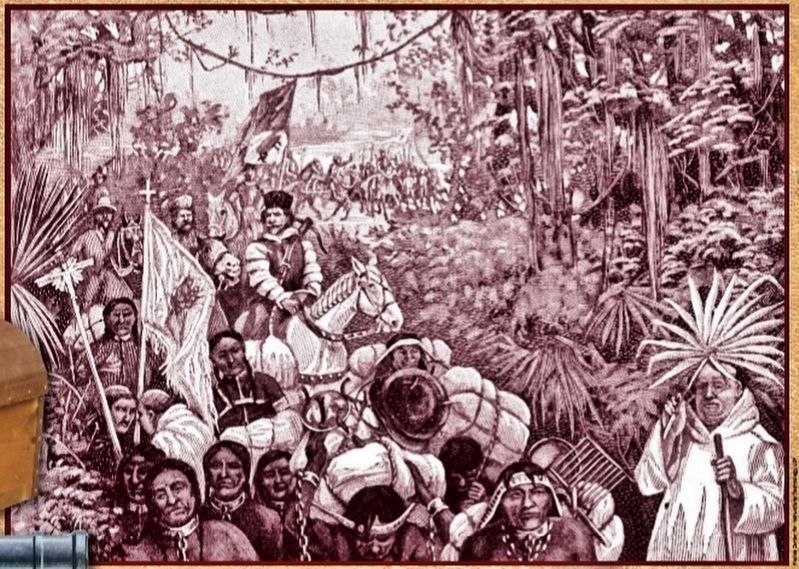
3. Marker detail: Slave labor
Hernando de Soto’s army enslaved hundreds of Indians to carry provisions, materials, and equipment needed by the expedition. Indians were forced to carry chests, cannons, and many other items while captive under De Soto.
Photographed by Cosmos Mariner, November 1, 2018
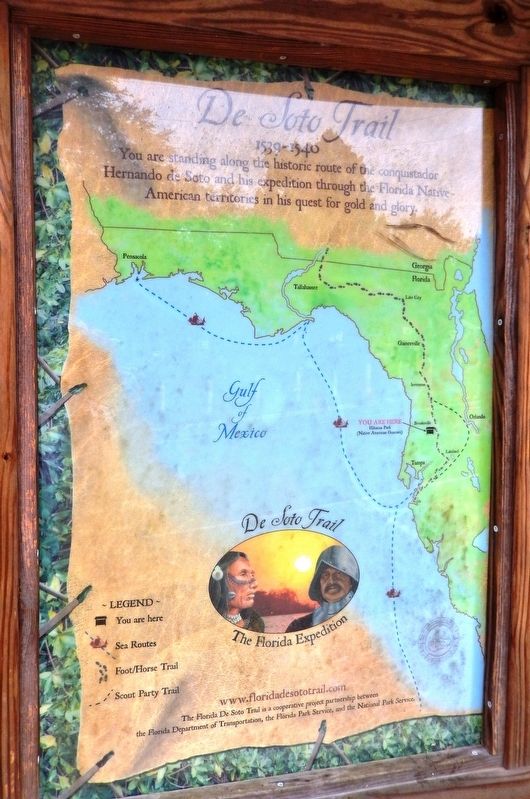
4. De Soto Trail Map (panel to the left of marker in kiosk)
1539-1540
Photographed by Cosmos Mariner, November 1, 2018
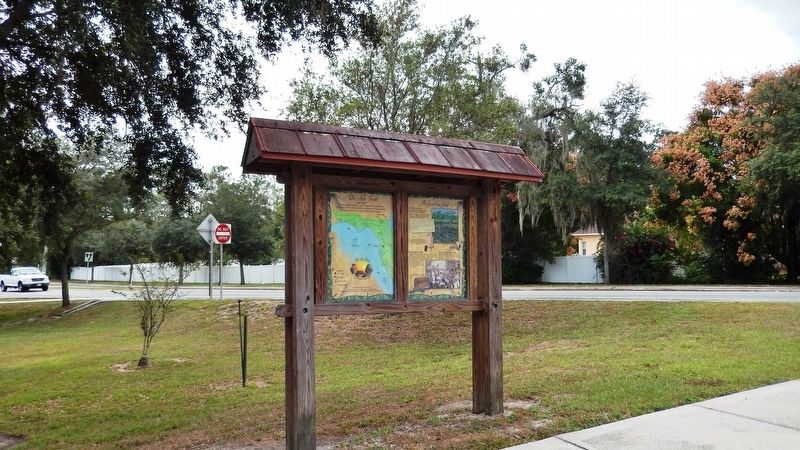
5. Good as Gold Marker Kiosk (marker panel is on right side of kiosk; map is on left)
Photographed by Cosmos Mariner, November 1, 2018
6. Good as Gold Marker Kiosk (wide view; 7th Street/US Highway 98 visible in background)
Credits. This page was last revised on December 24, 2020. It was originally submitted on November 1, 2018, by Cosmos Mariner of Cape Canaveral, Florida. This page has been viewed 1,127 times since then and 58 times this year. Last updated on November 21, 2018, by Cosmos Mariner of Cape Canaveral, Florida. Photos: 1. submitted on November 1, 2018, by Cosmos Mariner of Cape Canaveral, Florida. 2, 3. submitted on November 2, 2018, by Cosmos Mariner of Cape Canaveral, Florida. 4. submitted on November 1, 2018, by Cosmos Mariner of Cape Canaveral, Florida. 5, 6. submitted on November 2, 2018, by Cosmos Mariner of Cape Canaveral, Florida. • Bernard Fisher was the editor who published this page.
