Miami in Miami-Dade County, Florida — The American South (South Atlantic)
Crossing the Everglades
Photographed by Cosmos Mariner, January 8, 2015
1. Crossing the Everglades Marker
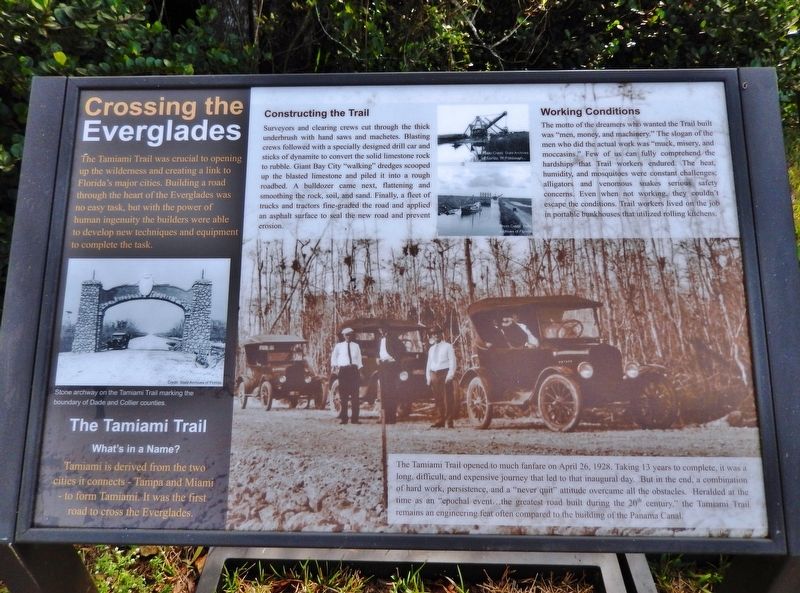
The Tamiami Trail was crucial to opening up the wilderness and creating a link to Florida's major cities. Building a road through the heart of the Everglades was no easy task, but with the power of human ingenuity the builders were able to develop new techniques and equipment to complete the task.
The Tamiami Trail
What's in a Name?
Tamiami is derived from the two cities it connects - Tampa and Miami - to form Tamiami. It was the first road to cross the Everglades.
Constructing the Trail
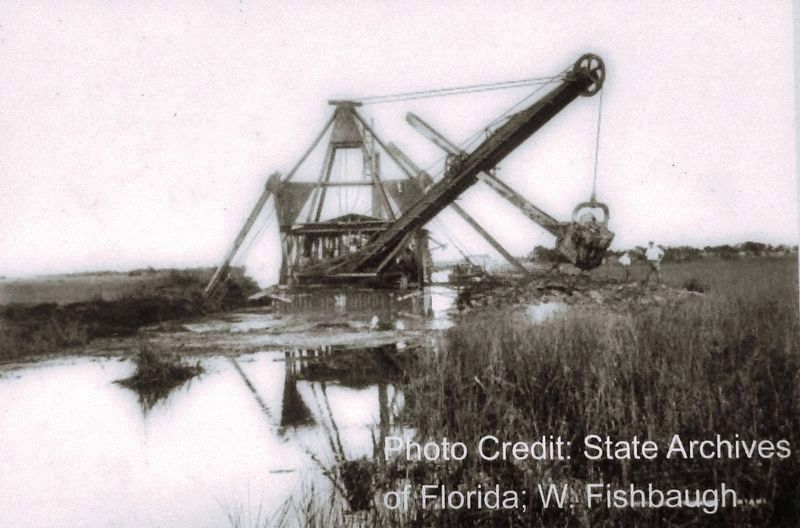
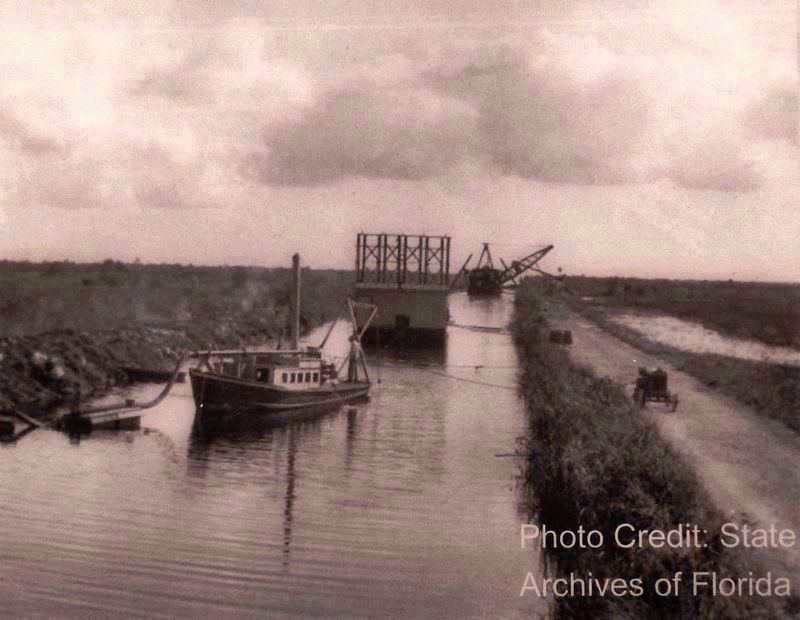
Surveyors and clearing crews cut through the thick underbrush with hand saws and machetes. Blasting crews followed with a specially designed drill car and sticks of dynamite to convert the solid limestone rock to rubble. Giant Bay City "walking" dredges scooped up the blasted limestone and piled it into a rough roadbed. A bulldozer came next, flattening and smoothing the rock, soil, and sand. Finally, a fleet of trucks and tractors fine-graded the road and applied an asphalt surface to seal the new road and prevent erosion.
Working Conditions
The motto of the dreamers who wanted the Trail built was "men, money, and machinery." The slogan
this page online
The Tamiami Trail opened to much fanfare on April 26, 1928. Taking 13 years to complete, it was a long, difficult, and expensive journey that led to that inaugural day. But in the end, a combination of hard work, persistence, and a "never quit" attitude overcame all the obstacles. Heralded at the time as an "epochal event… the greatest road built during the 20th century," the Tamiami Trail remains an engineering feat often compared to the building of the Panama Canal.
Topics. This historical marker is listed in these topic lists: Exploration • Natural Features • Roads & Vehicles • Waterways & Vessels. A significant historical date for this entry is April 26, 1928.
Location. 25° 45.65′ N, 80° 45.977′ W. Marker is in Miami, Florida,
State Archives of Florida
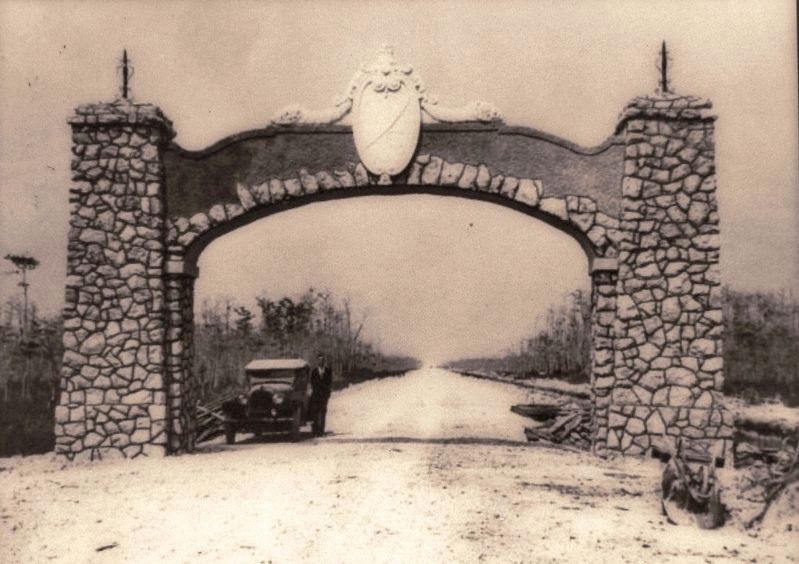
2. Marker detail: Stone archway on the Tamiami Trail marking the boundary of Dade and Collier counties

Regionally, this marker is in South Florida and on the Gold Coast. It is also in the American South and on the Eastern Seaboard. Globally, it is in the North Atlantic Region, North America, a Gulf of Mexico state, the Western Hemisphere, the Western World, and the Anglosphere. Historically, it finds itself in what was once New Spain, the territory of the Mississippian Culture, one of the Confederate States of America, and the Antebellum South.
Other nearby markers. At least 4 other markers are within 9 miles of this marker, measured as the crow flies: Life Along the Tamiami (here, next to this marker); Restoring The Everglades (here, next to this marker); The River of Grass (approx. 0.4 miles away); People Live Here / Aquívive gente
State Archives of Florida, W. Fishbaugh
3. Marker detail: Giant "walking" dredge
Related markers. Click here for a list of markers that are related to this marker. Tamiami Trail and the Everglades
Also see . . . Tamiami Trail. Wikipedia entry (Submitted on July 18, 2024, by Larry Gertner of New York, New York.)
State Archives of Florida
4. Marker detail: Barge
State Archives of Florida, W. Fishbaugh
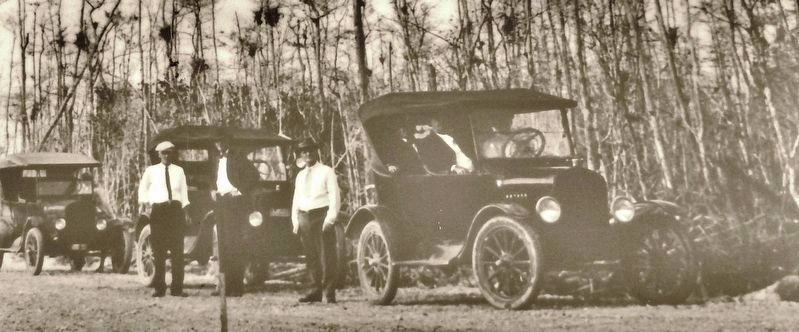
5. Crossing the Everglades Marker (background image)
Photographed by Cosmos Mariner, January 8, 2015
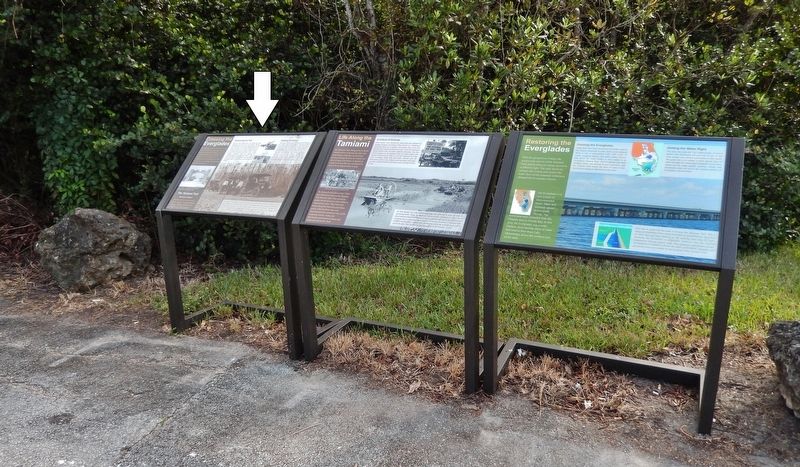
6. Crossing the Everglades Marker (wide view; leftmost of three markers at this location)
Credits. This page was last revised on July 18, 2024. It was originally submitted on April 14, 2019, by Cosmos Mariner of Cape Canaveral, Florida. This page has been viewed 988 times since then and 57 times this year. Photos: 1, 2, 3, 4, 5, 6. submitted on April 14, 2019, by Cosmos Mariner of Cape Canaveral, Florida.
