Near Collinsville in St. Clair County, Illinois — The American Midwest (Great Lakes)
Cahokia Mounds
The Road to America's Oldest City
Photographed by Jason Voigt, January 1, 2020
1. Cahokia Mounds Marker
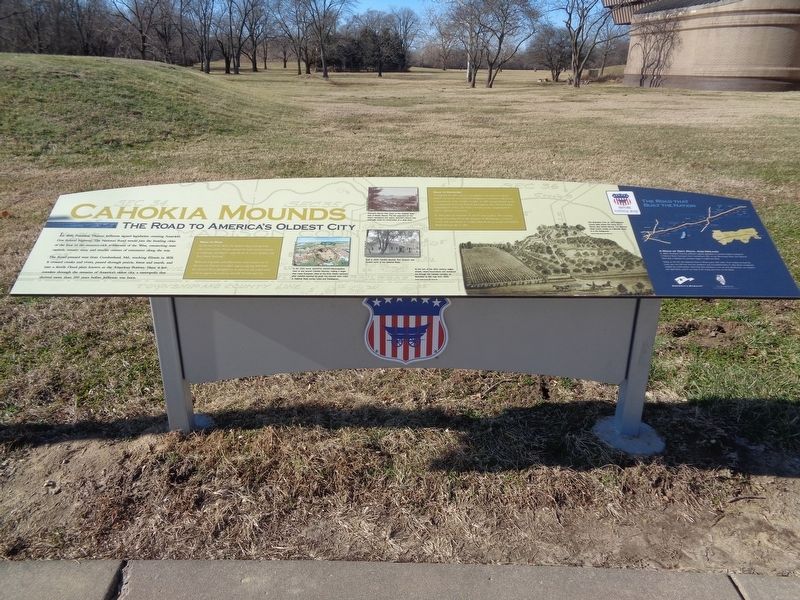
In 1806, President Thomas Jefferson signed legislation creating America's first federal highway. The National Road would join the bustling cities of the East to the resource-rich wilderness of the West, connecting state capitals, county seats, and smaller centers of commerce along the way.
The Road pressed west from Cumberland, Md., reaching Illinois in 1828. It crossed creeks and rivers, passed through prairie, forest and marsh, and into a fertile flood plain known as the American Bottom. Here, it led travelers through the remains of America's oldest city, a metropolis that thrived more than 500 years before Jefferson was born.
Road to Ruin
By the end of the 1800s, the National Road had spawned cities across eastern Illinois, opened the state's western counties to settlement, and plotted a path for the St. Louis, Vandalia and Terre Haute Railroad.
Westward migration and urbanization came at great cost to the mounds. Marvels of earthen engineering that had stood for centuries fell to ploughshares, or were cut and carted away as fill to support the growing network of roads and rails.
Road to Recovery
Throughout
this page online
By 1960, plans for Interstates 55 and 70 were in place. The resulting salvage archaeology led to the discovery of Woodhenge, a cultural artifact that contributed to Cahokia Mounds being named a UNESCO World Heritage Site in 1982.
[Captions:]
In AD 1150, some 10,000 to 20,000 Mississippians lived at and around Cahokia Mounds, making it larger than many European cities at the time. Seven centuries after Cahokia reached its peak, the mounds were noted in National Road survey notes and travelogues.
Schmidt's Mound Park stood on the National Road east of Monks Mound. The site supported an inn, tavern, bandstand and casino. Schmidt's Mound was eventually razed for construction of a retail store.
Built in 1929, Cahokia Mounds' first museum was located north of the National Road.
At the turn of the 20th century, wagon wheels, steam locomotives and streetcarrs cut through the Cahokia complex, as illustrated by this map from 1906.
This illustration from an 1873 Madison County atlas shows the home of T.T. Ramey atop Monks Mound. The National Road, known locally as Collinsville Road, is in the background.
[Sidebar:]
A Road of Dirt, Rock, And Dreams
In 1806, President Thomas Jefferson signed legislation to provide federal funding for a National Road. Surveyed from Cumberland, Md., to the Mississippi River, the National Road was a highway for pioneers eager to settle the West.
Today, as US 40, the National Road in Illinois spans 164 miles. From Indiana to East St. Louis, you can still see how the ambitions and accomplishments of early Illinois immigrants shaped our communities. You'll find their influence in our art and architecture, our industry and agriculture, and in our way of life. Enjoy your time on the Road.
Erected by National

Photographed by Jason Voigt, January 1, 2020
2. Cahokia Mounds Marker
Marker is next to the Interpretative Center and Museum
Topics and series. This historical marker is listed in these topic lists: Anthropology & Archaeology • Indigenous Peoples and Communities • Roads & Vehicles • Settlements & Settlers. In addition, it is included in the Former U.S. Presidents: #03 Thomas Jefferson, the The Historic National Road, and the UNESCO World Heritage Sites series lists.
Location. 38° 39.258′ N, 90° 3.538′ W. Marker is near Collinsville, Illinois, in St. Clair County. It is on Ramey Drive 0.3 miles south of Collinsville Road, on the right when traveling south. Marker is located next to the Cahokia Mounds State Historic Site's Interpretative Center. Touch for map. Marker is at or near this postal address: 30 Ramey Drive, Collinsville IL 62234, United States of America. Touch for directions.

Regionally, this marker is in Greater St. Louis. It is also in the American Midwest, in the Lewis & Clark Corridor, in the Corn Belt, and in the Great River Road Region. Globally, it is in North America, the Western Hemisphere, the Western World, and the Anglosphere. Historically, it finds itself in what was once the Viceroyalty of New France, the territory of the Mississippian Culture, and the Northwest Territory.
Other nearby markers. At least 8 other markers are within walking distance of this marker: Cahokia (here, next to this marker); You Are Walking Where a Cahokia Neighborhood Once Stood (within shouting distance of this marker); Interpretive Center Tract (about 600 feet away, measured in a direct line); Grand Plaza (about 600 feet away); Mound 55 (about 700 feet away); The South Stockade (approx. 0.2 miles away); Mound 50 (approx. ¼ mile away); The Twin Mounds (approx. ¼ mile away). Touch for a list and map of all markers in Collinsville.
Also see . . .
1. Cahokia Mounds. Official website for the UNESCO World Heritage Site. Includes plenty of information and what to expect when visiting the mounds. (Submitted on January 1, 2020, by Jason Voigt of Glen Carbon, Illinois.)
2. Collinsville & Fairmont City. From the Illinois National Road's YouTube channel, this is a short video that talks about the two cities that were on the Historic National Road. Cahokia Mounds comes on at the 2:24 mark in the video. (Submitted on January 1, 2020, by Jason Voigt of Glen Carbon, Illinois.)
Credits. This page was last revised on April 2, 2023. It was originally submitted on January 1, 2020, by Jason Voigt of Glen Carbon, Illinois. This page has been viewed 585 times since then and 53 times this year. Photos: 1, 2. submitted on January 1, 2020, by Jason Voigt of Glen Carbon, Illinois. • Devry Becker Jones was the editor who published this page.
