Fredericksburg, Virginia — The American South (Mid-Atlantic)
In Memory of Clara Barton
1862 - 1962
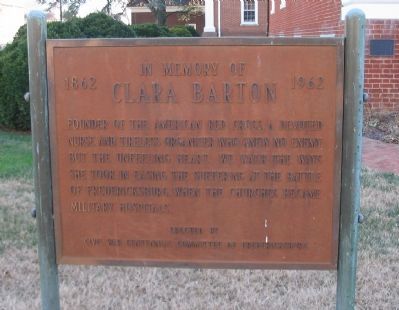
Photographed by Craig Swain, December 13, 2008
1. Clara Barton Marker
Erected 1962 by Civil War Centennial Committee of Fredericksburg.
Topics and series. This historical marker is listed in these topic lists: Charity & Public Work • Science & Medicine • War, US Civil • Women. In addition, it is included in the Clara Barton series list. A significant historical year for this entry is 1862.
Location. 38° 18.129′ N, 77° 27.609′ W. Marker is in Fredericksburg, Virginia. It is at the intersection of George Street and Princess Anne Street, on the right when traveling east on George Street. Located in front of the Fredericksburg Presbyterian Church. Touch for map. Marker is in this post office area: Fredericksburg VA 22401, United States of America. Touch for directions.

Regionally, this marker is in the Washington Metropolitan Area and in Northern Virginia. It is also in the American South and specifically in the Upper South. Globally,
this page online
Other nearby markers. At least 8 other markers are within walking distance of this marker: 1833 (a few steps from this marker); Gen. Stonewall Jackson (a few steps from this marker); a different marker also named War Comes to Fredericksburg (within shouting distance of this marker); a different marker also named A Vast Hospital (within shouting distance of this marker); A Sacked and Gutted Town (within shouting distance of this marker); The Court House (within shouting distance of this marker); Great Exodus From Bondage (within shouting distance of this marker); Corporation Court House (within shouting distance of this marker). Touch for a list and map of all markers in Fredericksburg.
Other markers no longer nearby. The Courthouse (was within shouting distance of this marker but has been replaced with another marker now near it); A Vast Hospital
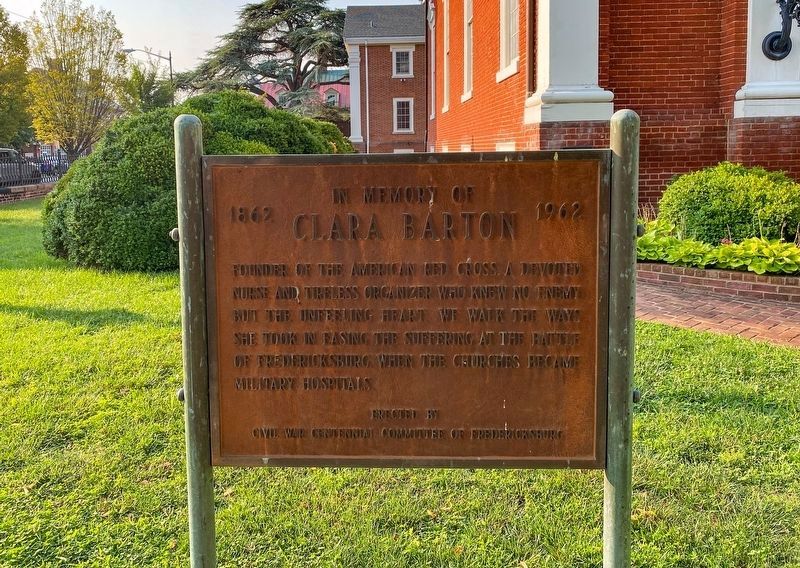
Photographed by J.T. Lambrou, August 12, 2021
2. In Memory of Clara Barton Marker
Also see . . . Clara Barton, 1821-1912. Civil War Nurse Founder American Red Cross (Submitted on March 26, 2010, by Sandra Hughes Tidwell of Killen, Alabama, USA.)
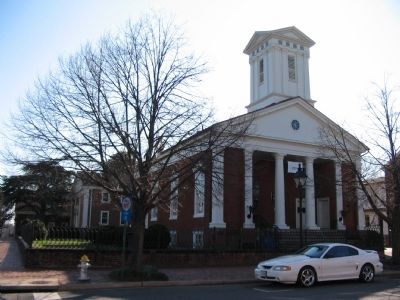
Photographed by Craig Swain, December 13, 2008
3. Marker in front of the Presbyterian Church
The Church, like most others in Fredericksburg, was used as a hospital during the 1862 battle of Fredericksburg. The church was also used by the Federals in 1864.
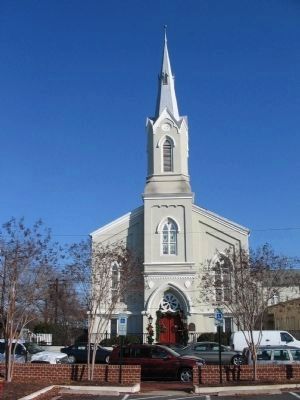
Photographed by Craig Swain, December 13, 2008
4. Fredericksburg Baptist Church
Another of Fredericksburg's Churches turned into a field hospital during the 1862 battle.
Photographed by Allen C. Browne, February 16, 2015
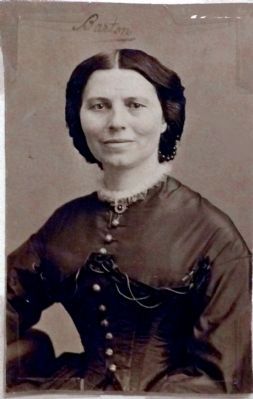
5. Clara Barton
This c. 1865 photo of Clara Barton by Mathew B. Brady hangs in the National Portrait Gallery in Washington, DC.
“Clara Barton considered herself foremost a relief worker, whose efforts to aid those in need consumed most of her adult life. Yet she is remembered best as a Civil War nurse and as the founder of the American Red Cross. During the war; Barton realized her true calling of service by organizing and distributing supplies to Union soldiers and visiting the fields of battle as an independent nurse. At war's end; she organized a missing soldiers office, answering thousands of inquiries from bereaved families about their loved ones. When she closed the office in 1867, she had identified the fate of some 22,000 men. Later, after attending a European meeting of the International Red Cross, Barton returned home and worked to found the American Red Cross in 1881. She served as its first president for the next twenty-three years.” — National Portrait Gallery
“Clara Barton considered herself foremost a relief worker, whose efforts to aid those in need consumed most of her adult life. Yet she is remembered best as a Civil War nurse and as the founder of the American Red Cross. During the war; Barton realized her true calling of service by organizing and distributing supplies to Union soldiers and visiting the fields of battle as an independent nurse. At war's end; she organized a missing soldiers office, answering thousands of inquiries from bereaved families about their loved ones. When she closed the office in 1867, she had identified the fate of some 22,000 men. Later, after attending a European meeting of the International Red Cross, Barton returned home and worked to found the American Red Cross in 1881. She served as its first president for the next twenty-three years.” — National Portrait Gallery
Credits. This page was last revised on February 2, 2023. It was originally submitted on December 14, 2008, by Craig Swain of Leesburg, Virginia. This page has been viewed 1,990 times since then and 22 times this year. Photos: 1. submitted on December 14, 2008, by Craig Swain of Leesburg, Virginia. 2. submitted on September 8, 2021, by J.T. Lambrou of New Boston, Michigan. 3, 4. submitted on December 14, 2008, by Craig Swain of Leesburg, Virginia. 5. submitted on May 24, 2015, by Allen C. Browne of Silver Spring, Maryland.
