Martin in Stephens County, Georgia — The American South (South Atlantic)
Red Hollow Road
Photographed by David Seibert, September 16, 2006
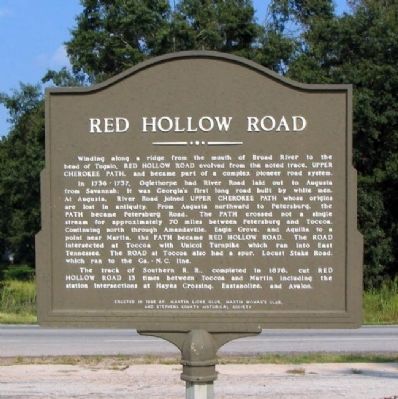
1. Red Hollow Road Marker
In 1736-1737, Oglethorpe had River Road laid out to Augusta from Savannah; it was Georgia`s first long road built by white men. At Augusta, River Road joined UPPER CHEROKEE PATH whose origins are lost in antiquity. From Augusta northward to Petersburg, the PATH became Petersburg Road. The PATH crossed not a single stream for approximately 70 miles between Petersburg and Toccoa. Continuing north through Amandaville, Eagle Grove, and Aquilla to a point near Martin, the PATH became RED HOLLOW ROAD. The ROAD intersected at Toccoa with Unicoi Turnpike which ran into East Tennessee. The ROAD at Toccoa also had a spur, Locust Stake Road, which ran to the Ga.-N.C. line.
The track of Southern R.R., completed in 1878, cut RED HOLLOW ROAD 13 times between Toccoa and Martin including the station intersection at Hayes Crossing, Eastonollee, and Avalon.
Erected 1986 by Martin Lions Club, Martin Woman's Club, and Stephens County
this page online
Topics. This historical marker is listed in these topic lists: Colonial Era • Indigenous Peoples and Communities • Railroads & Streetcars • Roads & Vehicles. A significant historical year for this entry is 1878.
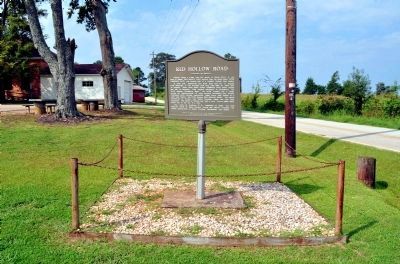
Location. 34° 29.02′ N, 83° 11.068′ W. Marker is in Martin, Georgia, in Stephens County. It is at the intersection of East Main Street (Georgia Route 17) and Red Hollow Road, on the left when traveling north on East Main Street. The marker is located at the Martin Community Center. Touch for map. Marker is in this post office area: Martin GA 30557, United States of America. Touch for directions.

Regionally, this marker is in Georgia’s Mountains. It is also in the American South, specifically in the Deep South, in Appalachia, and specifically in Southern Appalachia. Globally, it is in North America, the Western Hemisphere, the Western World, and the Anglosphere. Historically, it finds itself in what was once the original Cherokee Nation, the territory of the Mississippian Culture, one of the original Thirteen Colonies, one of the Confederate States of America, and the Antebellum
Photographed by David Seibert, August 22, 2012
2. Red Hollow Road Marker
Other nearby markers. At least 8 other markers are within 9 miles of this marker, measured as the crow flies: Poplar Springs Baptist Church (approx. 4½ miles away); Stephens County High School (approx. 4.7 miles away); Red Hill School (approx. 5½ miles away); Veteran's Walk (approx. 5.6 miles away); The State of Georgia Salutes (approx. 6.6 miles away); Tugalo Baptist Church and Cemetery (approx. 7 miles away); Double Branches Baptist Church (approx. 7.8 miles away); Franklin County Veterans Memorial (approx. 8.4 miles away).
Other markers no longer nearby. Eastanollee Baptist Church (was approx. 4.2 miles away but has been confirmed missing); Parkertown - 1832 (was approx. 8.3 miles away but has been confirmed missing).
Photographed by David Seibert, August 22, 2012
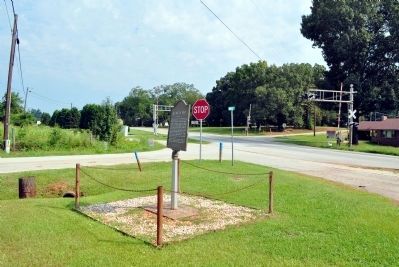
3. Red Hollow Road Marker
Looking at an intersection of six roads, the Red Hollow Road is second from the left, barely visible in the brush.
Credits. This page was last revised on June 16, 2016. It was originally submitted on December 21, 2008, by David Seibert of Sandy Springs, Georgia. This page has been viewed 1,652 times since then and 95 times this year. Photos: 1. submitted on December 21, 2008, by David Seibert of Sandy Springs, Georgia. 2, 3. submitted on September 2, 2012, by David Seibert of Sandy Springs, Georgia. • Bill Pfingsten was the editor who published this page.
