Elko in Elko County, Nevada — The American Mountains (Southwest)
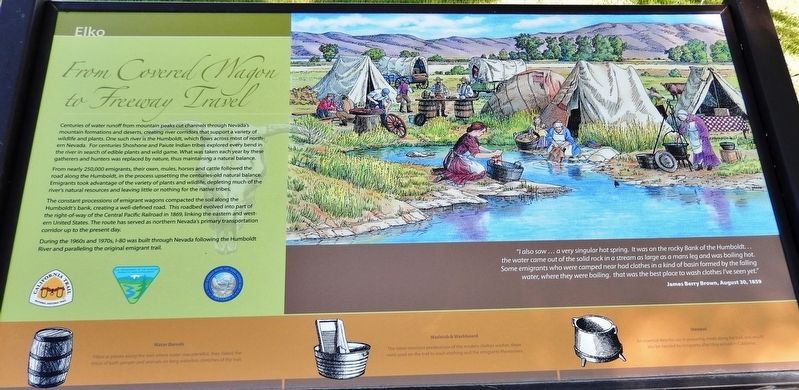
From Covered Wagon to Freeway Travel
Photographed by Cosmos Mariner, June 19, 2016
1. From Covered Wagon to Freeway Travel Marker
From nearly 250,000 emigrants, their oxen, mules, horses and cattle followed the road along the Humboldt, in the process upsetting the centuries-old natural balance. Emigrants took advantage of the variety of plants and wildlife, depleting much of the river's natural resources and leaving little or nothing for the native tribes.
The constant processions of emigrant wagons compacted the soil along the Humboldt's bank, creating a well-defined road. This roadbed evolved into part of the right-of-way of the Central Pacific Railroad in 1869, linking the eastern and western United States. The route has served as northern Nevada's primary
this page online
During the 1960s and 1970s, I-80 was built through Nevada following the Humboldt River and paralleling the original emigrant trail.
Water Barrels
Filled at places along the trail where water was plentiful, they slaked the thirst of both people and animals on long waterless stretches of the trail.
Washtub & Washboard
The labor-intensive predecessor of the modern clothes washer, these were used on the trail to wash clothing and the emigrants themselves.
StewpotAn essential item for use in preparing meals along the trail, and would also be needed by emigrants after they arrived in California.
Erected by California Trail, Bureau of Land Management, U.S. Department of the Interior, and State of Nevada.
Topics and series. This historical marker is listed in these topic lists: Indigenous Peoples and Communities • Roads & Vehicles • Settlements & Settlers • Waterways & Vessels. In addition, it is included in the California Trail series list.
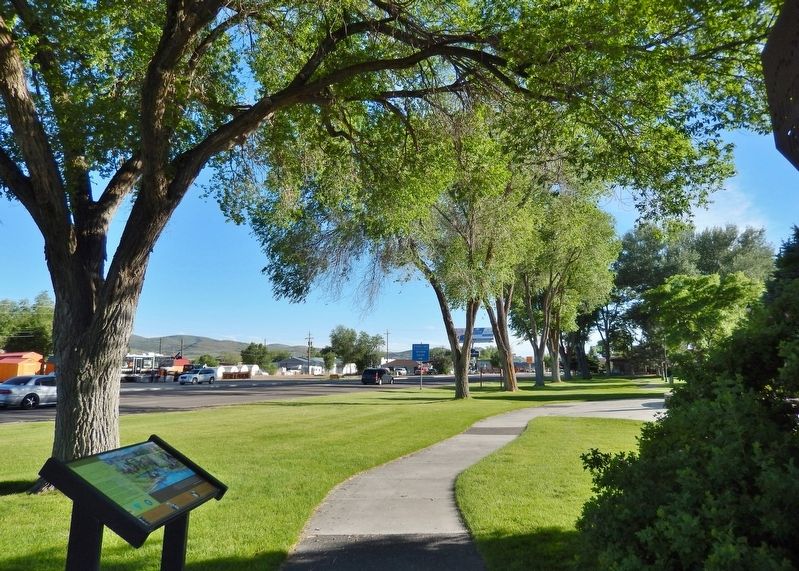
Location. 40° 50.465′ N, 115° 45.217′ W. Marker is in Elko, Nevada, in Elko County.
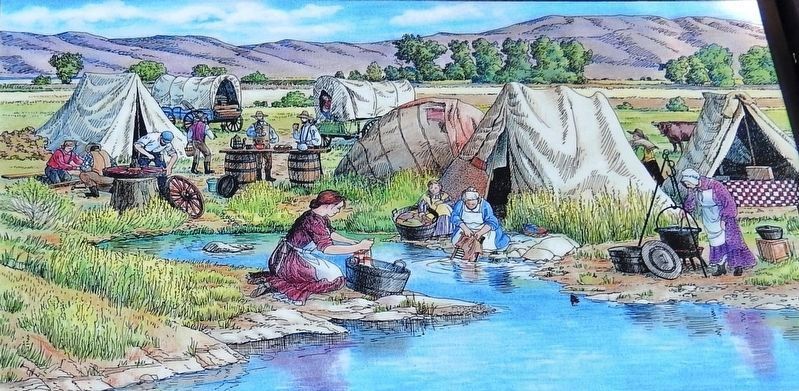
2. Covered Wagon to Freeway Travel Marker detail
"I also saw… a very singular hot spring. It was on the rocky Bank of the Humboldt… the water came out of the solid rock in a stream as large as a mans leg and was boiling hot. Some emigrants who were camped near had clothes in a kind of basin formed by the falling water, where they were boiling. That was the best place to wash clothes I've seen yet"
James Berry Brown, August 30, 1859
James Berry Brown, August 30, 1859

Regionally, this marker is in Elko Country. It is also in the American Mountain West. Globally, it is in North America, the Western Hemisphere, the Western World, and the Anglosphere. Historically, it finds itself in what was once New Spain and also Mexico’s Alta California.
Other nearby markers. At least 8 other markers are within walking distance of this marker: About Your Journey... (here, next to this marker); Artzaina Zain (within shouting distance of this marker); Elko (within shouting distance of this marker); Ruby Valley Pony Express Station (about 400 feet away, measured in a direct line); a different marker also named Ruby Valley Pony Express Station (about 400 feet away); Sherman Station (about 500 feet away); Sesquicentennial Sagebrush Sculpture & Time Capsule (approx. 0.2 miles away);
Photographed by Cosmos Mariner, June 19, 2016
3. From Covered Wagon to Freeway Travel Marker
Credits. This page was last revised on March 18, 2020. It was originally submitted on March 17, 2020, by Cosmos Mariner of Cape Canaveral, Florida. This page has been viewed 291 times since then and 23 times this year. Photos: 1, 2, 3. submitted on March 18, 2020, by Cosmos Mariner of Cape Canaveral, Florida.
