Fredericksburg, Virginia — The American South (Mid-Atlantic)
A Vast Hospital
Fredericksburg: Timeless.
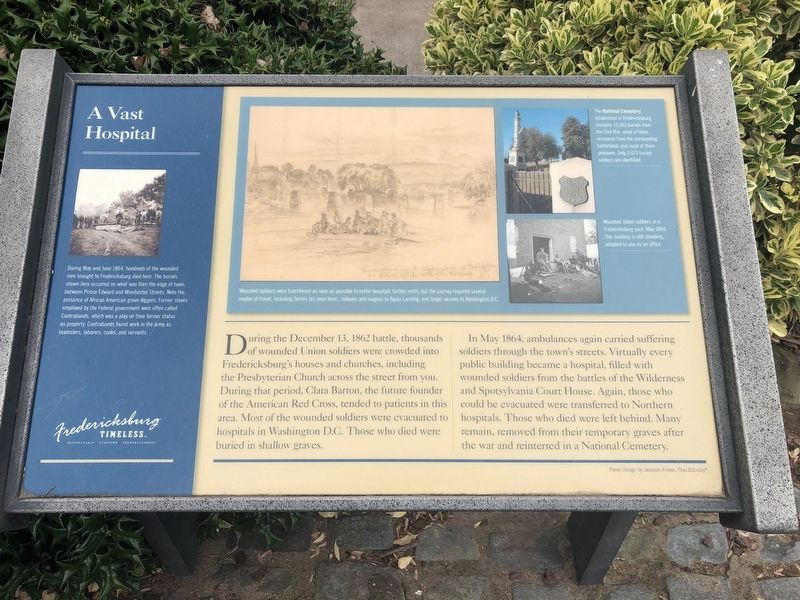
During the December 13, 1862 battle, thousands of wounded Union soldiers were crowded into Fredericksburg's houses and churches, including the Presbyterian Church across the street from you. During that period, Clara Barton, the future founder of the American Red Cross, tended to patients in this area. Most of the wounded soldiers were evacuated to hospitals in Washington D.C. Those who died were buried in shallow graves.
In May 1864, ambulances again carried suffering soldiers through the town's streets. Virtually every public building became a hospital, filled with wounded soldiers from the battles of the Wilderness and Spotsylvania Court House. Again, those who could be evacuated were transferred to Northern hospitals. Those who died were left behind. Many remain, removed from their temporary graves after the war and reinterred in a National Cemetery.
[Aside and captions:]
During May and June 1864, hundreds of the wounded men brought to Fredericksburg died here. The burials shown here occurred on what was then the edge of town, between Prince Edward and Winchester Streets. Note the presence of African American grave diggers. Former slaves employed by the Federal government were often called Contrabands, which was a play on their former status on property. Contrabands found work in the army as teamsters, laborers, cooks, and servants.
Wounded soldiers were transferred as soon as possible to better hospitals farther north, but the journey required several modes of travel, including ferries (as seen here), railways and wagons to Aquia Landing, and larger vessels to Washington D.C.
The National Cemetery established in Fredericksburg contains 15,243 burials from the Civil War, most of them recovered from the surrounding battlefields and most of them unknown. Only 2,473 buried soldiers are identified.
Wounded Union soldiers in a Fredericksburg yard, May 1864. This building is still standing, adapted to use as an office.
Erected by Fredericksburg
this page online
Topics and series. This historical marker is listed in these topic lists: African Americans • Cemeteries & Burial Sites • Religion & Religious Structures • Science & Medicine • War, US Civil • Women. In addition, it is included in the Clara Barton, the National Cemeteries, and the Virginia, Fredericksburg: Timeless. series lists. A significant historical month for this entry is May 1864.
Location. 38° 18.132′ N, 77° 27.59′ W. Marker is in Fredericksburg, Virginia. It can be reached from the intersection of Princess Anne Street (Business U.S. 17) and George Street, on the left when traveling south. Touch for map. Marker is at or near this postal address: 817 Princess Anne St, Fredericksburg VA 22401, United States of America. Touch for directions.

Regionally, this marker is in the Washington Metropolitan Area and in Northern Virginia. It is also in the American South and specifically in the Upper South. Globally, it is in North America, the Western Hemisphere, the Western World, and the Anglosphere. Historically, it finds itself in what was once the territory of
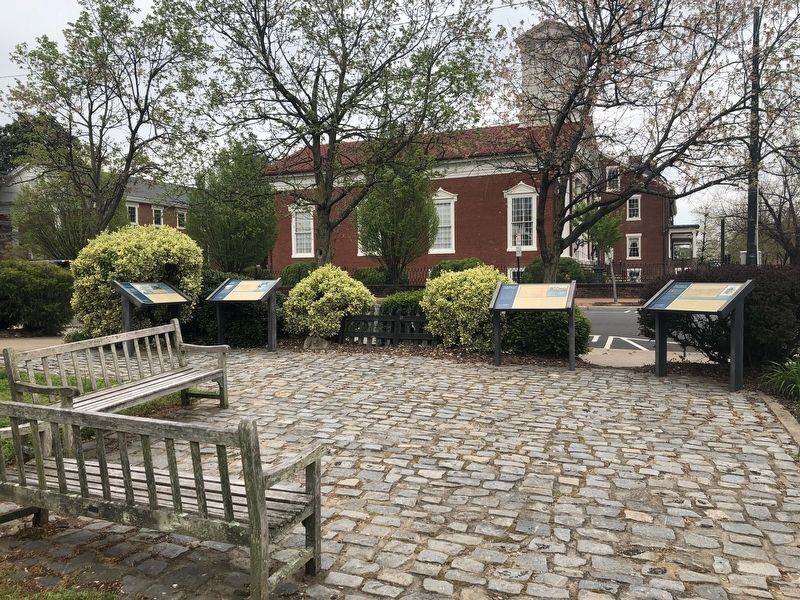
Other nearby markers. At least 8 other markers are within walking distance of this marker: The Court House (here, next to this marker); A Sacked and Gutted Town (here, next to this marker); War Comes to Fredericksburg (here, next to this marker); Gen. Stonewall Jackson (a few steps from this marker); 1910 (a few steps from this marker); In Memory of Clara Barton (within shouting distance of this marker); Corporation Court House (within shouting distance of this marker); Great Exodus From Bondage (within shouting distance of this marker). Touch for a list and map of all markers in Fredericksburg.
Other markers no longer nearby. The Courthouse (was a few steps from this marker but has been replaced with another marker now near it); a different marker also named A Vast Hospital (was a few steps from this marker but has been replaced with another marker now near it); The “Demon of Destruction” (was a few steps from this marker but has been replaced with another marker now near it); a different marker also named War Comes to Fredericksburg (was a few steps from this marker but has been replaced with another marker now near it).
Related marker. Click here for another marker that is related to this marker. This marker has replaced the linked marker.
Credits. This page was last revised on February 2, 2023. It was originally submitted on April 12, 2020, by Devry Becker Jones of Washington, District of Columbia. This page has been viewed 724 times since then and 34 times this year. Photos: 1, 2. submitted on April 12, 2020, by Devry Becker Jones of Washington, District of Columbia.
