Downtown Ottawa , Ontario — Central Canada (North America)
Supreme Court of Canada
A Pillar of Canadian Democracy
⎯⎯⎯
La Cour suprême du Canada
Un pilier de la démocratie canadienne

Photographed by Cosmos Mariner, August 10, 2019
1. Supreme Court of Canada Marker

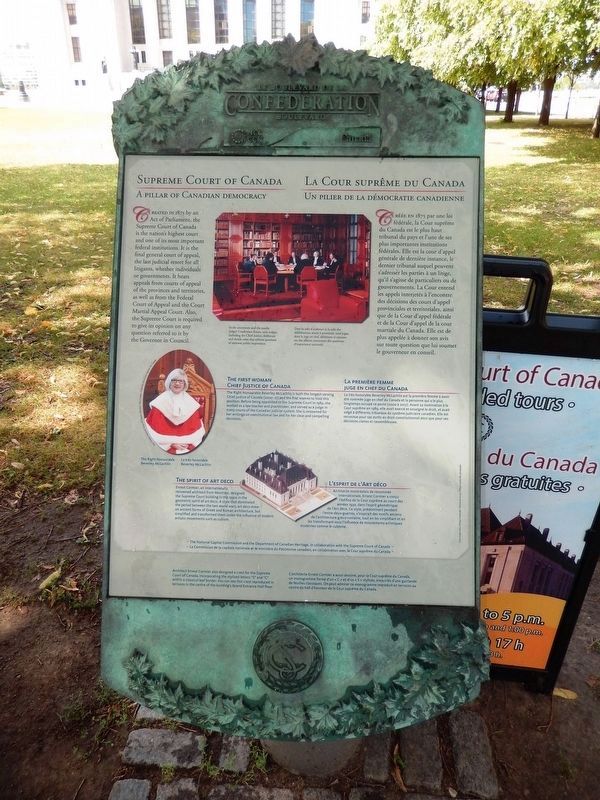
Created in 1875 by an Act of Parliament, the Supreme Court of Canada is the nation's highest court and one of its most important federal institutions. It is the final general court of appeal, the last judicial resort for all litigants, whether individuals or governments. It hears appeals from courts of appeal of the provinces and territories, as well as from the Federal Court of Appeal and the Court Martial Appeal Court. Also, the Supreme Court is required to give its opinion on any question referred to it by the Governor in Council.
The First Woman Chief Justice of Canada
The Right Honourable Beverley McLachlin is both the longest-serving Chief Justice of Canada (2000-17) and the first woman to hold this position. Before being appointed to the Supreme Court in 1989, she worked as a law teacher and practitioner, and served as a judge in many courts of the Canadian judicial system. She is renowned for her writings on constitutional law and for her clear and compelling decisions.
The Spirit of Art Deco
Ernest Cormier, an internationally renowned architect from Montreal, designed the Supreme Court building in the
this page online
The National Capital Commission and the Department of Canadian Heritage, in collaboration with the Supreme Court of Canada
Créée en 1875 par une loi fédérale, la Cour suprême du Canada est le plus haut tribunal du pays et l'une de ses plus importantes institutions fédérales. Elle est la cour d'appel générale de dernière instance, le dernier tribunal auquel peuvent s'adresser les parties à un litige, qu'il s'agisse de particuliers ou de gouvernements. La Cour entend les appels interjetés à l'encontre des décisions des cours d'appel provinciales et territoriales, ainsi que de la Cour d'appel fédérale et de la Cour d'appel de la cour martiale du Canada. Elle est de plus appelée à donner son avis sur toute question que lui soumet le gouverneur en conseil.
La première femme juge en chef du Canada
La très honorable Beverley McLachlin est la première femme à avoir été nommée
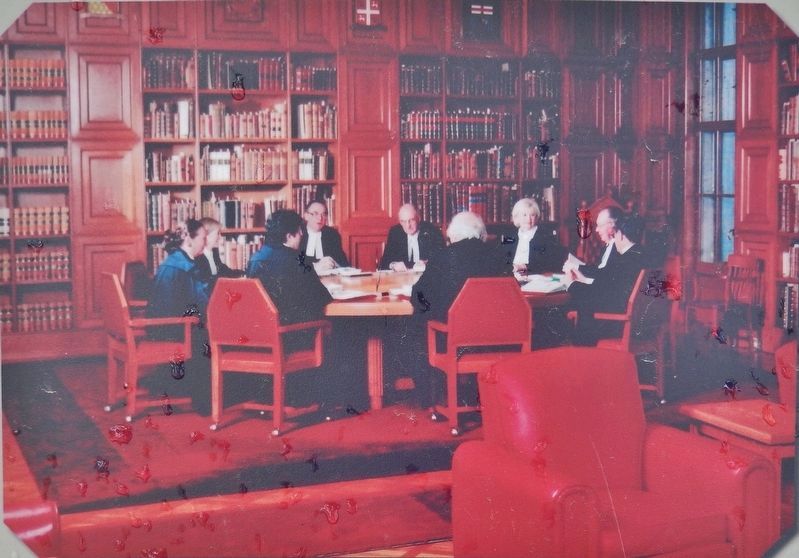
2. Marker detail: Judges' Conference Room /
Salle de délibérations
Salle de délibérations
• • • Dans la salle d'audience et la salle des délibérations, située à proximité, neuf juges, dont le juge en chef, délibèrent et statuent sur des affaires concernant des questions d'importance nationale.
L’esprit de l’Art déco
Architecte montréalais de renommée internationale, Ernest Cormier a conçu l'édifice de la Cour suprême au cours des années 1930, dans l'esprit géométrique de l'Art déco. Ce style, prédominant pendant l'entre-deux-guerres, s'inspirait des motifs anciens de l'architecture gréco-romaine, tout en les simplifiant et en les transformant sous l'influence de mouvements artistiques modernes comme le cubisme.
La Commission de la capitale nationale et le ministère du Patrimoine canadien, en collaboration avec La Cour suprême du Canada
Erected by The National Capital Commission / La Commission de la capitale nationale.
Topics and series. This historical marker is listed in these topic lists: Architecture • Law Enforcement • Women. In addition, it

Roy Grogan, Supreme Court of Canada collection
3. Marker detail: The Right Honourable Beverly McLachlin
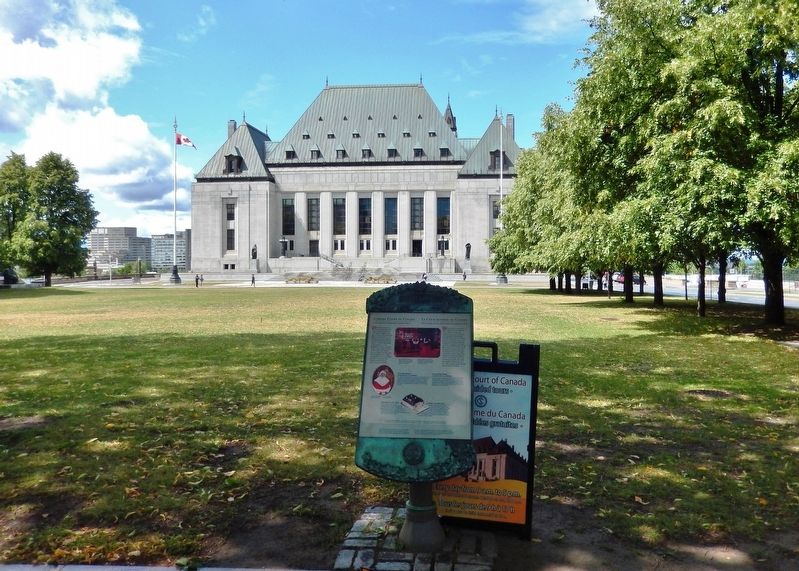
Location. 45° 25.255′ N, 75° 42.257′ W. Marker is in Ottawa, Ontario. It is in Downtown Ottawa. It is on Wellington Street (Route 34) just west of Kent Street (Route 83), on the right when traveling west. Marker is located beside the sidewalk directly in front of the Supreme Court of Canada. Touch for map. Marker is at or near this postal address: 301 Wellington Street, Ottawa ON K1A 0J1, Canada. Touch for directions.

Regionally, this marker is in Eastern Ontario. It is also in Central Canada. Globally, it is in North America, the Western Hemisphere, the Western World, and the Anglosphere. Historically, it finds itself in what was once a British colony, the Viceroyalty of New France, the Haudenosaunee (Iroquois) Confederacy, and Rupert’s Land.
Other nearby markers. At least 8 other markers are within walking distance of this marker: St. Andrew's Church / L’église St. Andrew's (within shouting distance of this marker); St. Andrew's Presbyterian Church (within shouting distance of this marker); Henriette Bourque (within shouting distance
Photographed by Cosmos Mariner, August 10, 2019
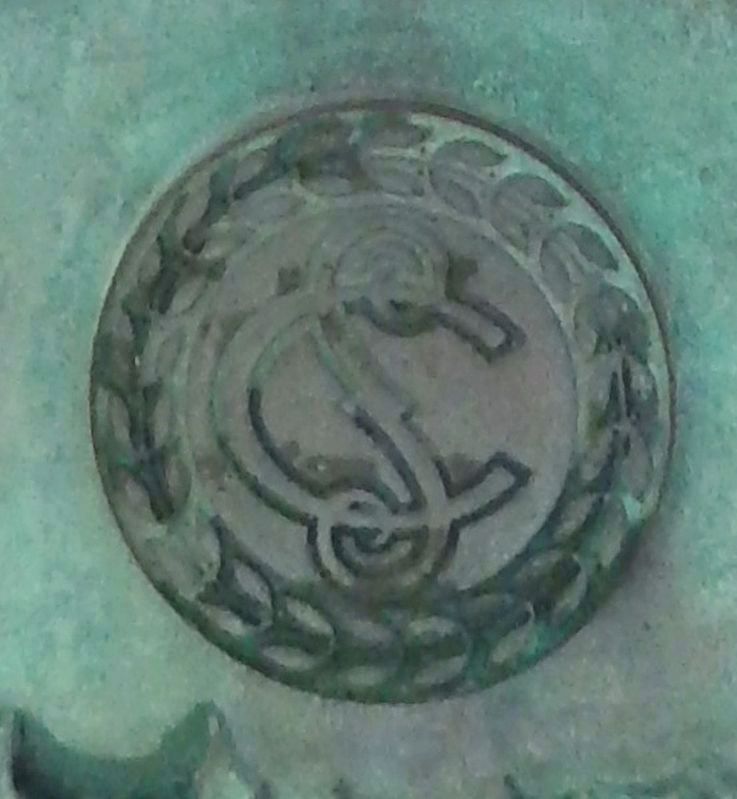
4. Marker detail: Supreme Court Crest
(at bottom center of marker)
(at bottom center of marker)
• • •
L'architecte Ernest Cormier a aussi dessiné, pour la Cour suprême du Canada. Un monogramme formé d'un « C » et d'un « S » stylisés, encerclés d'une guirlande de feuilles classiques. On peut admirer ce monogramme reproduit en terrazzo au centre du hall d'honneur de la Cour suprême du Canada.
Related markers. Click here for a list of markers that are related to this marker. Confederation Boulevard / Boulevard de la Confédération
Also see . . .
1. Supreme Court of Canada. The Supreme Court did not come into being until nearly a decade after Confederation. The British North America Act, 1867, the country's founding constitutional statute, included a provision for Parliament to establish a “General Court of Appeal for Canada.” However, the idea caused sharp debate among Canadian politicians. (Submitted on June 1, 2020, by Cosmos Mariner of Cape Canaveral, Florida.)
2. The Right Honourable Beverley McLachlin, P.C., C.C. Her judicial career
Photographed by Cosmos Mariner, August 10, 2019
5. Supreme Court of Canada /
La Cour suprême du Canada Marker
La Cour suprême du Canada Marker
3. Ernest Cormier. In 1938, at the end of the Great Depression, Ernest Cormier was put in charge of the new Supreme Court of Canada in Ottawa, a building whose simple classicism illustrates his understanding of modernism. A few years later, Cormier became a member of the international team assembled to build the Headquarters of the United Nations (1947) in New York, for which he designed the exterior doors. (Submitted on June 1, 2020, by Cosmos Mariner of Cape Canaveral, Florida.)
Photographed by Cosmos Mariner, August 10, 2019
6. Supreme Court of Canada /
La Cour suprême du Canada Marker
La Cour suprême du Canada Marker

Photographed by Cosmos Mariner, August 10, 2019
7. Supreme Court of Canada / La Cour suprême du Canada
Credits. This page was last revised on January 24, 2022. It was originally submitted on May 29, 2020, by Cosmos Mariner of Cape Canaveral, Florida. This page has been viewed 312 times since then and 20 times this year. Photos: 1, 2, 3, 4. submitted on May 31, 2020, by Cosmos Mariner of Cape Canaveral, Florida. 5. submitted on June 1, 2020, by Cosmos Mariner of Cape Canaveral, Florida. 6. submitted on May 31, 2020, by Cosmos Mariner of Cape Canaveral, Florida. 7. submitted on June 1, 2020, by Cosmos Mariner of Cape Canaveral, Florida.
