Rosemont in Alexandria, Virginia — The American South (Mid-Atlantic)
Fun in the Forest
Alexandria Heritage Trail
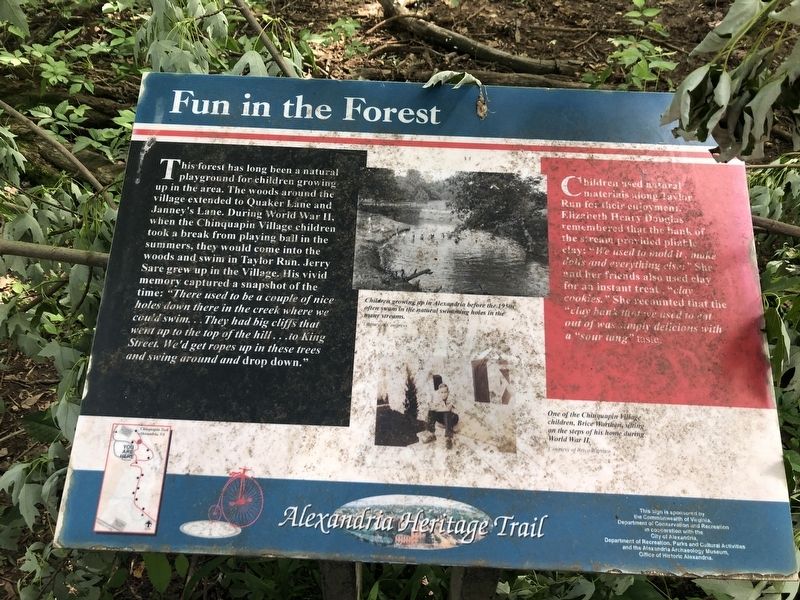
This forest has long been a natural playground for children growing up in the area. The woods around the village extended to Quaker Lane and janney's Lane. During World War II, when the Chinquapin Village children took a break from playing ball in the summers, they would come into the woods and swim in Taylor Run. Jerry Sare grew up in the Village. His vivid memory captured a snapshot of the time: "There used to be a couple of nice holes down there in the creek where we could swim...They had big cliffs that went up to the top of the hill...to King Street. We'd get ropes up in these trees and swing around and drop down."
Children used natural materials along Taylor Run for their enjoyment. Elizabeth Henry Douglas remembered that the bank of the stream provided public clay: "We used to mold it, make dolls and everything else! She and her friends also used clay for an instant treat, "clay cookies." She recounted that the "clay bank that we used to eat out of was simply delicious with a "sour tang" taste.
Erected by City of Alexandria, Virginia.
Topics and series. This historical marker is listed in these topic
this page online
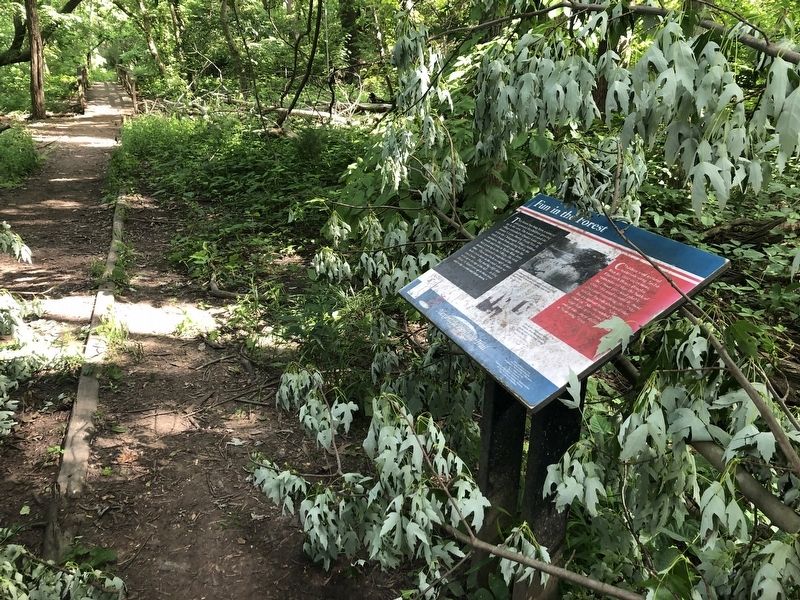
Location. 38° 49.347′ N, 77° 4.886′ W. Marker is in Alexandria, Virginia. It is in Rosemont. It can be reached from Chinquapin Drive 0.2 miles south of King Street (Virginia Route 7), on the right when traveling north. Touch for map. Marker is at or near this postal address: 3127 King St, Alexandria VA 22302, United States of America. Touch for directions.

Regionally, this marker is in the Washington Metropolitan Area and in Northern Virginia. It is also in the American South, specifically in the Upper South, in the Mid-Atlantic, and on the Eastern Seaboard. Globally, it is in the North Atlantic Region, North America, the Western Hemisphere, the Western World, and the Anglosphere. Historically, it finds itself in what was once the territory of the Mississippian Culture, one of the original Thirteen Colonies, one of the Confederate States of America, and the Antebellum South.
Other nearby markers. At least 8 other markers
More about this marker. [Captions:]
Children growing up in Alexandria before the 1950s often swam in the natural swimming holes in the many streams.
Library of Congress
One of the Chinquapin Village children, Brice Warthen, sitting on the steps of his home during World War II.
Courtesy of Brice Warthen
Additional commentary.
1. Formatting
The formatting from the marker has been used verbatim, notably the inconsistent italics in both paragraphs as well as the missing quotation mark in the second paragraph.
— Submitted May 31, 2020, by Devry Becker Jones of Washington, District of Columbia.
Credits. This page was last revised on January 27, 2023. It was originally submitted on May 31, 2020, by Devry Becker Jones of Washington, District of Columbia. This page has been viewed 455 times since then and 37 times this year. Photos: 1, 2. submitted on May 31, 2020, by Devry Becker Jones of Washington, District of Columbia.
