Hinsdale in Cheshire County, New Hampshire — The American Northeast (New England)
The Story of Anadromous Fish
From Freshwater to the Ocean and Back Again
Photographed by Cosmos Mariner, July 8, 2019
1. The Story of Anadromous Fish Marker
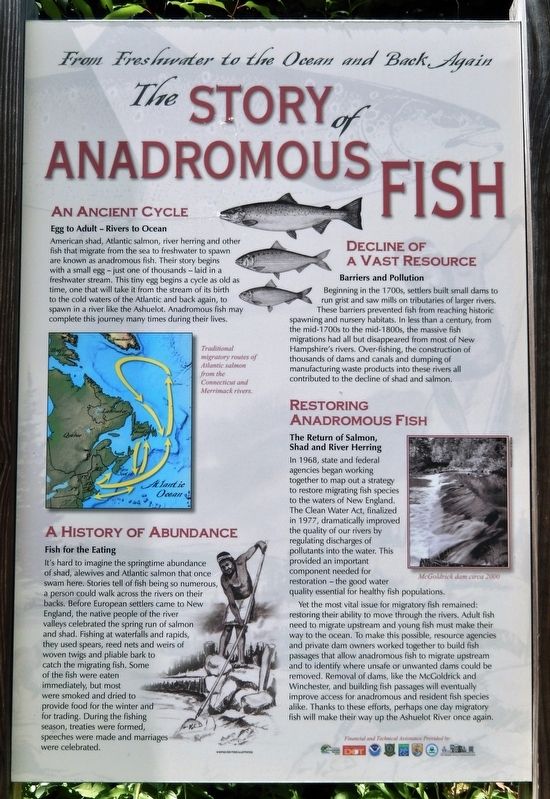
An Ancient Cycle
Egg to Adult — Rivers to Ocean
American shad, Atlantic salmon, river herring and other fish that migrate from the sea to freshwater to spawn are known as anadromous fish. Their story begins with a small egg — just one of thousands — laid in a freshwater stream. This tiny egg begins a cycle as old as time, one that will take it from the stream of its birth to the cold waters of the Atlantic and back again, to spawn in a river like the Ashuelot. Anadromous fish may complete this journey many times during their lives.
A History of Abundance
Fish for the Eating
It's hard to imagine the springtime abundance of shad, alewives and Atlantic salmon that once swam here. Stories tell of fish being so numerous, a person could walk across the rivers on their backs. Before European settlers came to New England, the native people of the river valleys celebrated the spring run of salmon and shad. Fishing at waterfalls and rapids, they used spears, reed nets and weirs of woven twigs and pliable bark to catch the migrating fish. Some of the fish were eaten immediately, but most were smoked and dried to provide
this page online
Decline of a Vast Resource
Barriers and Pollution
Beginning in the 1700s, settlers built small dams to run grist and saw mills on tributaries of larger rivers. These barriers prevented fish from reaching historic spawning and nursery habitats. In less than a century, from the mid-1700s to the mid-1800s, the massive fish migrations had all but disappeared from most of New Hampshire's rivers. Over-fishing, the construction of thousands of dams and canals and dumping of manufacturing waste products into these rivers all contributed to the decline of shad and salmon.
Restoring Anadromous Fish
The Return of Salmon, Shad and River Herring
In 1968, state and federal agencies began working together to map out a strategy to restore migrating fish species to the waters of New England. The Clean Water Act, finalized in 1977, dramatically improved the quality of our rivers by regulating discharges of pollutants into the water. This provided an important component needed for restoration — the good water quality
Photographed by Cosmos Mariner, July 8, 2019
2. The Story of Anadromous Fish Marker
Yet the most vital issue for migratory fish remained: restoring their ability to move through the rivers. Adult fish need to migrate upstream and young fish must make their way to the ocean. To make this possible, resource agencies and private dam owners worked together to build fish passages that allow anadromous fish to migrate upstream and to identify where unsafe or unwanted dams could be removed. Removal of dams, like the McGoldrick and Winchester, and building fish passages will eventually improve access for anadromous and resident fish species alike. Thanks to these efforts, perhaps one day migratory fish will make their way up the Ashuelot River once again.
Topics. This historical marker is listed in these topic lists: Animals • Environment • Indigenous Peoples and Communities • Waterways & Vessels.
Location. 42° 47.297′ N, 72° 28.203′ W. Marker is in Hinsdale, New Hampshire, in Cheshire County. It is on Canal Street (New Hampshire Route 119) half a mile east of Chesterfield Road ( Route 63), on the left when traveling east. Marker is located in a pull-out on the north side of the highway. Touch for map. Marker is in this post office area: Hinsdale NH 03451, United States of America. Touch for directions.

Regionally, this marker is in the American Northeast and in New England. Globally, it is in North America, the Western Hemisphere, the Western World, and the Anglosphere. Historically, it finds itself in what was once one of the original Thirteen Colonies.
Other nearby markers. At least 8 other markers are within 3 miles of this marker, measured as the crow flies: Hinsdale and the Power of the Ashuelot (here, next to this marker); Hinsdale's Auto Pioneer (approx. 0.2 miles away); Newhall & Stebbins (approx. half a mile away); Hinsdale World War I Memorial (approx. 0.6 miles away); Hinsdale World War II Veterans Memorial (approx. 0.6 miles away); Town of Hinsdale Veterans Memorial (approx. 0.6 miles away); Hinsdale, New Hampshire Post Office (approx. 0.6 miles away); Ashuelot Covered Bridge (approx. 2½ miles away). Touch for a list and map of all markers in Hinsdale.
Also see . . .
1. Restoring Anadromous Fish. New Hampshire Fish and Game entry:
Today, only a few thousand shad even have the chance to spawn in New Hampshire waters. There is a ripple effect on the ecosystem as predator populations grow and the shift in resource use takes the pressure off of other prey populations. There are many aspects to this ripple effect that we do not understand. Similar to the bison of the great plains, the decline of diadromous fish marked a major shift in the ecosystem of the Northeast. (Submitted on July 1, 2020, by Cosmos Mariner of Cape Canaveral, Florida.)
2. New Hampshire River Restoration Task Force. New Hampshire Department of Environmental Services entry:
The removal of the McGoldrick dam was a critical piece of a larger plan to restore anadromous fish to the Ashuelot River, a historically significant Connecticut River tributary for American shad, blueback herring and Atlantic salmon. Two additional dams on the river have since been removed, the Winchester Dam in Winchester, removed in 2002 and the Homestead Woolen Mill Dam in West Swanzey, removed in 2010. Since 2002, numerous obsolete dams have been removed in New Hampshire with input from the task force. Most recently, the Great Dam on the Exeter River in Exeter was removed in the summer of 2016. (Submitted on July 1, 2020, by Cosmos Mariner of Cape Canaveral, Florida.)
Credits. This page was last revised on October 8, 2023. It was originally submitted on July 1, 2020, by Cosmos Mariner of Cape Canaveral, Florida. This page has been viewed 500 times since then and 27 times this year. Photos: 1, 2. submitted on July 1, 2020, by Cosmos Mariner of Cape Canaveral, Florida.
