Near Cortez in Montezuma County, Colorado — The American Mountains (Southwest)
Greening the Valley
Photographed by Duane and Tracy Marsteller, July 10, 2020
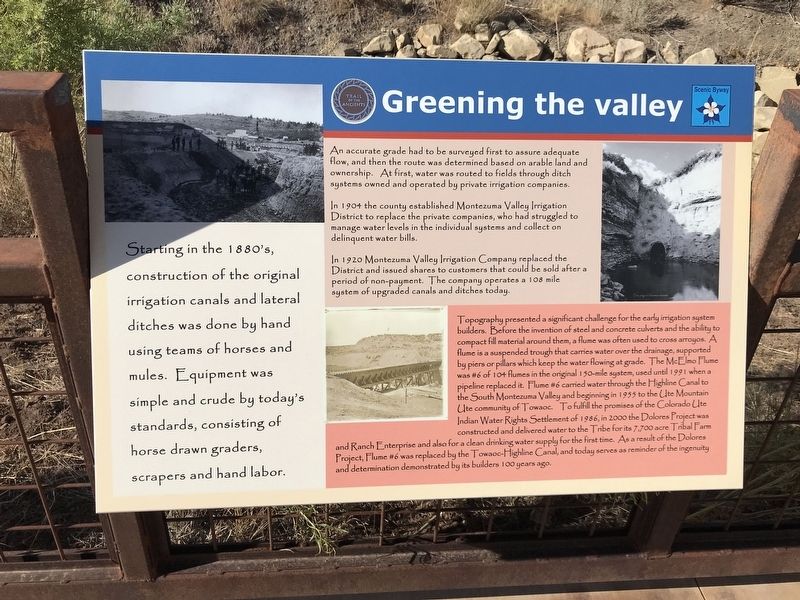
1. Greening the Valley Marker
An accurate grade had to be surveyed first to assure adequate flow, and then the route was determined based on arable land and ownership. At first, water was routed to fields through ditch systems owned and operated by private irrigation companies.
In 1904 the county established Montezuma Valley Irrigation District to replace the private companies, who had struggled to manage water levels in the individual systems and collect on delinquent water bills.
In 1920 Montezuma Valley Irrigation Company replaced the District and issued shares to customers that could be sold after a period of non-payment. The company operates a 108-mile system of upgraded canals and ditches today.
Topography presented a significant challenge for the early irrigation system builders. Before the invention of steel and concrete culverts and the ability to compact fill material around them, a flume
this page online
Topics. This historical marker is listed in these topic lists: Agriculture • Indigenous Peoples and Communities • Waterways & Vessels. A significant historical year for this entry is 1880.
Location. 37° 20.879′ N, 108° 30.176′ W. Marker
Photographed by Duane and Tracy Marsteller, July 10, 2020
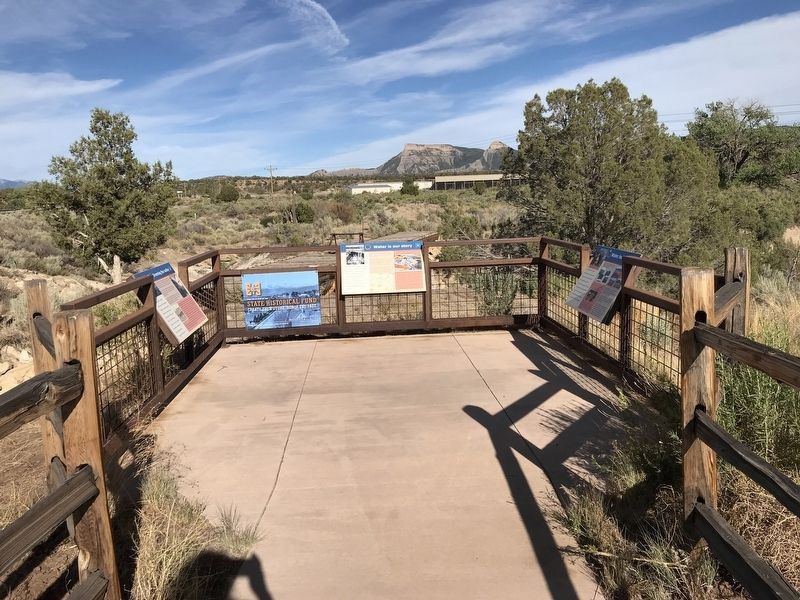
2. Greening the Valley Marker
Marker is on the left.

Regionally, this marker is in the American Mountain West, on the Colorado Plateau, and at the Four Corners. Globally, it is in North America, the Rocky Mountains, the Western Hemisphere, the Western World, and the Anglosphere. Historically, it finds itself in what was once the territory of the Ancestral Puebloans and also Mexico’s Alta California.
Other nearby markers. At least 8 other markers are within 4 miles of this marker, measured as the crow flies: Water is Our Story (here, next to this marker); Water Technology (here, next to this marker); Preserving the McElmo Creek Flume (within shouting distance of this marker); Veterans Memorial (approx. 2.4 miles away); Four Corners (approx. 3.3 miles away); Cortez (approx. 3.3 miles away); Southwest Survival (approx. 3.3 miles away); Mesa Verde Country (approx. 3.3 miles away). Touch for a list and map of all markers in Cortez.
Credits. This page was last revised on August 18, 2020. It was originally submitted on July 23, 2020, by Duane and Tracy Marsteller of Murfreesboro, Tennessee. This page has been viewed 320 times since then and 24 times this year. Photos: 1, 2. submitted on July 23, 2020, by Duane and Tracy Marsteller of Murfreesboro, Tennessee. • Andrew Ruppenstein was the editor who published this page.
