Squirrel Hill South in Pittsburgh in Allegheny County, Pennsylvania — The American Northeast (Mid-Atlantic)
From Slavery to Freedom Garden
Photographed by Devry Becker Jones (CC0), September 11, 2020
1. From Slavery to Freedom Garden Marker
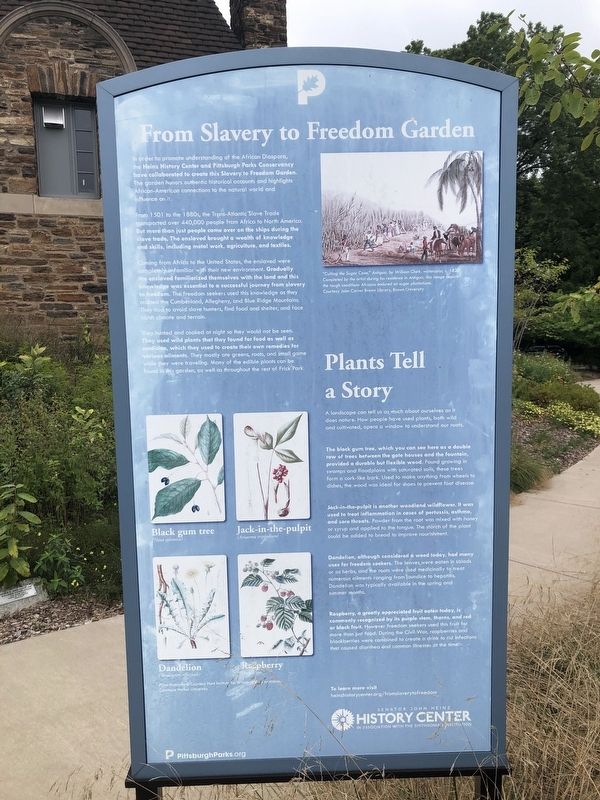
In order to promote understanding of the African Diaspora, the Heinz History Center and Pittsburgh Parks Conservancy have collaborated to create this Slavery to Freedom Garden. The garden honors authentic historical accounts and highlights African-American connections to the natural world and influence on it.
From 1501 to the 1880s, the Trans-Atlantic Slave Trade transported over 440,000 people from Africa to North America. But more than just people came over on the ships during the slave trade. The enslaved brought a wealth of knowledge and skills, including metal work, agriculture, and textiles.
Coming from Africa to the United States, the enslaved were completely unfamiliar with their new environment. Gradually the enslaved familiarized themselves with the land and this knowledge with essential to a successful journey from slavery to freedom. The freedom seekers used this knowledge as they crossed the Cumberland, Allegheny, and Blue Ridge Mountains. They had to avoid slave hunters, find food and shelter, and face harsh climate and terrain.
They hunted and cooked at night so they would not be seen. They used wild plants that they found for food as well as medicine, which they used to create their own remedies for various ailments.
this page online
Plants Tell a Story
A landscape can tell us as much about ourselves as it does nature. How people have used plants, both wild and cultivated, opens a window to understand our roots.
The black gum tree, which you can see here as a double row of trees between the gate houses and the fountain, provided a durable but flexible wood. Found growing in swamps and floodplains with saturated soils, these trees form a cork-like bark. Used to make anything from wheels to dishes, the wood was ideal for shoes to prevent foot disease.
Jack-in-the-pulpit is another woodland wildflower. It was used to treat inflammation in cases of pertussis, asthma, and sore throats. Powder from the root was mixed with honey or syrup and applied to the tongue. The starch of the plant could be added to bread to improve nourishment.
Dandelion, although considered a weed today, had many uses for freedom seekers. The leaves were eaten in salads or as herbs, and the roots were used medicinally
Photographed by Devry Becker Jones (CC0), September 11, 2020
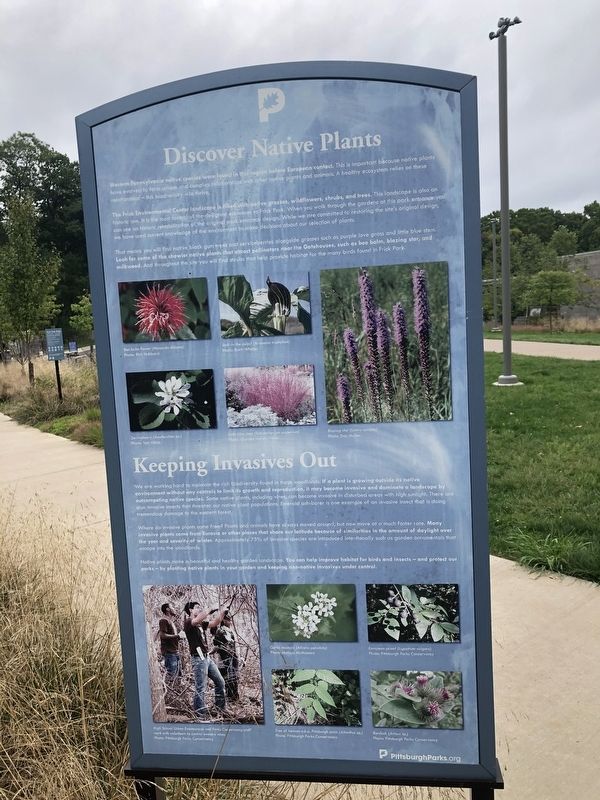
2. Discover Native Plants / Keeping Invasive Out side of marker
The reverse is a nature/environmental marker.
Raspberry, a greatly appreciated fruit eaten today, is commonly recognized by its purple stem, thorns, and red or black fruit. However freedom seekers used this fruit for more than just food. During the Civil War, raspberries and blackberries were combined to create a drink to rid infections that caused diarrhea and common illnesses at the time.
Erected by Pittsburgh Parks Conservancy, City of Pittsburgh, Pennsylvania.
Topics. This historical marker is listed in these topic lists: Abolition & Underground RR • African Americans • Science & Medicine • War, US Civil. A significant historical year for this entry is 1501.
Location. 40° 26.216′ N, 79° 54.481′ W. Marker is in Pittsburgh, Pennsylvania, in Allegheny County. It is in Squirrel Hill South. It can be reached from Beechwood Boulevard 0.1 miles east of Shaw Avenue, on the right when traveling north. Touch for map. Marker is at or near this postal address: 1981 Beechwood Blvd, Pittsburgh PA 15217, United States of America. Touch for directions.

Regionally,
Photographed by Devry Becker Jones (CC0), September 11, 2020
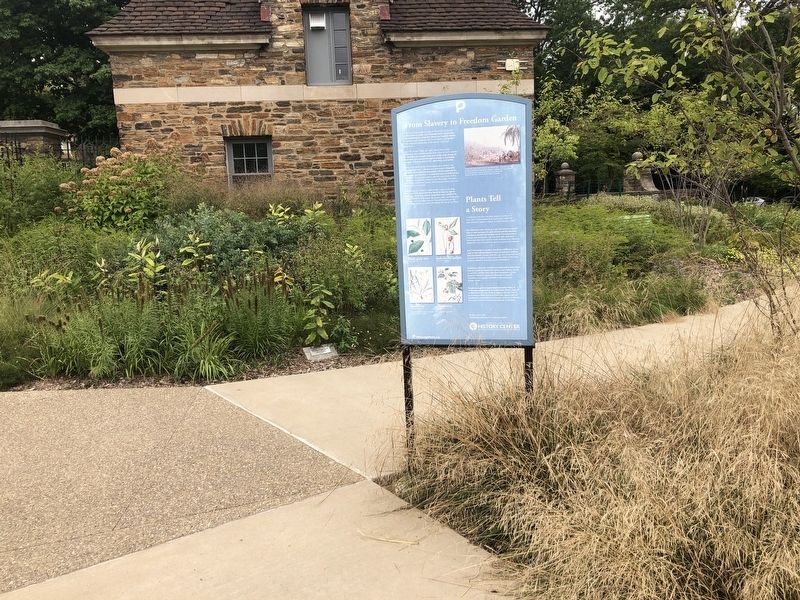
3. From Slavery to Freedom Garden Marker
Other nearby markers. At least 8 other markers are within walking distance of this marker: A different marker also named From Slavery to Freedom Garden (a few steps from this marker); Park Development (within shouting distance of this marker); Frick Family (within shouting distance of this marker); Frick Park Today (within shouting distance of this marker); Welcome to the Frick Woods / Pennsylvania - Forest Land (about 400 feet away, measured in a direct line); Veterans Memorial (approx. ¼ mile away); a different marker also named Veterans Memorial (approx. 0.4 miles away); The Homewood Cemetery (approx. 0.4 miles away). Touch for a list and map of all markers in Pittsburgh.
Additional keywords. Human trafficking, the slave trade
Credits. This page was last revised on February 2, 2023. It was originally submitted on September 13, 2020, by Devry Becker Jones of Washington, District of Columbia. This page has been viewed 403 times since then and 56 times this year. Photos: 1, 2, 3. submitted on September 13, 2020, by Devry Becker Jones of Washington, District of Columbia.
