
Near Winchester in Frederick County, Virginia — The American South (Mid-Atlantic)
The Third Battle of Winchester
Confederate Defense
Photographed by Craig Swain, August 26, 2007
1. The Third Battle of Winchester Marker
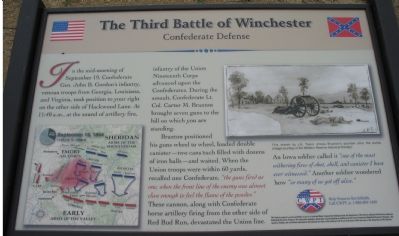
In the mid-morning of September 19, Confederate Gen. John B. Gordon's infantry, veteran troops from Georgia, Louisiana, and Virginia, took position to your right on the other side of Hackwood Lane. At 11:40 a.m., at the sound of artillery fire, infantry of the Union Nineteenth Corps advanced upon the Confederates. During the assault, Confederate Col. Carter M. Braxton brought seven guns to the hill on which you are standing.
Braxton positioned his guns wheel to wheel, loaded with double canister - two cans each filled with dozens of iron balls - and waited. When the Union troops were within 60 yards, recalled one Confederate, "the guns fired as one, when the front line of the enemy was almost close enough to feel the flame of the powder." These cannon, along with Confederate horse artillery firing from the other side of Red Bud Run, devastated the Union line. An Iowa soldier called it, "one of the most withering fires of shot, shell, and canister I have ever witnessed." Another soldier wondered how "so many of us got off alive."
Erected by Civil War Preservation Trust.
Topics. This historical marker is listed
this page online
Location. Marker has been reported permanently removed. It was located near 39° 12.051′ N, 78° 7.752′ W. Marker was near Winchester, Virginia, in Frederick County. It could be reached from Redbud Road (County Route 661), on the right when traveling east. Located at the Confederate Defense Setup Wayside, along the Battle Trail, inside the CWPT Third Winchester Battlefield site. The closest trailhead to this marker is along Redbud Road. Touch for map. Marker was in this post office area: Winchester VA 22603, United States of America.
We have been informed that this marker is no longer there and will not be replaced. This page is an archival view of what was.
Regionally, this marker was in Virginia’s Shenandoah Valley. It was also in the American South, specifically in the Upper South, and in the Mid-Atlantic. Globally, it was in North America, the Western Hemisphere, the Western World, and the Anglosphere. Historically, it found itself in what was once the territory of the Mississippian Culture, one of the original Thirteen Colonies, one

Photographed by Craig Swain, August 26, 2007
2. The Battle Map
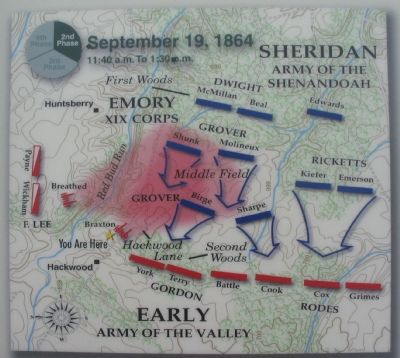
Note how well integrated were the artillery of Braxton and Breathed. The rose shaded area in the middle of the map indicates the area covered by Confederate artillery fires. At the time of the battle, this section of the battlefield was open, and was called "Middle Field" by the Federal leaders in their after action reports.
Other nearby markers. At least 7 other markers are within walking distance of this location: Bloody Repulse (about 400 feet away, measured in a direct line); Hackwood And Patton (about 500 feet away); Union Breakthrough (approx. 0.2 miles away); Alabama (approx. 0.2 miles away); The Cost of Battle (approx. 0.2 miles away); Ten Thousand Devils (approx. 0.2 miles away); In Memory of Gilcin F. Meadors III (approx. 0.2 miles away). Touch for a list and map of all markers in Winchester.
Other markers no longer nearby. The Third Battle of Winchester (was here, next to this marker but has been permanently removed); a different marker also named The Third Battle of Winchester (was within shouting distance of this marker but has been permanently removed); a different marker also named The Third Battle of Winchester (was about 500 feet away but has been permanently removed); a different marker also named The Third Battle of Winchester (was about 500 feet away but has been permanently removed); a different marker also named The Third Battle of Winchester (was about 500
Photographed by Craig Swain, March 15, 2008
3. Confederate Defense Wayside
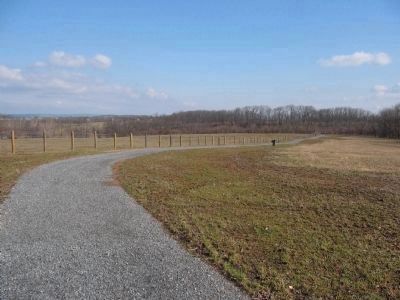
The marker faces to the southeast off the trail in the center. The next stop, Hackwood House, is just before the tree line in the distance.
More about this marker. On the lower left is a battle map showing the tactical situation between 11:40 a.m. and 1:30 p.m. on September 19, 1864. On the right is a drawing depicting Braxton's position - "This sketch by J.E. Taylor shows Braxton's position after the battle."
Also see . . .
1. Summary of the Battle of Third Winchester. The action described on the marker falls under Phase 4 of this National Parks Service summary. (Submitted on October 27, 2007, by Craig Swain of Leesburg, Virginia.)
2. CWPT Walking Tour of The Third Battle of Winchester. This marker is one
Photographed by Craig Swain, August 26, 2007
4. Middle Field
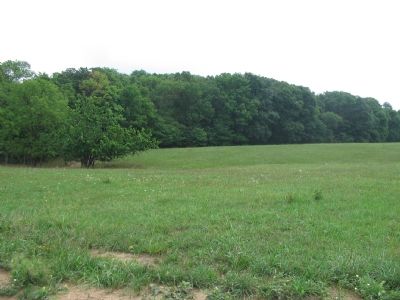
Trees have grown, and covered, portions of Middle Field today, but not so much to obscure the view Braxton's gunners had of the Federal mid-day advance.
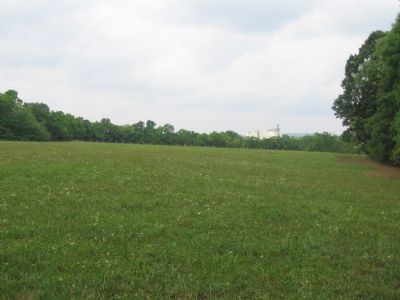
Photographed by Craig Swain, August 26, 2007
5. Braxton's Position
Looking from the Federal side of the field, the Confederate artillery was positioned at the higher ground, in the vicinity of the modern fence line in the distance.
Photographed by Craig Swain, August 26, 2007
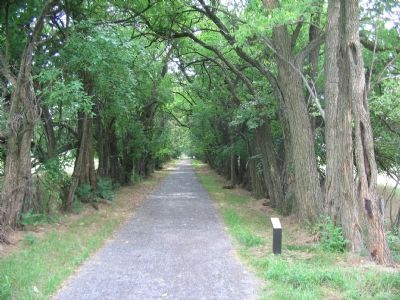
6. Hackwood Lane
This road cut across the Middle Field at the time of the battle. The trees were not present at the time of the battle.
Photographed by Craig Swain, August 26, 2007
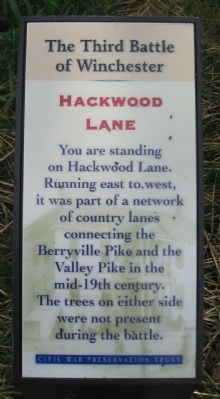
7. Hackwood Lane Sign
The small sign on the lower right of the photo above reads:
You are standing on Hackwood Lane. Running east to west, it was part of a network of country lanes connecting the Berryville Pike and the Valley Pike in the mid-19th century. The trees on either side were not present during the battle.
You are standing on Hackwood Lane. Running east to west, it was part of a network of country lanes connecting the Berryville Pike and the Valley Pike in the mid-19th century. The trees on either side were not present during the battle.

8. Obsolete entry
Credits. This page was last revised on June 5, 2024. It was originally submitted on October 27, 2007. This page has been viewed 1,720 times since then and 19 times this year. Last updated on November 3, 2020, by Bradley Owen of Morgantown, West Virginia. Photos: 1, 2. submitted on October 27, 2007, by Craig Swain of Leesburg, Virginia. 3. submitted on March 16, 2008, by Craig Swain of Leesburg, Virginia. 4, 5, 6, 7. submitted on October 27, 2007, by Craig Swain of Leesburg, Virginia. 8. submitted on March 13, 2009, by Craig Swain of Leesburg, Virginia. • J. Makali Bruton was the editor who published this page.
