The National Mall in Southwest Washington in Washington, District of Columbia — The American Northeast (Mid-Atlantic)
Eastern Meadow
Pradera del este
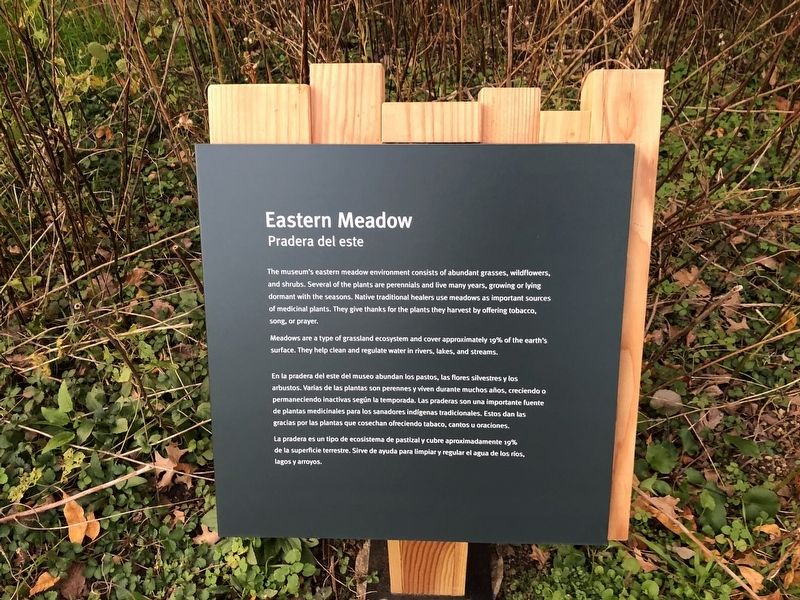

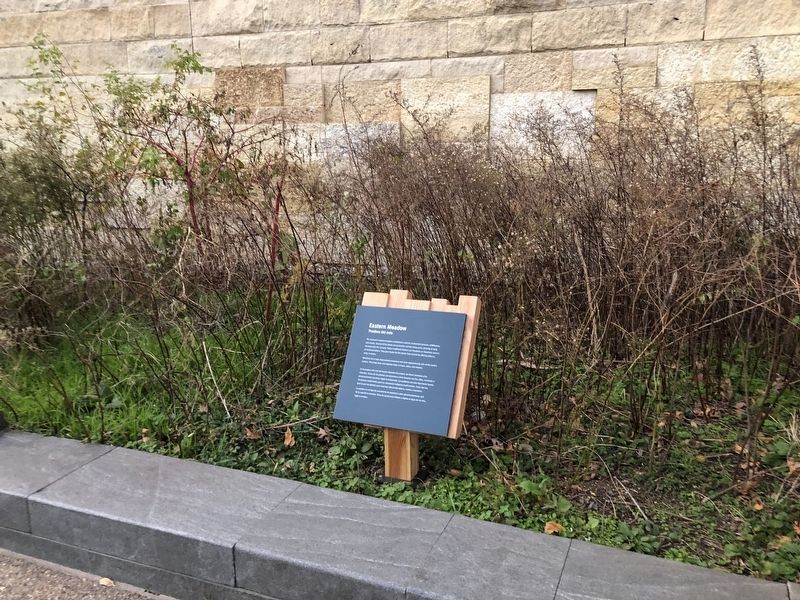
This museum's eastern meadow environment consists of abundant grasses, wildflowers, and shrubs. Several of the plants are perennials and live many years, growing or lying dormant with the seasons. Native traditional healers use meadows as important sources of medicinal plants. They give thanks for the plants they harvest by offering tobacco, song, or prayer.
Meadows are a type of grassland ecosystem and cover approximately 19% of the earth's surface. They help clean and regulate water in rivers, lakes, and streams.
[Spanish translation:]
La pradera es un tipo de ecosistema de pastizal y cubre aproximadamente 19% de la superficie terrestre. Sirve de ayuda para limpiar y regular el agua de los rios,
this page online
Erected by Smithsonian Institution.
Topics. This historical marker is listed in these topic lists: Anthropology & Archaeology • Indigenous Peoples and Communities • Science & Medicine.
Location. 38° 53.272′ N, 77° 1.025′ W. Marker is in Southwest Washington in Washington, District of Columbia. It is in The National Mall. It is at the intersection of Independence Avenue Southwest and 4th Street Southwest, on the right when traveling west on Independence Avenue Southwest. Touch for map. Marker is at or near this postal address: 482 Independence Ave SW, Washington DC 20024, United States of America. Touch for directions.

Regionally, this marker is in the Washington Metropolitan Area. It is also in the American Northeast, in the Upper South, in the Mid-Atlantic, in the Tidewater, and in the Chesapeake Bay Region. Globally, it is in North America, the Western Hemisphere, the Western World, and the Anglosphere.
Other nearby markers. At least 5 other markers are within walking distance of this marker: A different marker also named Nora Naranjo-Morse
Other markers no longer nearby. Wingapo (was a few steps from this marker but has been replaced with another marker now near it); Meadow (was a few steps from this marker but has been replaced with another marker now near it); Broomsedge (was a few steps from this marker but has been permanently removed); Nora Naranjo-Morse (was a few steps from this marker but has been replaced with another marker now near it); Lunar Calendars (was within shouting distance of this marker but has been permanently removed); a different marker also named Nora Naranjo-Morse (was within shouting distance of this marker but has been replaced with another marker now near it); Eastern Redcedar • Muráhk (mah-dok) (was within shouting distance of this marker but has been permanently removed); Cardinal Direction Marker: South (was within shouting distance of this marker but has been replaced with another marker now near it); Traditional Croplands (was within shouting distance of this marker but has been replaced with another marker now near it); a different marker also named Cardinal Direction Marker: West (was within shouting distance of this marker but has been replaced with another marker now near it); Sunflower • Wádxaweew (wah-ha-way-oh) (was within shouting distance of this marker but has been permanently removed).
Related marker. Click here for another marker that is related to this marker. This marker has replaced the linked marker.
Credits. This page was last revised on January 30, 2023. It was originally submitted on December 3, 2020, by Devry Becker Jones of Washington, District of Columbia. This page has been viewed 263 times since then and 10 times this year. Photos: 1, 2. submitted on December 3, 2020, by Devry Becker Jones of Washington, District of Columbia.
