Near Chickamauga in Walker County, Georgia — The American South (South Atlantic)
Cooper's Gap
Chickamauga Campaign Heritage Trail
Photographed by Darren Jefferson Clay, March 27, 2022
1. Cooper's Gap Marker
Inscription.
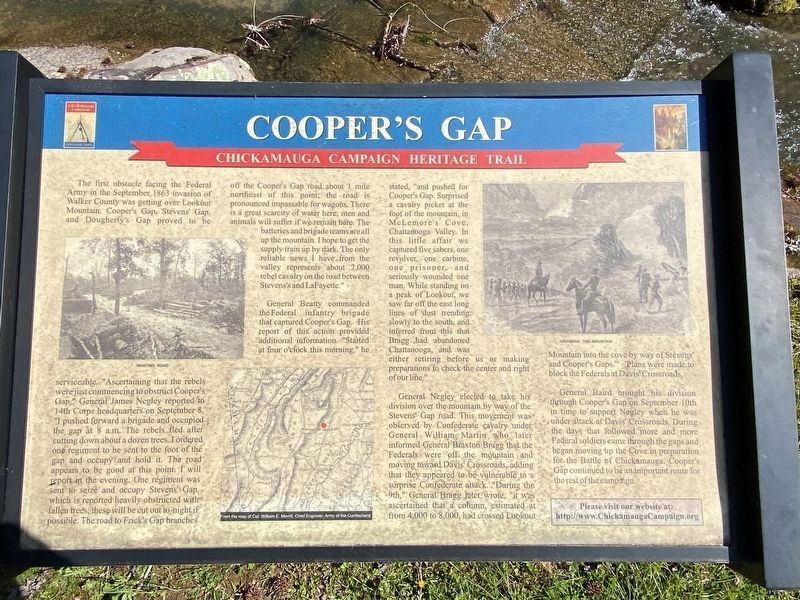
Cooper's Gap. Chickamauga Campaign Heritage Trail. The first obstacle facing the Federal Army in the September 1863 invasion of Walker County was getting over Lookout Mountain. Cooper's Gap, Stevens' Gap, and Dougherty's Gap proved to be serviceable. "Ascertaining that the rebels were just commencing to obstruct Cooper's Gap," General James Negley reported to 14th Corps headquarters on September 8, "I pushed forward a brigade and occupied the gap at 8 a.m. The rebels fled after cutting down about a dozen trees. I ordered one regiment to be sent to the foot of the gap and occupy and hold it. The road appears to be good at this point. I will report in the evening. One regiment was sent to seize and occupy Stevens' Gap, which is reported heavily obstructed with fallen trees; these will be cut out to-night if possible. The road to Frick's Gap branches off the Cooper's Gap road about 1 mile northeast of this point; the road is pronounced impassable for wagons. There is a great scarcity of water here; men and animals will suffer if we remain here. The batteries and brigade teams are all up the mountain. I hope to get the supply train up by dark. The only reliable news I have from the valley represents about 2,000 rebel cavalry on the road between Stevens's and LaFayette.", General Beatty commanded the Federal infantry brigade that captured Cooper's Gap. His report of this action provided additional information. "Started at four o'clock this morning," he stated, "and pushed for Cooper's Gap. Surprised a cavalry picket at the foot of the mountain, in McLemore's Cove, Chattanooga Valley. In this little affair we captured five sabers, one revolver, one carbine, one prisoner, and seriously wounded one man. While standing on a peak of Lookout, we saw far off the east long-lines of dust trending slowly to the south, and inferred from this that Bragg had abandoned Chattanooga, and was either retiring before us or making preparations to check the center and right of our line.", General Negley elected to take his division over the mountain by way of the Stevens' Gap road. This movement was observed by Confederate cavalry under General William Martin who later informed General Braxton Bragg that the Federals were off the mountain and moving toward Davis' Crossroads, adding that they appeared to be vulnerable to a surprise Confederate attack. "During the 9th," General Bragg later wrote, "it was ascertained that a column, estimated at from 4,000 to 8,000, had crossed Lookout Mountain into the cove by way of Stevens' and Cooper's Gaps." Plans were made to block the Federals at Davis' Crossroads., General Baird brought his division through Cooper's Gap on September 10th in time to support Negley when he was under attack at Davis' Crossroads. During the days that followed more and more Federal soldiers came through the gaps and began moving up the Cove in preparation for the Battle of Chickamauga. Cooper's Gap continued to be an important route for the rest of the campaign., Captions(left to right): , . Wartime road , . From the map of Col. William E. Merrill, Chief Engineer, Army of the Cumberland , . Crossing the mountain
The first obstacle facing the Federal Army in the September 1863 invasion of Walker County was getting over Lookout Mountain. Cooper's Gap, Stevens' Gap, and Dougherty's Gap proved to be serviceable. "Ascertaining that the rebels were just commencing to obstruct Cooper's Gap," General James Negley reported to 14th Corps headquarters on September 8, "I pushed forward a brigade and occupied the gap at 8 a.m. The rebels fled after cutting down about a dozen trees. I ordered one regiment to be sent to the foot of the gap and occupy and hold it. The road appears to be good at this point. I will report in the evening. One regiment was sent to seize and occupy Stevens' Gap, which is reported heavily obstructed with fallen trees; these will be cut out to-night if possible. The road to Frick's Gap branches off the Cooper's Gap road about 1 mile
northeast of this point; the road is pronounced impassable for wagons. There is a great scarcity of water here; men and animals will suffer if we remain here. The batteries and brigade teams are all up the mountain. I hope to get the supply train up by dark. The only reliable news I have from the valley represents about 2,000 rebel cavalry on the road between Stevens's and LaFayette."
General Beatty commanded the Federal infantry brigade that captured Cooper's Gap. His
report of this action provided
Click or scan to see this page online
additional information. "Started at four o'clock this morning," he stated, "and pushed for Cooper's Gap. Surprised a cavalry picket at the
foot of the mountain, in McLemore's Cove, Chattanooga Valley. In this little affair we
captured five sabers, one revolver, one carbine, one prisoner, and seriously wounded one
man. While standing on a peak of Lookout, we saw far off the east long-lines of dust trending slowly to the south, and inferred from this that Bragg had abandoned Chattanooga, and was either retiring before us or making preparations to check the center and right of our line."
General Negley elected to take his division over the mountain by way of the Stevens' Gap road. This movement was observed by Confederate cavalry under General William Martin who later informed General Braxton Bragg that the Federals were off the mountain and moving toward Davis' Crossroads, adding that they appeared to be vulnerable to a surprise Confederate attack. "During the 9th," General Bragg later wrote, "it was ascertained that a column, estimated at from 4,000 to 8,000, had crossed Lookout Mountain into the cove by way of Stevens' and Cooper's Gaps." Plans were made to block the Federals at Davis' Crossroads.
General Baird brought his division through Cooper's Gap on September 10th in time to support Negley when he was under attack at Davis' Crossroads. During the days
Photographed by Duane and Tracy Marsteller, March 6, 2021
2. Cooper's Gap Marker
that followed more and more Federal soldiers came through the gaps and began moving up the Cove in preparation for the Battle of Chickamauga. Cooper's Gap continued to be an important route for the rest of the campaign.
Captions(left to right):
Wartime road
From the map of Col. William E. Merrill, Chief Engineer, Army of the Cumberland
Crossing the mountain
Erected by Chickamauga Campaign Heritage Trail.
Topics and series. This historical marker is listed in these topic lists: Natural Features • War, US Civil. In addition, it is included in the Chickamauga Campaign Heritage Trail series list. A significant historical month for this entry is September 1863.
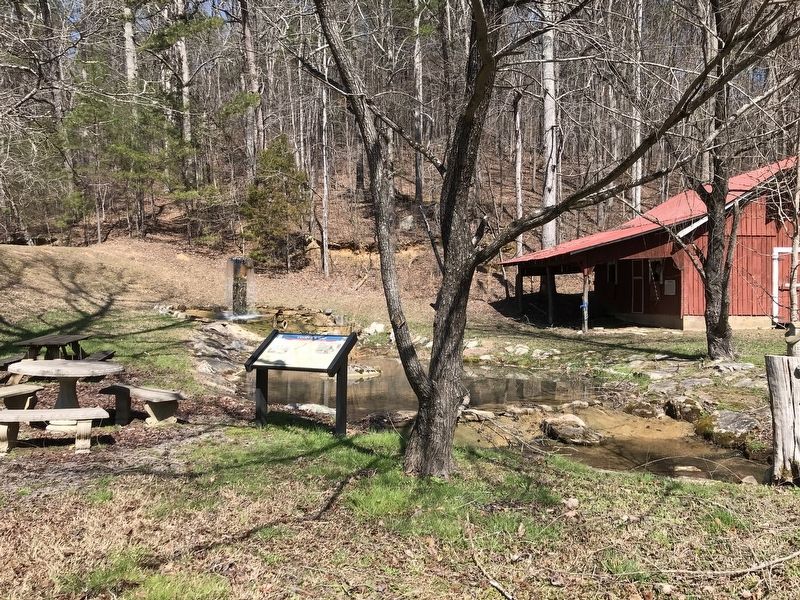
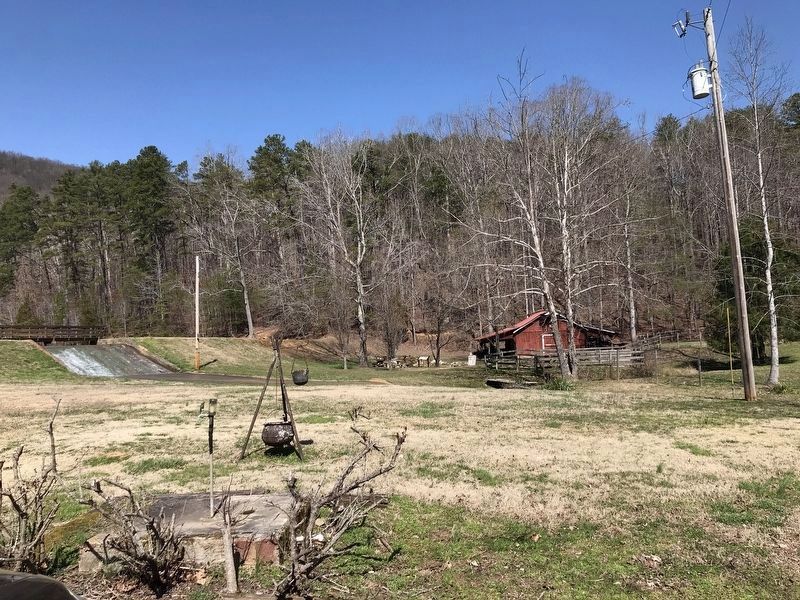
Location. 34° 49.399′ N, 85° 23.923′ W. Marker is near Chickamauga, Georgia, in Walker County. It is on Hidden Hollow Lane half a mile east of Lookout Mountain Scenic Highway (Georgia Route 136), on the left when traveling east. Touch for map. Marker is at or near this postal address: 463 Hidden Hollow Lane, Chickamauga GA 30707, United States of America. Touch for directions.
Regionally, this marker is in Georgia’s Mountains. It is also in the American South, specifically in the Deep South, in Appalachia, and specifically in Southern Appalachia. Globally, it is in the North Atlantic Region, North America, the Western Hemisphere, the Western World, and the Anglosphere. Historically, it finds itself in what was once the original Cherokee Nation, the territory of the Mississippian Culture, one of the original Thirteen Colonies, one of the Confederate States of America, and the Antebellum South.
Other markers no longer nearby. Bailey's Crossroads (was approx. 3.6 miles away but has been confirmed missing); Davis' Cross Roads (was approx. 5 miles away but has been confirmed missing).
Credits. This page was last revised on March 29, 2022. It was originally submitted on March 6, 2021, by Duane and Tracy Marsteller of Murfreesboro, Tennessee. This page has been viewed 1,003 times since then and 51 times this year. Photos:1. submitted on March 28, 2022, by Darren Jefferson Clay of Duluth, Georgia. 2, 3. submitted on March 6, 2021, by Duane and Tracy Marsteller of Murfreesboro, Tennessee.

