Florence in Hampshire County, Massachusetts — The American Northeast (New England)
The Anti-Slavery Community
Photographed by Don Morfe, May 23, 2013
1. The Anti-Slavery Community Marker
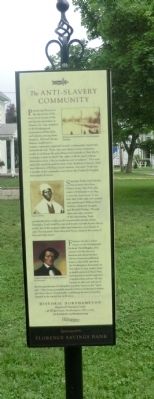
Sojourner Truth, born Isabella, was a former slave from Ulster County, New York who came to Northampton in 1843 to join the Association. It was here that Truth came into contact with abolitionists William Lloyd Garrison, Frederick Douglass and Wendell Phillips. Through them and other members of the Association, Truth was introduced to a wider world of nineteenth century reform. Thereafter, Truth would become well known not only in anti-slavery circles, but in the women’s rights and temperance movements as well. The Sojourner Truth Memorial Statue stands at the corner of Pine and Park streets.
Florence was also a major station on the Underground Railroad. David Ruggles, who assisted over 600 slaves to freedom and owned the first African-American publishing house in New York, arrived at the Northampton Association in November of 1842, broken down in health and nearly blind. Here, he found much needed supportive companionship and rest. He also became an advocate and one of the first practitioners of hydropathy, popularly known
this page online
Erected by Historic Northampton.
Topics and series. This historical marker is listed in these topic lists: Abolition & Underground RR • African Americans • Civil Rights • Women. In addition, it is included in the Communal and Utopian Societies series list. A significant historical month for this entry is November 1842.
Location. 42° 20.117′ N, 72° 40.4′ W. Marker is in Florence, Massachusetts, in Hampshire County. It is at the intersection of Park Street and Meadow Street on Park Street. Touch for map. Marker is in this post office area: Florence MA 01062, United States of America. Touch for directions.

Regionally, this marker is in the Knowledge Corridor, in Pioneer Valley, and in Greater Springfield. It is also in the American Northeast and in New England. Globally, it is in North America, the Western Hemisphere, the Western World, and the Anglosphere. Historically, it finds itself in what was once one of the original
Photographed by Don Morfe, May 23, 2013
2. The Anti-Slavery Community Marker
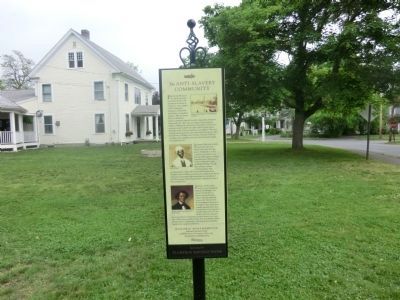
Wide shot of the marker
Other nearby markers. At least 8 other markers are within walking distance of this marker: Florence Manufacturing (here, next to this marker); Entrepreneurs and Philanthropists (here, next to this marker); The Florence Eagles (here, next to this marker); Mill River Flood (about 300 feet away, measured in a direct line); Basil C. Dorsey (about 500 feet away); After the demise of the Northampton Association (approx. ¼ mile away); Sojourner Truth (approx. ¼ mile away); Northampton Association of Education and Industry (approx. ¼ mile away). Touch for a list and map of all markers in Florence.
Photographed by Don Morfe, May 23, 2013
3. The Anti-Slavery Community Marker
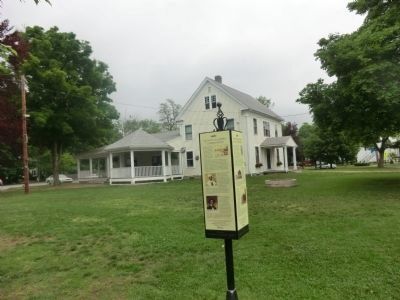
Four markers on one stand
Credits. This page was last revised on March 17, 2021. It was originally submitted on June 8, 2013, by Don Morfe of Baltimore, Maryland. This page has been viewed 992 times since then and 30 times this year. Last updated on March 17, 2021, by Carl Gordon Moore Jr. of North East, Maryland. Photos: 1, 2, 3. submitted on June 8, 2013, by Don Morfe of Baltimore, Maryland. • Bill Pfingsten was the editor who published this page.
