Near Chinook in Pacific County, Washington — The American West (Northwest)
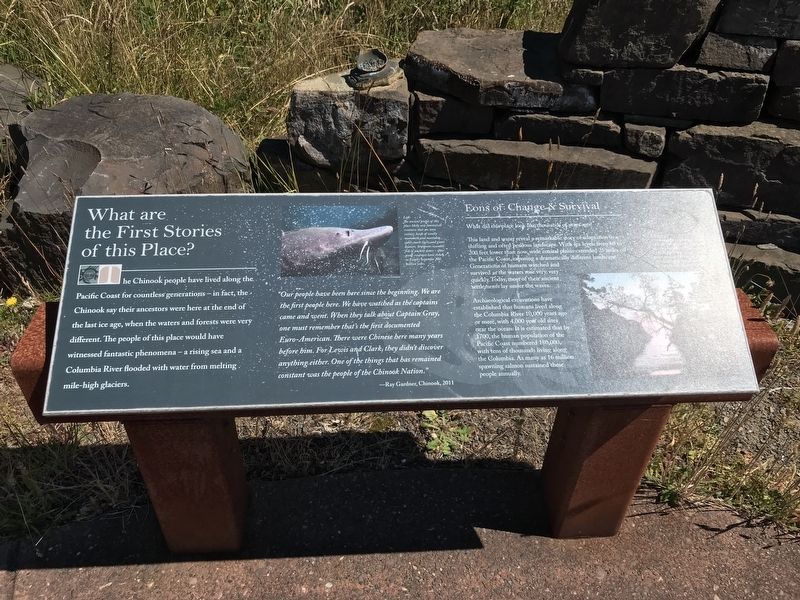
What Are the First Stories of This Place?
Photographed by Duane and Tracy Marsteller, June 27, 2021
1. What Are the First Stories of This Place? Marker
"Our people have been here since the beginning. We are the first people here. We have watched as the captains came and went. When they talk about Captain Gray, one must remember that's the first documented Euro-American. There were Chinese here many years before him. For Lewis and Clark, they didn't discover anything either. One of the things that has remained constant was the people of the Chinook Nation." — Ray Gardner, Chinook, 2011Eons of Change & Survival
What did this place look like thousands of years ago?
This land and water reveal a-remarkable story of adaptation in a shifting and often perilous landscape. With sea levels from 60 to 200 feet lower than now, wide coastal plains extended 25 miles off the Pacific Coast, exposing a dramatically different
this page online
Archaeological excavations have established that humans lived along the Columbia River 10,000 years ago or more, with 4,000-year-old sites near the ocean. It is estimated that by 1700, the human population of the Pacific Coast numbered 180,000, with tens of thousands living along the Columbia. As many as 16 million spawning salmon sustained these people annually.
Captions:
(left) The ancient people of this place likely saw fantastical creatures that are now extinct: herds of woolly mammoth and mastodon, saber-tooth tigers and giant beavers. Sturgeons resemble fish of ancient times – these giant creatures have swum in Earth's waters for 200 million years. Creative Commons
(right) [obscured in photograph]
Topics. This historical marker is listed in these topic lists: Environment • Indigenous Peoples and Communities • Waterways & Vessels.
Location. 46° 14.833′ N, 123° 54.63′ W. Marker is near Chinook, Washington, in Pacific
Photographed by Duane and Tracy Marsteller, June 27, 2021
2. What Are the First Stories of This Place? Marker
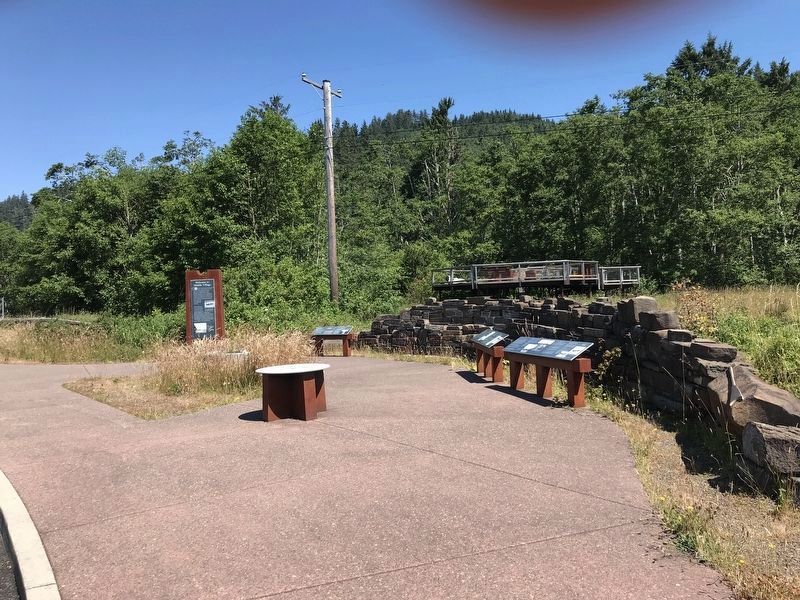
Marker is to the left.

Regionally, this marker is in Southwest Washington State. It is also on the American Pacific Coast, in the Pacific Northwest, and in the Lewis & Clark Corridor. Globally, it is in North America, on the Ring of Fire, on the Pacific Rim, in the Western Hemisphere, in the Western World, and in the Anglosphere.
Other nearby markers. At least 8 other markers are within walking distance of this marker: Welcome to Middle Village (here, next to this marker); A Collision of Cultures / How Did They Live? (here, next to this marker); The Search for the Northwest Passage / Jefferson's Mission Accomplished (here, next to this marker); How Do These Stories Continue? (within shouting distance of this marker); The Business of Trade (within shouting distance of this marker); In Search of Recognition (within shouting distance of this marker); St. Mary's Church (within shouting distance of this marker); Fort Columbia (approx. 0.7 miles away). Touch for a list and map of all markers in Chinook.
Credits. This page was last revised on July 16, 2021. It was originally submitted on July 16, 2021, by Duane and Tracy Marsteller of Murfreesboro, Tennessee. This page has been viewed 291 times since then and 27 times this year. Photos: 1, 2. submitted on July 16, 2021, by Duane and Tracy Marsteller of Murfreesboro, Tennessee.
