Near Chivington in Kiowa County, Colorado — The American Mountains (Southwest)
Cheyenne and Arapaho Village at Sand Creek
Sand Creek Massacre National Historic Site
Photographed by Connor Olson, August 30, 2021
1. Cheyenne and Arapaho Village at Sand Creek Marker
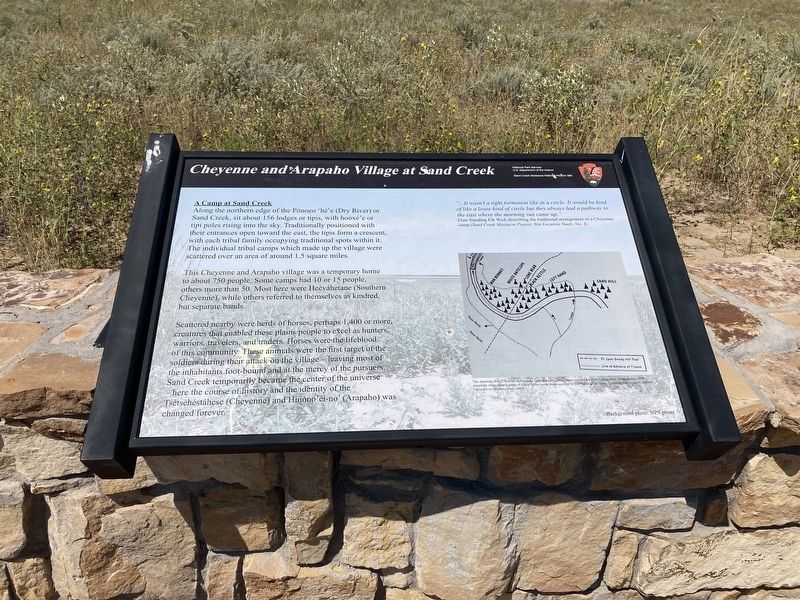
A Camp at Sand Creek
Along the northern edge of the Pónoeo 'hé'e (Dry River) or Sand Creek, sit about 156 lodges or tipis, with hoóxé’e or tipi poles rising into the sky. Traditionally positioned with their entrances open toward the east, the tipis form a crescent, with each tribal family occupying traditional spots within it. The individual tribal camps which made up the village were scattered over an area of around 1.5 square miles.
This Cheyenne and Arapaho village was a temporary home to about 750 people. Some camps had 10 or 15 people, others more than 50. Most here were Heéváhetane (Southern Cheyenne), while others referred to themselves as kindred, but separate bands.
Scattered nearby were herds of horses, perhaps 1,400 or more, creatures that enabled these plains people to excel as hunters, warriors, travelers, and traders. Horses were the lifeblood of this community. These animals were the first target of the soldiers during their attack on the village – leaving most of the inhabitants foot-bound and at the mercy of the pursuers. Sand Creek temporarily became the center of the universe here
this page online
"... It wasn't a tight formation like in a circle. It would be kind of like a loose kind of circle but they always had a pathway to the east where the morning sun came up.”
Elsie Standing Elk Wick describing the traditional arrangement of a Cheyenne camp ( Sand Creek Massacre Project, Site Location Study, Vol. 1 )
Caption: This depiction of the Cheyenne and Arapaho camp at Sand Creek is based on maps drawn by George Bent. Archaeology in 1999 placed the village three quarters of a mile farther north.
Erected by National Park Service.
Topics. This historical marker is listed in these topic lists: Indigenous Peoples and Communities • Wars, US Indian.
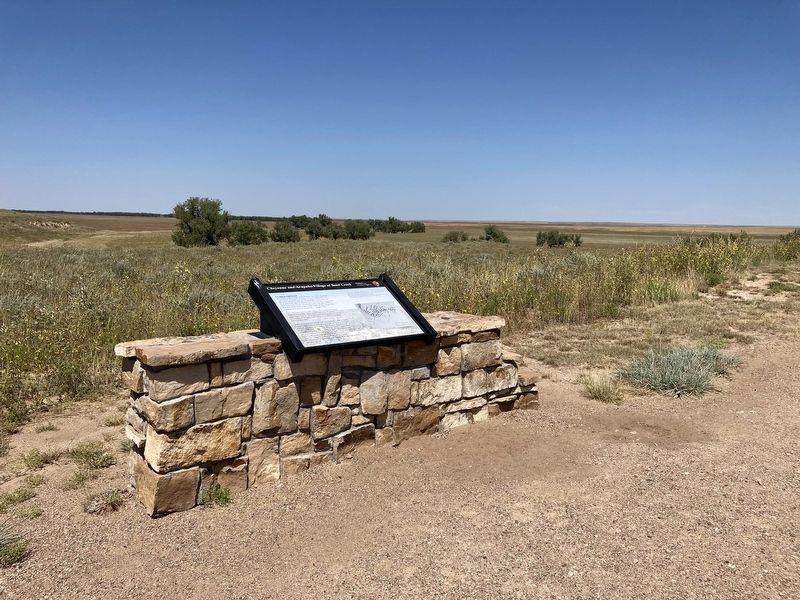
Location. 38° 32.962′ N, 102° 30.709′ W. Marker is near Chivington, Colorado, in Kiowa County. It can be reached from County Highway W east of Chief White Antelope Way. Located on Monument Hill. Touch for map. Marker is in this post office area: Eads CO 81036, United States of America. Touch for directions.

Regionally,
Photographed by Connor Olson, August 30, 2021
2. Cheyenne and Arapaho Village at Sand Creek Marker
Other nearby markers. At least 8 other markers are within walking distance of this marker: A Chief’s Village (a few steps from this marker); Sacred Memory (within shouting distance of this marker); Dawn November 29, 1864 (about 300 feet away, measured in a direct line); Fort Lyon Reservation (approx. ¼ mile away); Sand Creek as Camp Site (approx. ¼ mile away); Troops Approach the Village (approx. 0.4 miles away); Attack and Pursuit (approx. 0.4 miles away); Conscience and Courage (approx. half a mile away). Touch for a list and map of all markers in Chivington.
Other markers no longer nearby. Why? (was here, next to this marker but has been permanently removed); Pleas for Peace (was here, next to this marker but has been permanently removed); Returned to Sand Creek (was within shouting distance of this marker but has been permanently removed); Remains (was within shouting distance of this marker but has been permanently removed); Testimony (was within shouting distance of this marker but has been permanently removed); Healing (was within shouting distance of this marker but has been permanently removed); The Attack (was approx. 0.2 miles away but has been permanently removed); The Sand Creek Massacre (was approx. half a mile away but has been permanently removed).
Credits. This page was last revised on July 5, 2025. It was originally submitted on September 7, 2021, by Connor Olson of Menomonee Falls, Wisconsin. This page has been viewed 507 times since then and 61 times this year. Photos: 1, 2. submitted on September 7, 2021, by Connor Olson of Menomonee Falls, Wisconsin. • Andrew Ruppenstein was the editor who published this page.
