Downtown in Cleveland in Cuyahoga County, Ohio — The American Midwest (Great Lakes)
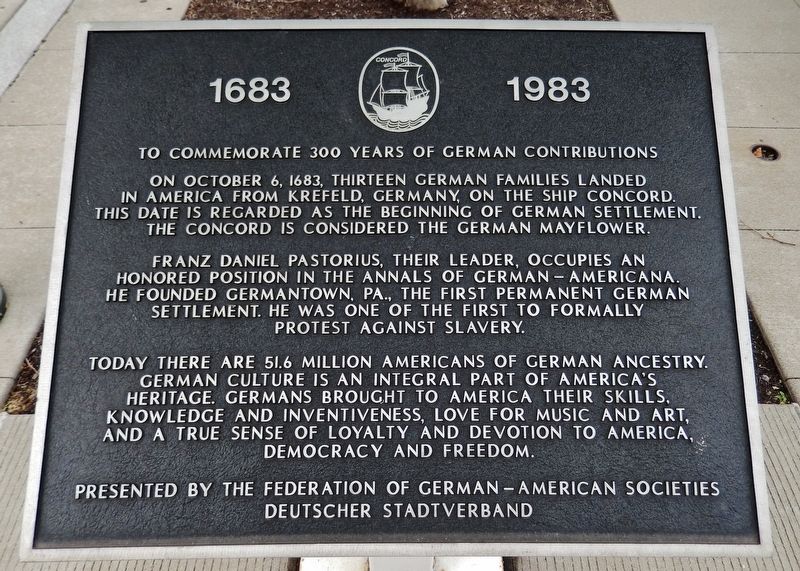
To Commemorate 300 Years of German Contributions
1683-1983
Photographed by Cosmos Mariner, June 18, 2021
1. To Commemorate 300 Years of German Contributions Marker
On October 6, 1683, thirteen German families landed in America from Krefeld, Germany, on the ship Concord. This date is regarded as the beginning of German settlement. The Concord is considered the German Mayflower.
Franz Daniel Pastorius, their leader, occupies an honored position in the annals of German-Americana. He founded Germantown, Pa., the first permanent German settlement. He was one of the first to formally protest against slavery.
Today there are 51.6 million Americans of German ancestry. German culture is an integral part of America's heritage. Germans brought to America their skills, knowledge and inventiveness, love for music and art, and a true sense of loyalty and devotion to America, Democracy and Freedom.
Erected by Federation of German-American Societies; and Deutscher Stadtverband.
Topics. This historical marker is listed in these topic lists: Civil Rights • Colonial Era • Settlements & Settlers • Waterways & Vessels. A significant historical date for this entry is October 6, 1683.
Location. 41° 30.176′ N, 81° 41.679′ W. Marker is in Cleveland, Ohio, in Cuyahoga County. It is in Downtown. It is
this page online

Regionally, this marker is on the Lake Erie Shore and in the Western Reserve. It is also in the American Midwest. Globally, it is in North America, on the Great Lakes, in the Western Hemisphere, in the Western World, and in the Anglosphere. Historically, it finds itself in what was once the Haudenosaunee (Iroquois) Confederacy, the territory of the Mississippian Culture, and the Northwest Territory.
Other nearby markers. At least 8 other markers are within walking distance of this marker: The First Christmas Tree in America (here, next to this marker); Slovenians, Thomas Jefferson and The Declaration of Independence (here, next to this marker); The Burnham Mall (about 500 feet away, measured in a direct line); War Savings Stamps (about 600 feet away); The Ohio AFL-CIO (about 700 feet away); Abraham Lincoln (about 700 feet away); Cleveland City Hall Centennial
Photographed by Cosmos Mariner, June 18, 2021
2. To Commemorate 300 Years of German Contributions Marker
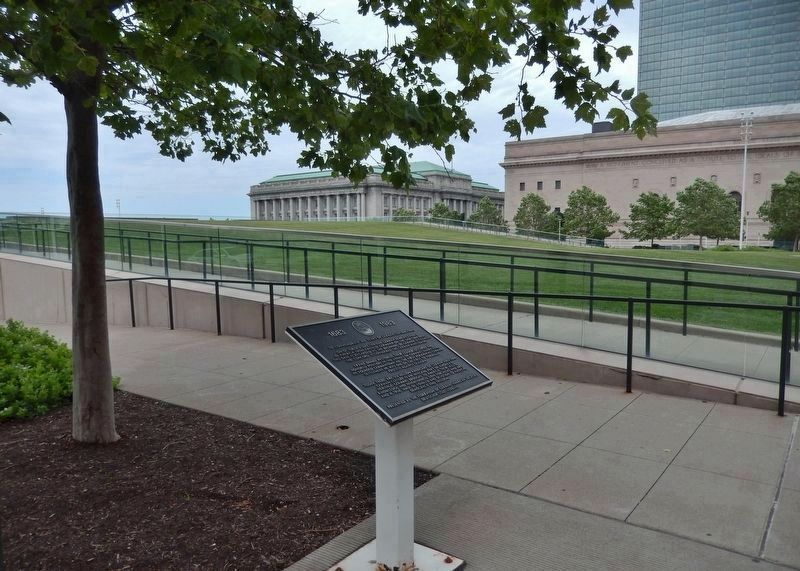
Looking northeast. Cleveland City Hall & Cleveland Public Auditorium in background.
Another marker is no longer nearby. Terry v. Ohio (was about 800 feet away but has been confirmed missing).
Also see . . .
1. The First Large Wave of German Immigrants to North America. The 13 immigrant families were Quakers or Mennonites by religion. These Christian denominations were subject to prosecution in Europe, and found refuge mostly on the territory of North America, on the territory of what is now the USA. The surnames of the 13 immigrant families were: Theisen, Bleickers, Kürlis, Strepers, Coenen-Heggers, Arets, Simons, Lenssen, Klinken, Lucken, and op den Graeff. (Submitted on September 19, 2021, by Cosmos Mariner of Cape Canaveral, Florida.)
2. Concord (1683) (Wikipedia). On board the galleon were 13 Mennonite families from Krefeld with a total of 33 people. The Concord took sail on July 6, 1683, in Rotterdam under Captain William Jeffries with 57 passengers. The journey took 74 days to reach Philadelphia (Germantown) on October 6, 1683, which was declared German-American Day in 1983. (Submitted on September 19, 2021, by Cosmos Mariner of Cape Canaveral, Florida.)
3. Germantown, Philadelphia, Pennsylvania. In 1688, five years after its founding, Germantown became the birthplace of the anti-slavery movement in America. Pastorius, Gerret Hendericks, Derick Updegraeff and Abraham Updengraef gathered at Thones Kunders's house and wrote a two-page condemnation of slavery and sent it to the governing bodies of their Quaker church, the Society of Friends. The 1688 Germantown Quaker Petition Against Slavery was an unusually early, clear and forceful argument against slavery and initiated the process of banning slavery in the Society of Friends (1776) and Pennsylvania (1780). (Submitted on September 19, 2021, by Cosmos Mariner of Cape Canaveral, Florida.)
Credits. This page was last revised on February 4, 2023. It was originally submitted on September 19, 2021, by Cosmos Mariner of Cape Canaveral, Florida. This page has been viewed 841 times since then and 83 times this year. Photos: 1, 2. submitted on September 19, 2021, by Cosmos Mariner of Cape Canaveral, Florida.
