North Highland in Arlington in Arlington County, Virginia — The American South (Mid-Atlantic)
The Tulip Poplar - Giant of the Arlington Forest
Photographed by Devry Becker Jones (CC0), November 27, 2021
1. The Tulip Poplar - Giant of the Arlington Forest Marker
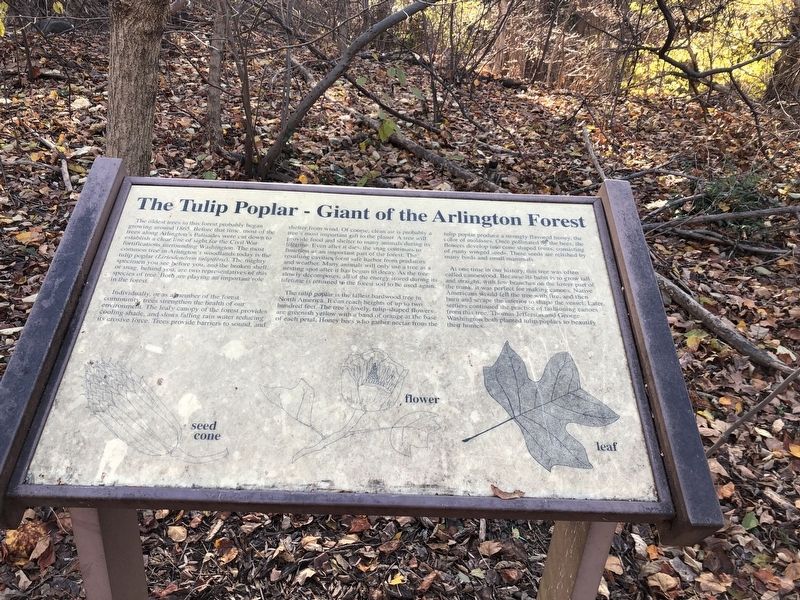
The oldest trees in this forest probably began growing around 1865. Before that time, most of the trees along Arlington's Palisades were cut down to establish a clear line of sight for the Civil War fortifications surrounding Washington. The most common tree in Arlington's woodlands today is the tulip poplar (Liriodendron tulipifera). The mighty specimen you see before you, and the broken shell, or snag, behind you, are two representations of this species of tree. Both are playing an important role in the forest.
Individually, or as a member of the forest community, trees strengthen the health of our environment. The leafy canopy of the forest provides cooling shade, and slows falling rain water reducing its erosive force. Trees provide barriers to sound, and shelter from wind. Of course, clean air is probably a tree's most important gift to the planet. A tree will provide food and shelter to many animals during its lifetime. Even after it dies, the snag continues to function as an important part of the forest. The resulting cavities form a safe harbor from predators and weather. Many animals will only use a tree as
this page online
The tulip poplar is the tallest hardwood tree in North America. It can reach heights of up to two hundred feet. The tree's lovely, tulip-shaped flowers are greenish yellow with a band of orange at the base of each petal. Honey bees who gather nectar from the tulip poplar produce a strongly flavored honey, the color of molasses. Once pollinated by the bees, the flowers develop into cone shaped fruits, consisting of many winged seeds. These seeds are relished by many birds and small mammals.
At one time in our history, this tree was often called canoewood. Becasue its habit is to grow tall and straight, with few branches on the lower part of the trunk, it was perfect for making canoes. Native Americans would fell the tree with fire, and then burn and scrape the interior to shape the vessel. Later, settlers continued the practice of fashioning canoes from this tree. Thomas Jefferson and George Washington both planted tulip poplars to beautify their homes.
Topics and series.
Photographed by Devry Becker Jones (CC0), November 27, 2021
2. The Tulip Poplar - Giant of the Arlington Forest Marker
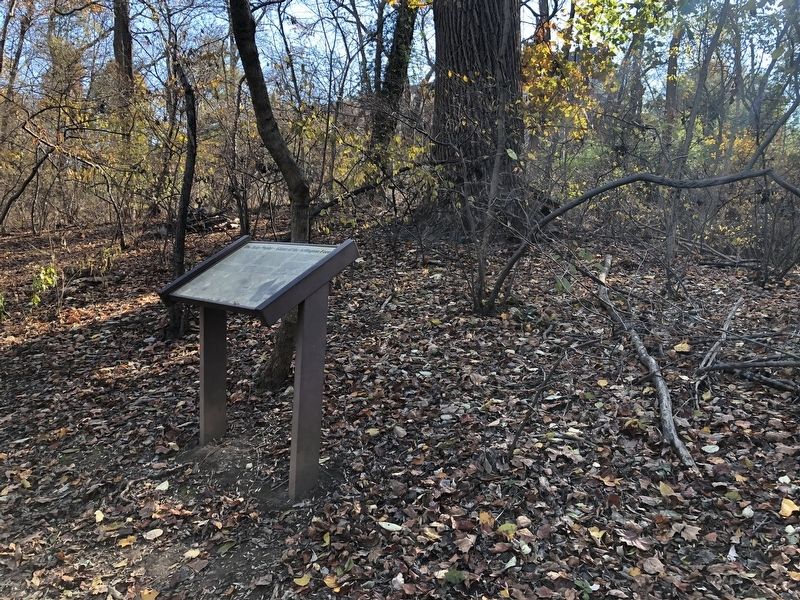
Location. 38° 54.07′ N, 77° 4.776′ W. Marker is in Arlington, Virginia, in Arlington County. It is in North Highland. It can be reached from Palisades Trail 0.1 miles west of 22nd Court North, on the left when traveling west. Touch for map. Marker is at or near this postal address: 1739 22nd Ct N, Arlington VA 22209, United States of America. Touch for directions.

Regionally, this marker is in the Washington Metropolitan Area and in Northern Virginia. It is also in the American South, specifically in the Upper South, in the Mid-Atlantic, and on the Eastern Seaboard. Globally, it is in the North Atlantic Region, North America, the Western Hemisphere, the Western World, and the Anglosphere. Historically, it finds itself in what was once the territory of the Mississippian Culture, one of the original Thirteen Colonies, one of the Confederate States of America, and the Antebellum South.
Other nearby markers. At least 8 other markers are within walking distance of this marker: The Bay-Eva Castle Site (about 600 feet away, measured in a direct line); Fort Bennett (about 600 feet away); The Dawson-Bailey Spring Site (about 700 feet away); The Dawson-Bailey House (approx. ¼ mile away); Fort Corcoran (approx. 0.4 miles away); Henry Foxall - Industrialist (approx. 0.4 miles away in District of Columbia); Sustainability at Georgetown University (approx. 0.4 miles away in District of Columbia); For God And Country (approx. 0.4 miles away in District of Columbia). Touch for a list and map of all markers in Arlington.
Credits. This page was last revised on February 1, 2023. It was originally submitted on November 27, 2021, by Devry Becker Jones of Washington, District of Columbia. This page has been viewed 820 times since then and 50 times this year. Photos: 1, 2. submitted on November 27, 2021, by Devry Becker Jones of Washington, District of Columbia.
