Chattanooga in Hamilton County, Tennessee — The American South (East South Central)
Union Army Hospital
Stringer’s Spring
| — | Chattanooga Campaign | — |

Photographed by Tom Bosse, November 13, 2021
1. Union Army Hospital Marker
When the Union Army of the Cumberland fell back to Chattanooga after its defeat at Chickamauga on September 19-20, 1863, the wounded quickly filled hospital facilities here. On September 21, using the pontoon bridge across the Tennessee River, the Federals erected a field hospital near here at Stringer’s Spring. Physicians and nurses only treated the seriously wounded who could not withstand transportation to a larger hospital and railhead at Bridgeport, Alabama.
The Stringer’s Spring hospital consisted of tents and shelters
this page online
When Confederate sharpshooters on Raccoon Mountain fired across the Tennessee River and closed Haley’s Trace, the wounded were forced to endure a torturous sixty-mile journey over Walden’s Ridge (Signal Mountain) that took four days to complete. After the Battle of Wauhatchie late in October 1863 and the opening of the supply of “cracker line”, the wounded were taken by the direct route through Lookout Valley. The Stringer’s Spring hospital operated until December 6, 1863, when a permanent facility was established in Chattanooga Valley.
(sidebar)
In field hospitals such as this one, the amputation of wounded limbs was the primary method of treatment. The Civil War occurred in the era before the advent of “germ theory”, rudimentary
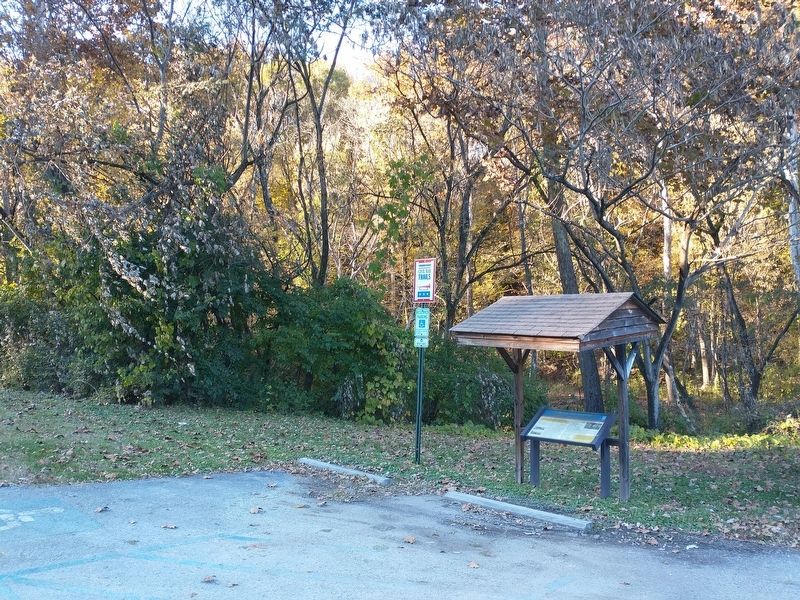
Photographed by Tom Bosse, November 13, 2021
2. Union Army Hospital Marker
(captions)
Ambulance crew at drill Courtesy Library of Congress
Union hospital of tents and bowers Courtesy Library of Congress
Convalescing wounded soldiers Courtesy Library of Congress
Methods of amputation, from A Manual of Military Surgery (Richmond, 1863)
Erected by Tennessee Civil War Trails.
Topics and series. This historical marker is listed in these topic lists: Science & Medicine • War, US Civil. In addition, it is included in the Tennessee Civil War Trails series list. A significant historical date for this entry is September 19, 1863.
Location. 35° 5.073′ N, 85° 19.152′ W. Marker is in Chattanooga, Tennessee, in Hamilton County. It is at the intersection of Signal Mountain Road (Tennessee Route 8) and Lullwater Road, on the right when traveling west on Signal Mountain Road. Touch for map. Marker is at or near this postal address: 109 Signal

Photographed by Tom Bosse, November 13, 2021
3. Stringer’s Spring

Regionally, this marker is in the American South, specifically in the Upper South, in Appalachia, and specifically in Southern Appalachia. Globally, it is in North America, the Western Hemisphere, the Western World, and the Anglosphere. Historically, it finds itself in what was once the original Cherokee Nation, the territory of the Mississippian Culture, one of the Confederate States of America, and the Antebellum South.
Other nearby markers. At least 8 other markers are within 2 miles of this marker, measured as the crow flies: Wilder's Artillery Position (approx. 0.8 miles away); Reinforcing Chattanooga (approx. one mile away); Chattanooga High School (approx. one mile away); Sherman's Hideout (approx. 1.1 miles away); Hill Overlooks & Industrial Past (approx. 1.6 miles away); 1864 Military Bridge (approx. 1.7 miles away); Union Block House (approx. 1.7 miles away); Coolidge Riverside Park / Charles H. Coolidge Medal of Honor Citation (approx. 1.7 miles away). Touch for a list and map of all markers in Chattanooga.
Other markers no

4. Unknown location. Zouave ambulance crew demonstrating removal of wounded soldiers from the field
Library of Congress (LC-DIG-cwpb-03950 )

Brady-Handy Collection, circa 1864
5. Wounded near Fredericksburg, Va.
(Library of Congress LC-DIG-ppmsca-33748)
Credits. This page was last revised on December 27, 2021. It was originally submitted on December 26, 2021, by Tom Bosse of Jefferson City, Tennessee. This page has been viewed 2,280 times since then and 169 times this year. Last updated on December 26, 2021, by Bradley Owen of Morgantown, West Virginia. Photos: 1, 2, 3. submitted on December 26, 2021, by Tom Bosse of Jefferson City, Tennessee. 4. submitted on December 26, 2021. 5. submitted on December 27, 2021. • Mark Hilton was the editor who published this page.
