Near Gering in Scotts Bluff County, Nebraska — The American Midwest (Upper Plains)
A Sea of Grass
Scotts Bluff National Monument
| — | National Park Service, U.S. Department of the Interior | — |
Photographed by Cosmos Mariner, August 1, 2021
1. A Sea of Grass Marker
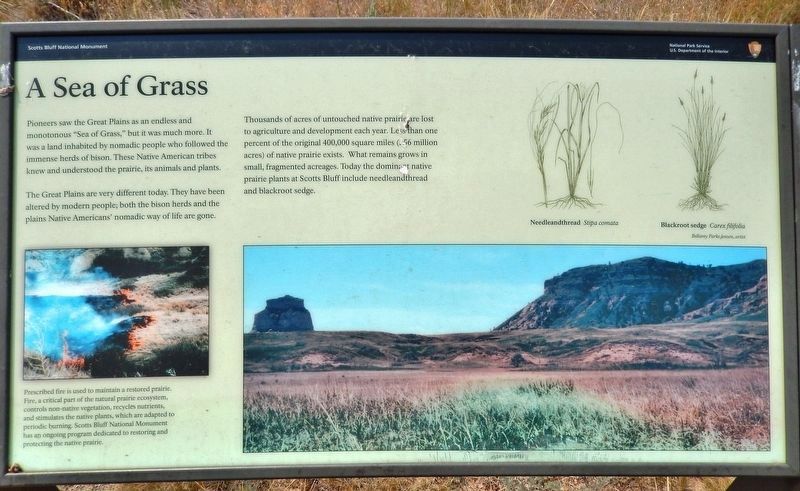
Pioneers saw the Great Plains as an endless and monotonous "Sea of Grass," but it was much more. It was a land inhabited by nomadic people who followed the immense herds of bison. These Native American tribes knew and understood the prairie, its animals and plants.
The Great Plains are very different today. They have been altered by modern people; both the bison herds and the plains Native Americans' nomadic way of life are gone.
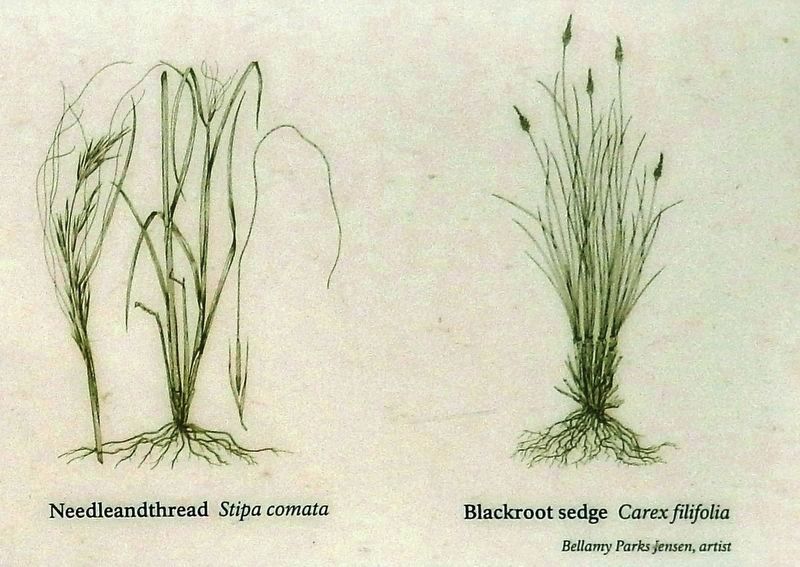
Thousands of acres of untouched native prairie are lost to agriculture and development each year. Less than one percent of the original 400,000 square miles (256 million acres) of native prairie exists. What remains grows in small, fragmented acreages. Today the dominant native prairie plants at Scotts Bluff include needleandthread and blackroot sedge.
Prescribed fire is used to maintain a restored prairie. Fire, a critical part of the natural prairie ecosystem, controls non-native vegetation, recycles nutrients, and stimulates the native plants, which are adapted to periodic burning. Scotts Bluff National Monument has an ongoing program dedicated to restoring and protecting the native prairie.
Erected by National
this page online
Topics. This historical marker is listed in these topic lists: Agriculture • Animals • Environment • Indigenous Peoples and Communities.
Location. 41° 49.679′ N, 103° 41.963′ W. Marker is near Gering, Nebraska, in Scotts Bluff County. It can be reached from Old Oregon Trail (Old State Highway 92) 1.8 miles west of Five Rocks Road, on the right when traveling west. Marker is located within Scotts Bluff National Monument, about ½ mile east of the Visitor Center on the Prairie View Trail. Touch for map. Marker is at or near this postal address: 190276 Old Oregon Trail, Gering NE 69341, United States of America. Touch for directions.

Regionally, this marker is in the Nebraska Panhandle. It is also in the American Midwest, in the Corn Belt, and on the prairies. Globally, it is in North America, the Western Hemisphere, the Western World, and the Anglosphere. Historically, it finds itself in what was once the Louisiana Purchase.
Other nearby markers. At least 8 other markers are within walking distance of this marker:
Courtesy Bellamy Parks Jensen, artist
2. Marker detail: Grasses
Blackroot Sedge Carex filifolia
Other markers no longer nearby. Scotts Bluff (was approx. 0.4 miles away but has been replaced with another marker now near it); Oregon Trail (was approx. half a mile away but has been permanently removed); The Overland Experience (was approx. half a mile away but has been permanently removed); Pony Express (was approx. half a mile away but has been permanently removed); a different marker also named Scotts Bluff (was approx. half a mile away but has been permanently removed); Traces of the Trail (was approx. 0.6 miles away but has been replaced with another marker now near it).
Also see . . .
1. History of Grassland Studies. University of Nebraska - Lincoln website
Photographed by Cosmos Mariner, August 1, 2021
3. A Sea of Grass Marker
Grasslands once spanned across Nebraska in waves, from the tallgrass prairies in the east to the shortgrass prairie in the west and all the mixed-grass prairies in between. The history of Nebraska’s grasslands are deeply intertwined with the history of its people. Indigenous peoples across the Great Plains possess diverse and intimate knowledge about the region’s grasslands. They once utilized fire to shape the prairie landscape and attract large herds of grazing animals. But as settlers moved west, Nebraska’s Indigenous peoples were dispossessed, and much of the state’s grasslands were lost to the plow.(Submitted on January 31, 2022, by Cosmos Mariner of Cape Canaveral, Florida.)
2. Prairie View Trail. National Park Service website entry:
The Prairie View Trail runs from the Visitor Center to the eastern boundary of Scotts Bluff National Monument.(Submitted on January 31, 2022, by Cosmos Mariner of Cape Canaveral, Florida.)
Photographed by Cosmos Mariner, August 1, 2021
4. Scotts Bluff National Monument
Credits. This page was last revised on March 5, 2026. It was originally submitted on January 31, 2022, by Cosmos Mariner of Cape Canaveral, Florida. This page has been viewed 628 times since then and 22 times this year. Photos: 1, 2, 3, 4. submitted on January 31, 2022, by Cosmos Mariner of Cape Canaveral, Florida.
