Brandywine Park in Wilmington in New Castle County, Delaware — The American Northeast (Mid-Atlantic)
Golden Lion Tamarin
⎯⎯⎯
The Amazon River and Rainforest
⎯⎯⎯
White-faced Saki
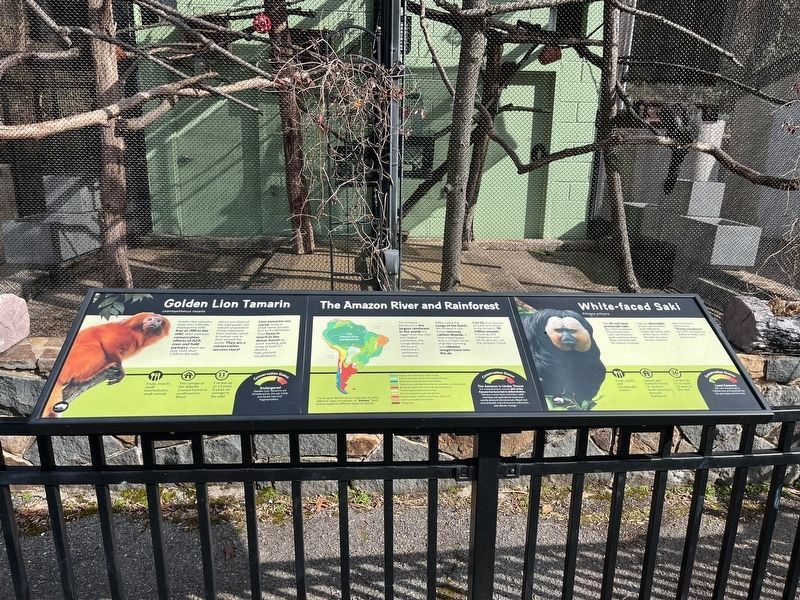
Photographed by Devry Becker Jones (CC0), February 10, 2023
1. Golden Lion Tamarin / The Amazon River and Rainforest / White-faced Saki Marker
Golden Lion Tamarin
Leontophithecus rosalia
Golden lion tamarins were once critically endangered, with few as 200 in the wild. With intensive conservation efforts of AZA zoos and field partners, there are now more than 1,500 in the wild.
About one-third of the wild golden lion tamarin population today originated from animals raised in human care in zoos around the world. They are a conservation success story!
Lion tamarins are social, living in small family groups of 2 to 8 individuals. They keep in touch in the dense forest by scent marking and using at least 17 distinct, high-pitched vocalizations.
🍴 Fruits, insects, small invertebrates, small animals.
🏠 The canopy of the Atlantic Coastal Forest in southeastern Brazil.
⏲️ 11 Years. Can live up to 11 years, 8 years on average in the wild.
Conservation Status: Endangered
Golden Lion Tamarins are threatened by the pet trade and forest loss and fragmentation.
The Amazon River and Rainforest
The Amazon Rainforest is the largest rainforest in the world. It's bigger than the next two largest rainforests, the Congo Basin
this page online
Often called the Lungs of the Earth, the Amazon's vast forest removes carbon dioxide, a heat-trapping gas that is a major cause of global warming and releases oxygen back into the air.
1 in 10 of all the species on Earth are found in the Amazon. 30 million people, including 350 indigenous and ethnic groups, call the Amazon home.
The Amazon Rainforest is composed of many different types of habitats, or "biomes." Each biome supports different types of species.
Conservation Status: The Amazon is Under Threat
It is estimated that at least 20% of the Amazon has been lost to deforestation. This loss comes from extensive cattle ranching and agricultural expansion, poorly planned infrastructure, illegal and unsustainable natural resource extraction, and climate change.
White-faced Saki
Pithecia pithecia
Saki do not have prehensile tails like other monkeys. This means they can't use them to grab onto branches; they use their tails for balance instead.
Saki are dimorphic (males and females look different). Males are black with white faces, while females are gray, brown and
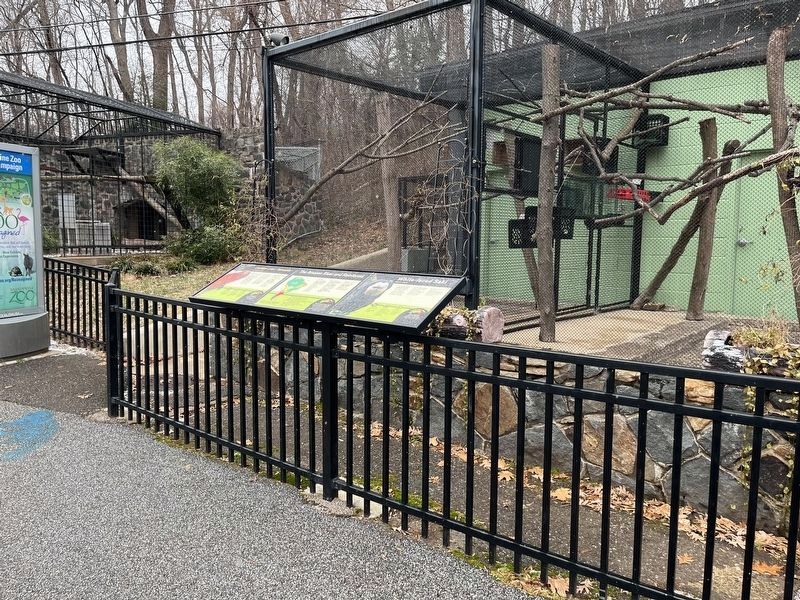
Photographed by Devry Becker Jones (CC0), January 28, 2022
2. Golden Lion Tamarin / The Amazon River and Rainforest / White-faced Saki Marker
Saki have been nicknamed "flying monkeys" for their exceptional ability to leap from tree to tree.
🍴 Fruits, seeds, and occasionally insects.
🏠 Upland and lowland forests of northern South America's Amazon Rainforest.
⏲️ 36 Years. Can live up to 33 years, 15 years in the wild.
Conservation Status: Least Concern
Saki are threatened by habitat loss and poached for pet trade and for food.
Erected by Brandywine Zoo; Delaware State Parks.
Topics and series. This historical marker is listed in these topic lists: Agriculture • Animals • Environment • Science & Medicine. In addition, it is included in the Delaware State Parks series list.
Location. 39° 45.313′ N, 75° 32.916′ W. Marker is in Wilmington, Delaware, in New Castle County. It is in Brandywine Park. It can be reached from North Park Drive 0.1 miles east of North Van Buren Street, on the left when traveling east. Touch for map. Marker is at or near this postal address: 200 N Park Dr, Wilmington DE 19802, United States of America. Touch for directions.

Regionally, this marker is in Greater Philadelphia. It is also in the American Mid-Atlantic, on the Delmarva Peninsula, and on the Eastern Seaboard. Globally, it is in the North Atlantic Region, North America, the Western Hemisphere, the Western World, and the Anglosphere. Historically, it finds itself in what was once New Netherland and also one of the original Thirteen Colonies.
Other nearby markers. At least 8 other markers are within walking distance of this marker: Ameraucana (a few steps from this marker); Barred Rock (a few steps from this marker); Delaware Blue Hen (a few steps from this marker); Red Panda (within shouting distance of this marker); Red Panda Conservation (within shouting distance of this marker); Burrowing Owl (within shouting distance of this marker); Black and White Ruffed Lemur (within shouting distance of this marker); Radiated Tortoise (within shouting distance of this marker). Touch for a list and map of all markers in Wilmington.
Credits. This page was last revised on February 13, 2023. It was originally submitted on January 28, 2022, by Devry Becker Jones of Washington, District of Columbia. This page has been viewed 505 times since then and 19 times this year. Last updated on February 6, 2022, by Carl Gordon Moore Jr. of North East, Maryland. Photos: 1. submitted on February 11, 2023, by Devry Becker Jones of Washington, District of Columbia. 2. submitted on January 28, 2022, by Devry Becker Jones of Washington, District of Columbia.
