Wheeling in Ohio County, West Virginia — The American South (Appalachia)
White-Naped Crane
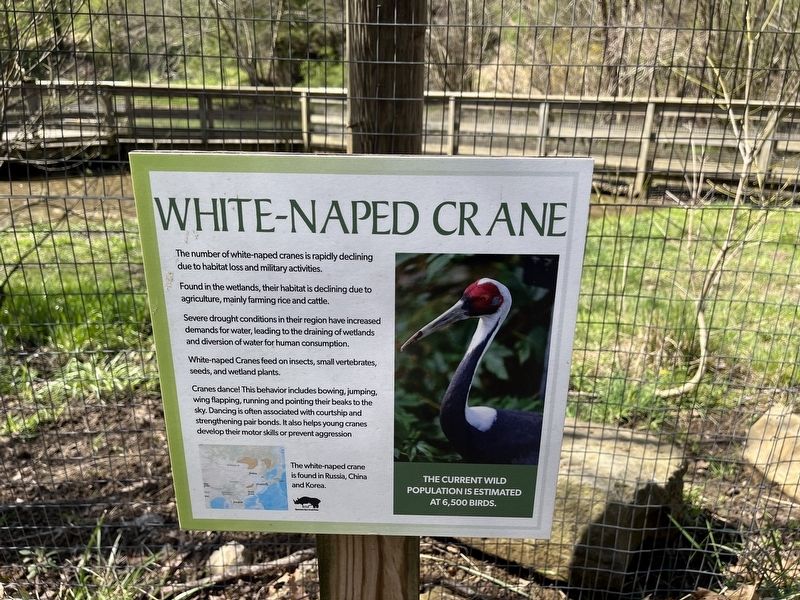
The number of white-naped cranes is rapidly declining due to habitat loss and military activities.
Found in the wetlands, their habitat is declining due to agriculture, mainly farming rice and cattle.
Severe drought conditions in their region have increased demands for water, leading to the draining of wetlands and diversion of water for human consumption.
White-naped Cranes feed on insects, small vertebrates, seeds, and wetland plants.
Cranes dance! This behavior includes bowing, jumping, wing flapping, running, and pointing their beaks to the sky. Dancing is often associated with courtship and strengthening pair bonds. It also helps young cranes develop their motor skills or prevent aggression.
The white-naped crane is found in Russia, China and Korea.
The current wild population is estimated at 6,500 birds.
Erected by The Good Zoo at Oglebay Park.
Topics. This historical marker is listed in these topic lists: Agriculture • Animals • Environment • Military • Waterways & Vessels.
Location. 40° 5.828′ N, 80° 40.094′ W. Marker
this page online

Regionally, this marker is in the Northern Panhandle and in the High Valley. It is also in the American South, specifically in the Upper South, in the Ohio River Valley, in Appalachia, and specifically in Northern Appalachia. Globally, it is in North America, the Western Hemisphere, the Western World, and the Anglosphere. Historically, it finds itself in what was once the territory of the Mississippian Culture.
Other nearby markers. At least 8 other markers are within walking distance of this marker: Bald Eagle / Amelia the Bald Eagle (within shouting distance of this marker); Bobcat (within shouting distance of this marker); Pallas's Cat Conservation (about 300 feet away, measured in a direct line); Eastern Box Turtle (about 300 feet away); Snow Leopard (about 300 feet away); Species Survival Plan (about 500 feet away); Grevy's Zebra (about 500 feet
Credits. This page was last revised on April 24, 2022. It was originally submitted on April 24, 2022, by Devry Becker Jones of Washington, District of Columbia. This page has been viewed 238 times since then and 12 times this year. Photos: 1, 2. submitted on April 24, 2022, by Devry Becker Jones of Washington, District of Columbia.
