Loch Raven in Towson in Baltimore County, Maryland — The American Northeast (Mid-Atlantic)
Hampton
1783-1790
| — | Baltimore County | — |
Photographed by Beverly Pfingsten, 08-12-2007
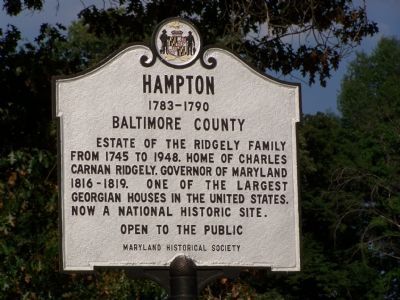
1. Hampton 1783-1790 Baltimore County Marker
Estate of the Ridgely Family from 1745 to 1948. Home of Charles Carnan Ridgely, Govenor of Maryland 1816–1819. One of the largest Georgian Houses in the United States. Now a National Historic Site.
Erected 1968 by Maryland Historical Society.
Topics and series. This historical marker is listed in these topic lists: Architecture • Colonial Era • Settlements & Settlers. In addition, it is included in the Maryland Historical Trust series list. A significant historical year for this entry is 1745.
Location. 39° 25.063′ N, 76° 35.477′ W. Marker is in Towson, Maryland, in Baltimore County. It is in Loch Raven. It is on Hampton Lane half a mile east of Dulaney Valley Road, on the right when traveling east. Touch for map. Marker is at or near this postal address: 535 Hampton Lane, Towson MD 21286, United States of America. Touch for directions.

Regionally, this marker is in the Baltimore Metro Region and in Central Maryland. It is also in the American Mid-Atlantic, in the Chesapeake Bay Region, and on the Eastern Seaboard. Globally, it is in the North Atlantic Region, North America,
this page online
Other nearby markers. At least 8 other markers are within walking distance of this marker: Wartime Support (about 600 feet away, measured in a direct line); Welcome to Hampton National Historic Site! (about 600 feet away); Hampton: An American Story (approx. 0.2 miles away); Captain Charles Ridgely (approx. 0.2 miles away); Ridgely's Pride (approx. 0.2 miles away); Ice Cream in July (approx. 0.2 miles away); Oranges in January (approx. 0.2 miles away); Greenhouse #2 (approx. 0.2 miles away). Touch for a list and map of all markers in Towson.
More about this marker. This marker replaced one erected by the Maryland State Roads Commission in 1934.
Photographed by Beverly Pfingsten, August 12, 2007
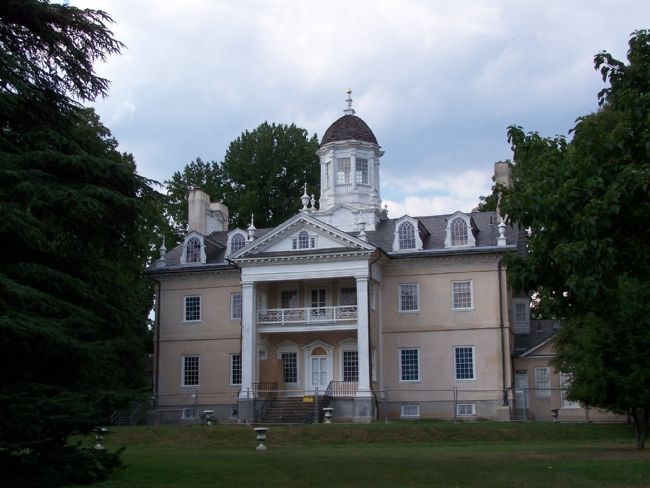
2. Front view of Hampton Mansion
Photographed by Beverly Pfingsten, 08-12-2007
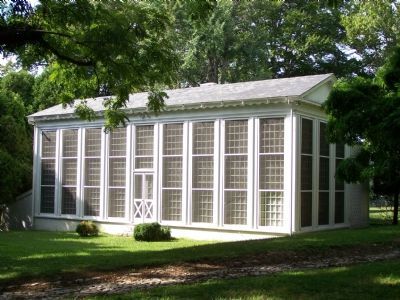
3. Orangery
Photographed by Beverly Pfingsten, August 12, 2007
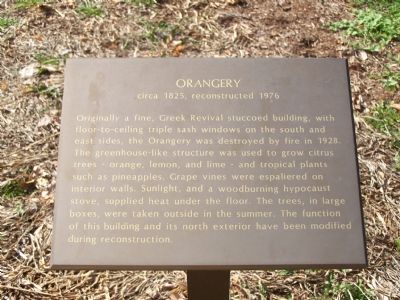
4. Orangery Interpretive Marker
Orangery circa 1825, reconstructed 1976. Originally a fine, Greek Revival stuccoed building, with floor-to-ceiling triple sash windows on the south and east sides, the Orangery was destroyed by fire in 1928. The greenhouse-like structure was used to grow citrus trees—orange lemon, and lime—and tropical plants such as pineapples. Grape vines were espaliered on interior walls. Sunlight, and a woodburning hypocaust stove, supplied heat under the floor. The trees, in large boxes, were taken outside in the summer. The function of this building and its north exterior have been modified during reconstruction.
Photographed by Beverly Pfingsten, 08-12-2007
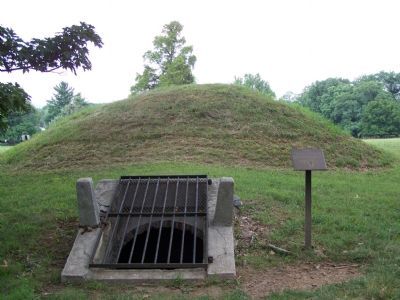
5. Hampton Ice House
Photographed by Beverly Pfingsten, August 12, 2007
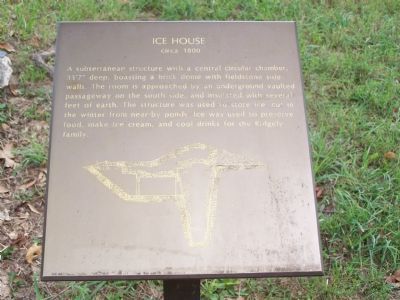
6. Ice House Interpretive Marker
Ice House circa 1800. A subterranean structure with central circular chamber, 33' 7" deep, boasting a brick dome with fieldstone side walls. The room is approached by an underground vaulted passageway on the south side, and insulated with several feet of earth. The structure was used to store ice cut in the winter from near-by ponds. Ice was used to preserve food, make ice cream, and cool drinks for the Ridgely family.
Photographed by Beverly Pfingsten, 08-12-2007
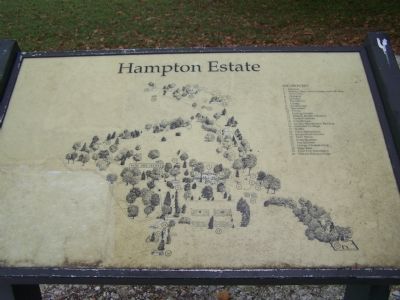
7. Map of Hampton Mansion grounds.
Photographed by Beverly Pfingsten, 08-12-2007
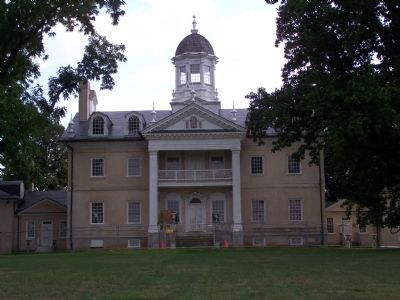
8. Hampton Mansion
National Park Service is renovating the building in 2007.
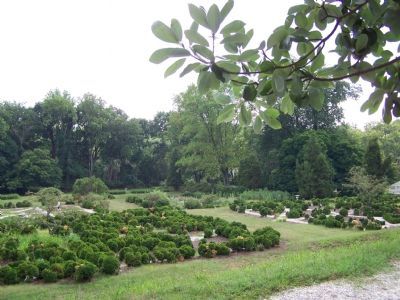
Photographed by Beverly Pfingsten, 08-12-2007
9. Formal Gardens at Hampton Mansion
Credits. This page was last revised on February 26, 2026. It was originally submitted on August 13, 2007, by Bill Pfingsten of Bel Air, Maryland. This page has been viewed 2,765 times since then and 34 times this year. Last updated on May 16, 2022, by Carl Gordon Moore Jr. of North East, Maryland. Photos: 1, 2, 3, 4, 5, 6, 7, 8, 9. submitted on August 13, 2007, by Bill Pfingsten of Bel Air, Maryland.
